
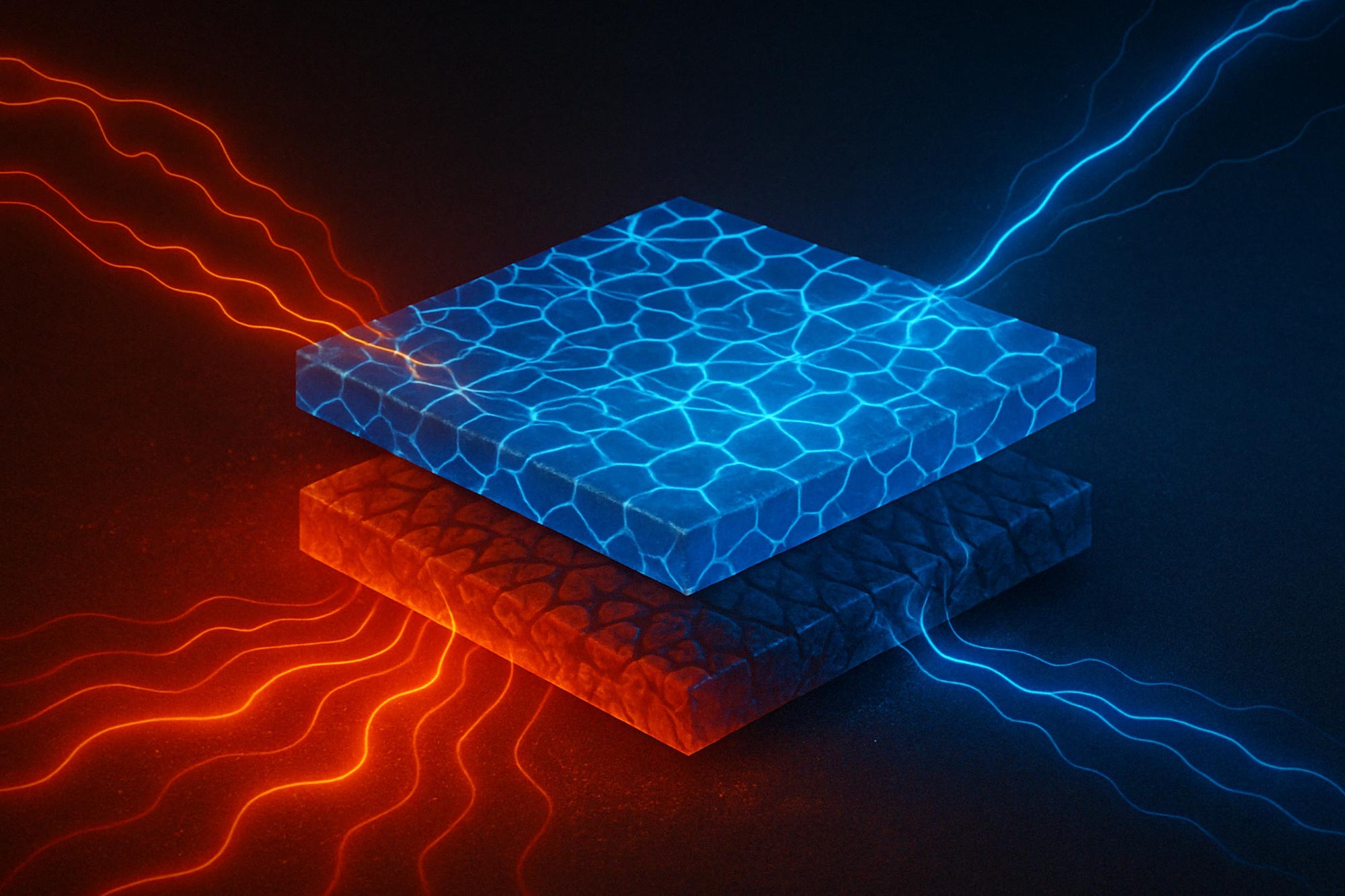
Scientists have found a clever way to double the efficiency of thermoelectric materials — those that convert heat into electricity — by mixing two substances with contrasting mechanical properties but similar electronic traits.
The result is a hybrid that blocks heat at microscopic interfaces while allowing electricity to flow freely, bringing us closer to cheaper, more stable alternatives to today’s gold-standard materials used in the Internet of Things and beyond.
Boosting Thermoelectrics for the Internet of Things
Thermoelectric materials can directly convert heat into electrical energy, making them especially useful for powering the tiny sensors and devices that make up the growing “Internet of Things.” However, improving their efficiency has long been a challenge. To boost performance, these materials must do two things at once: block the flow of heat through atomic vibrations in their structure, while allowing electrical charges to move freely. Achieving both has proven difficult, until now.
A research team led by Fabian Garmroudi has developed a new kind of hybrid material that overcomes this hurdle. By combining two materials with very different mechanical properties but similar electronic characteristics, they managed to reduce heat conduction while enhancing electrical mobility. The results were published in Nature Communications.
Breaking the Conductivity Paradox with Material Hybrids
The ideal thermoelectric material is one that conducts electricity efficiently but blocks heat – two qualities that don’t usually go hand in hand. Most good electrical conductors also tend to conduct heat well.
“In solid matter, heat is transferred both by mobile charge carriers and by vibrations of the atoms in the crystal lattice. In thermoelectric materials, we mainly try to suppress heat transport through the lattice vibrations, as they do not contribute to energy conversion,” explains first author Fabian Garmroudi, who obtained his doctorate at TU Wien and is now working as a Director’s Postdoctoral Fellow at Los Alamos National Laboratory (USA).
Over the past few decades, scientists have developed increasingly advanced ways to lower a material’s thermal conductivity. This new hybrid approach offers a promising way to push performance even further.
Hybrid Structures Built at the Microscopic Level
“Supported by the Lions Award, I was able to develop new hybrid materials at the National Institute for Materials Science in Japan that exhibit exceptional thermoelectric properties,” recalls Garmroudi of his research stay in Tsukuba (Japan), which he completed as part of his work at TU Wien.
Specifically, powder of an alloy of iron, vanadium, tantalum, and aluminum (Fe2V0.95Ta0.1Al0.95) was mixed with a powder of bismuth and antimony (Bi0.9Sb0.1) and pressed into a compact material under high pressure and temperature. Due to their different chemical and mechanical properties, however, the two components do not mix at an atomic level. Instead, the BiSb material is preferentially deposited at the micrometer-sized interfaces between the crystals of the FeVTaAl alloy.
Interfaces That Block Heat but Speed Up Electricity
The lattice structures of the two materials, and therefore also their quantum mechanically permitted lattice vibrations, are so different that thermal vibrations cannot simply be transferred from one crystal to the other. Heat transfer is therefore strongly inhibited at the interfaces. At the same time, the movement of the charge carriers remains unhindered due to the similar electronic structure and is even significantly accelerated along the interfaces. The reason: the BiSb material forms a so-called topological insulator phase – a special class of quantum materials that are insulating on the inside but enable almost loss-free charge transport on the surface.
Efficiency Doubled with Quantum-Engineered Materials
This targeted decoupling of heat and charge transport enabled the team to increase the efficiency of the material by more than 100 %. “This brings us a big step closer to our goal of developing a thermoelectric material that can compete with commercially available compounds based on bismuth telluride,” says Garmroudi. The latter was developed back in the 1950s and is still considered the gold standard of thermoelectrics today. The big advantage of the new hybrid materials is that they are significantly more stable and also cheaper.
Reference: “Decoupled charge and heat transport in Fe2VAl composite thermoelectrics with topological-insulating grain boundary networks” by Fabian Garmroudi, Illia Serhiienko, Michael Parzer, Sanyukta Ghosh, Pawel Ziolkowski, Gregor Oppitz, Hieu Duy Nguyen, Cédric Bourgès, Yuya Hattori, Alexander Riss, Sebastian Steyrer, Gerda Rogl, Peter Rogl, Erhard Schafler, Naoyuki Kawamoto, Eckhard Müller, Ernst Bauer, Johannes de Boor and Takao Mori, 26 March 2025, Nature Communications.
DOI: 10.1038/s41467-025-57250-6
Never miss a breakthrough: Join the SciTechDaily newsletter.
Follow us on Google and Google News.
1 Comment
Engineers. Not scientists.