
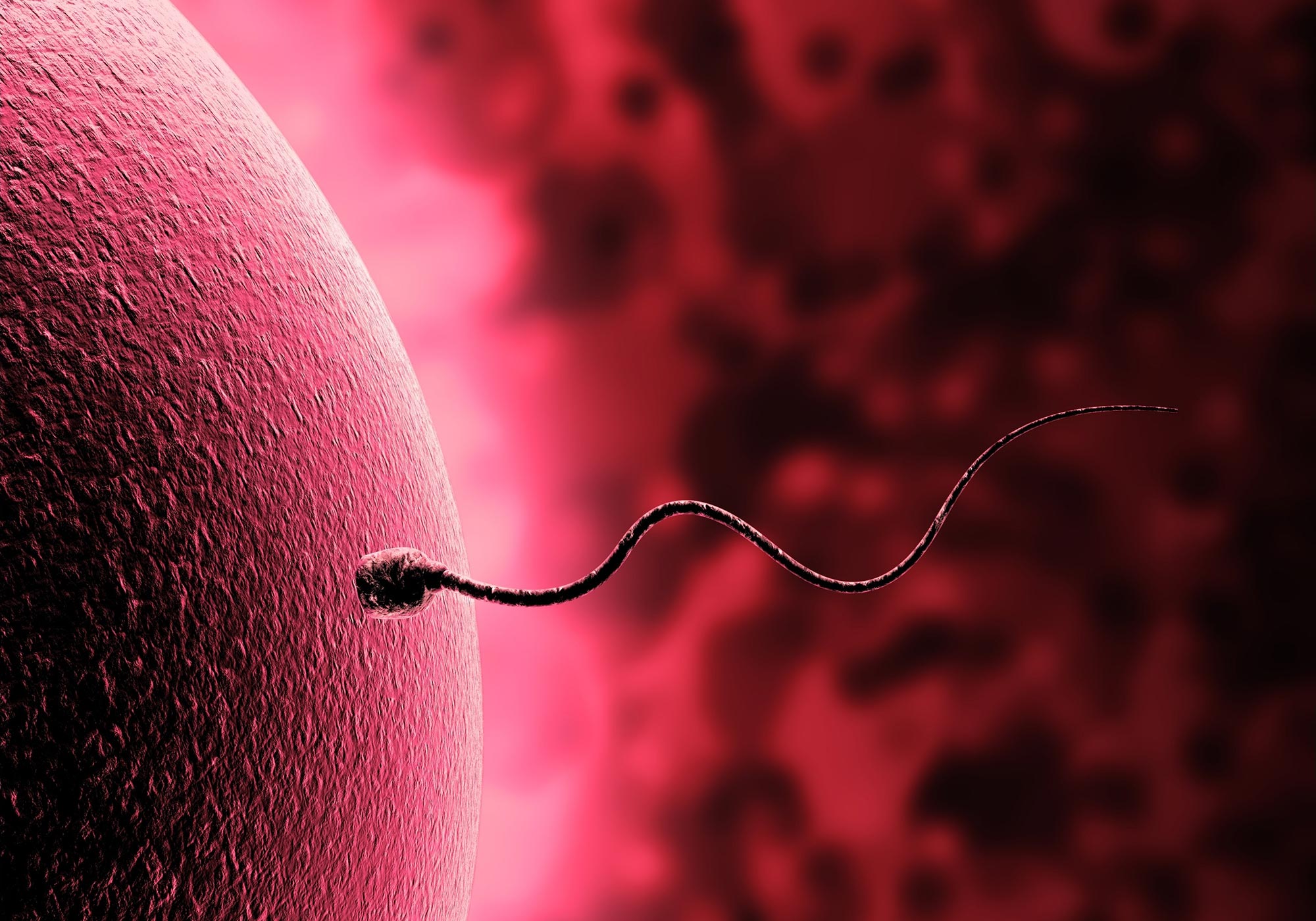
Egg and sperm cell size evolved from competition. Limited resources drove gametes to differ vastly in size and number.
In most living animals, egg cells are vastly larger than sperm cells. In humans, for example, a single egg is 10 million times the volume of a sperm cell.
In a new study, Northwestern Engineering researchers found that competition and natural selection drove this curious size discrepancy.
Using mathematical modeling, the researchers considered a time very early in evolution when primordial species reproduced using external fertilization. In the model, bigger reproductive cells, or gametes, presented a competitive edge because they could hold more nutrients for a potential zygote. Smaller gametes, however, required fewer resources to make, which put less stress on the parent.
“Organisms either needed to produce the biggest gametes with the most provisions or the smallest gametes to use the least resources,” said Daniel Abrams, professor of engineering sciences and applied mathematics at the McCormick School of Engineering and the study’s senior author. “We believe this size difference is almost inevitable, based on plausible assumptions about how sexual reproduction works and how natural selection works.”
The research was published online in the Journal of Theoretical Biology. Joseph Johnson, a PhD candidate in Abrams’s laboratory, is the paper’s first author. Nathan White and Alain Kangabire, undergraduate students in Abrams’s lab, coauthored the paper.
The Northwestern team’s model begins with isogamy, a primordial state in which all gametes were roughly the same size and distinct sexes did not yet exist. The team then developed and applied a simple mathematical model to show how isogamy transitioned to anisogamy, a state where the gametes either became very small or quite large — precursors to sperm and eggs associated with biological sexes today.
The Evolutionary “Arms Race” of Gametes
In the model, anisogamy emerged from competition to survive in an environment with limited resources. Gametes were more likely to survive if they had an edge in size over their neighbors, leading to an “arms race” favoring larger and larger gametes. But organisms could not produce many sex cells without needing more and more resources themselves. They could, however, save their resources by producing a lot of tiny gametes.
“Early in evolution when sexual reproduction emerged, gametes were symmetrical. But this is where that symmetry breaks,” Abrams said. “We end up with some organisms specializing in large gametes and others specializing in small gametes.”
Abrams said one remaining mystery is why some isogamist species still exist today. Some types of algae and fungi, for example, reproduce either asexually or with symmetrical mating types.
“There have been different theories about how anisogamy emerged, going all the way back to Charles Darwin,” Abrams said. “Issues in evolutionary biology are very hard to test because we can only study species that are around today. We can’t see what they looked like billions of years ago. Using mathematical models can yield new insight and understanding.”
Reference: “A dynamical model for the origin of anisogamy” by Joseph D. Johnson, Nathan L. White, Alain Kangabire and Daniel M. Abrams, 18 March 2021, Journal of Theoretical Biology.
DOI: 10.1016/j.jtbi.2021.110669
The research, “A Dynamical Model for the Origin of Anisogamy,” was supported by the National Science Foundation (grant number 1547394).
Never miss a breakthrough: Join the SciTechDaily newsletter.
Follow us on Google and Google News.
2 Comments
… but how did we lose one Chromosome, and that thing has changed us from monkeys to a human, but interesting thing is in order to have a valid explanation it means that the mutation has to be carried into the offspring, ( no, not the rock bend, even though they are cool)… and that offspring should give a rise to a new species…
“Issues in evolutionary biology are very hard to test…”
In fact, the bold assertion “Egg and sperm cell size evolved from competition” is completely non testable, in spite of the math expertise of scientists. Imagine the Covid-19 context: How cautious should one be on accepting information?
Should an article in which no real scientific and repeatable test has been presented make bold assertion on the new virus’ origins or on the efficacy of some drugs in destroying it?
Now look at “evolutionary gender” and propaganda in its best: no scientific (real and repeatable) test, no real gain of knowledge (no fact at all, a collection of assumptions at best), but in spite of this, we have a title:
“Scientists Solve…”. And now, for many, another evolutionary “fact” (as certain as gravity?) is born in front of our skeptical eyes. It’s sad to realize science (or media?) is not immune to exaggeration and to misleading (not correspondingly to facts) assertions. No, it’s not a scientific/testable/repeatable/demonstrated fact that “egg and sperm cell size evolved from competition” and no, scientists, with all respect to their expertise and math modeling, have not solved this “curious” fact. No, not at all. In this point, that’s the truth we should see/read in papers, magazines and news.