
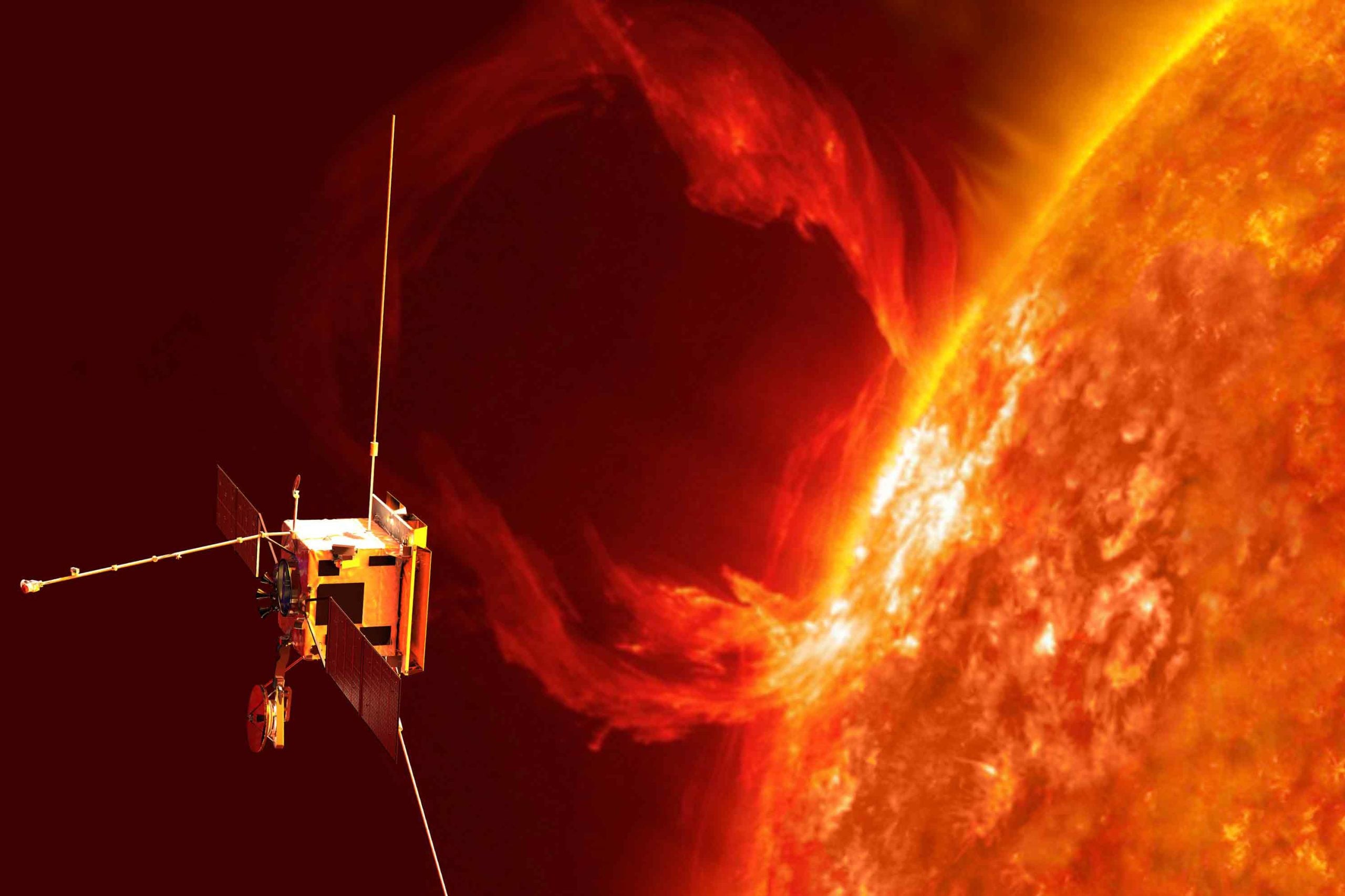
By combining observations from two space missions, scientists were able to follow one exceptionally active region on the Sun for months, revealing how its magnetic structure evolved over time.
Our sun spins on its axis about once every 28 days. Because of that, any active region can be watched from earth for only around two weeks before it turns out of view, then it stays hidden for roughly another two weeks on the far side.
“Fortunately, the Solar Orbiter mission, launched by the European Space Agency (ESA) in 2020, has broadened our perspective,” says Ioannis Kontogiannis, solar physicist at ETH Zurich and the Istituto ricerche solari Aldo e Cele Daccò (IRSOL) in Locarno.
The Solar Orbiter circles the sun once every six months and can observe the far side as well. From April to July 2024, it followed one of the most active solar regions seen in the past twenty years. When the region, called NOAA 13664, rotated into view in May 2024, it set off the strongest geomagnetic storms on Earth since 2003.
“This region caused the spectacular aurora borealis that was visible as far south as Switzerland,” says Louise Harra, professor at ETH Zurich and director of the Davos Physical Meteorological Observatory.
Data from two space probes combined
To learn more about how such superactive regions form, evolve, and influence the sun, Harra and Kontogiannis assembled an international research team. The group merged Solar Orbiter observations of NOAA 13664 on the far side with measurements from NASA’s Solar Dynamics Observatory, which sits on the Earth-Sun line and watches the near side.
Together, these datasets made it possible to follow NOAA 13664 for 94 days with only minimal gaps.
“This is the longest continuous series of images ever created for a single active region: it’s a milestone in solar physics,” says Kontogiannis. The team observed the birth of NOAA 13664 on 16 April 2024 on the far side of the sun, as well as all the changes that the active region underwent until its decay after 18 July 2024.
Complex magnetic fields causing solar storms
Active regions are shaped by powerful, tangled magnetic fields. They arise when strongly magnetized plasma pushes up to the sun’s surface, and they can unleash explosive events. During solar storms, the sun releases intense electromagnetic radiation, called flares, and hurls plasma and high-energy particles from its atmosphere into space.
These outbursts do more than create auroras. They can disrupt the technologies modern life depends on by triggering power outages on Earth, interfering with communication signals, increasing radiation exposure for aircraft crews, and even damaging satellites. One example occurred in February 2022, when 38 of 49 Starlink satellites belonging to US space company SpaceX were lost within two days of their launch.
Unnerving effects
“Even signals on railway lines can be affected and switch from red to green or vice versa,” says Harra. “That’s really scary.” NOAA 13664 also caused problems in May 2024. “Modern digital agriculture was particularly affected,” says the scientist. “Signals from satellites, drones and sensors were disrupted, causing farmers to lose working days and leading to crop failures with considerable economic losses.”
“It’s a good reminder that the sun is the only star that influences our activities,” adds Kontogiannis. “We live with this star, so it’s really important we observe it and try to understand how it works and how it affects our environment.”
Thanks to data from space probes, researchers were able to track three solar rotations for the first time ever, observing how the magnetic field of a superactive region developed over several episodes, becoming increasingly complex. Ultimately, an intertwined magnetic structure was formed, before the strongest flare in the past twenty years was released on the far side of the sun on 20 May 2024.
Weather forecasts in space
It is hoped that these observations will contribute to a better understanding of solar storms and their potential impact on Earth. The aim is to improve the accuracy of space weather forecasts, so that sensitive modern technology can be better protected. “When we see a region on the sun with an extremely complex magnetic field, we can assume that there is a large amount of energy there that will have to be released as solar storms,” explains Harra.
Currently, however, researchers are unable to predict how large an eruption will be, whether there will be one strong eruption or several weaker ones, and when these might occur. “We’re not there yet. But we’re currently developing a new space probe at ESA called Vigil which will be dedicated exclusively to improving our understanding of space weather,” says the scientist. The mission is planned for launch in 2031.
Reference: “Near-continuous tracking of solar active region NOAA 13664 over three solar rotations” by I. Kontogiannis, Y. Zhu, K. Barczynski, M. Z. Stiefel, H. Collier, J. McKevitt, J. S. Castellanos Durán, S. Berdyugina and L. K. Harra, 5 December 2025, Astronomy & Astrophysics.
DOI: 10.1051/0004-6361/202556136
Never miss a breakthrough: Join the SciTechDaily newsletter.
Follow us on Google and Google News.
1 Comment
It says the Sun takes 28 ‘days’ per revolution (about a month) but our days are longer than revolutions. So, first, what is the revolution period of the Sun? – Secondly, that approximates 12 revolutions for our year of spinning.
So I’d think how a chart could be arranged to account for the revolutions of all the planets, inclusive of their masses with that of the Sun. And the dispositions within the galaxy – just for fun.