
Close Menu
    Facebook X (Twitter) Instagram
    SciTechDaily
    • Biology
    • Chemistry
    • Earth
    • Health
    • Physics
    • Science
    • Space
    • Technology
    Facebook X (Twitter) Pinterest YouTube RSS
    SciTechDaily
    Home»Biology»Scientists Uncover Hidden “Second Layer” in Human DNA
    Biology

    Scientists Uncover Hidden “Second Layer” in Human DNA

    By Kyoto UniversityMarch 22, 20263 Comments3 Mins Read
    Facebook Twitter Pinterest Telegram LinkedIn WhatsApp Email Reddit
    Share
    Facebook Twitter LinkedIn Pinterest Telegram Email Reddit
    Light DNA Genetics
    Scientists have uncovered a mechanism by which human cells distinguish between more and less efficient genetic codons, revealing that the genetic code carries an additional layer of regulatory information. The findings identify a key protein that links codon usage to gene expression control, suggesting broader implications for cellular function and disease. Credit: Stock

    A newly identified cellular system monitors subtle variations in genetic coding, hinting at a hidden level of control over how genes are expressed.

    Human DNA stores instructions for life in sequences built from just four nucleotides. Those instructions are read in three-letter groups called codons, and each codon tells the cell which amino acid to add when building a protein. Since several codons can specify the same amino acid, these alternative spellings were once thought to be mostly interchangeable.

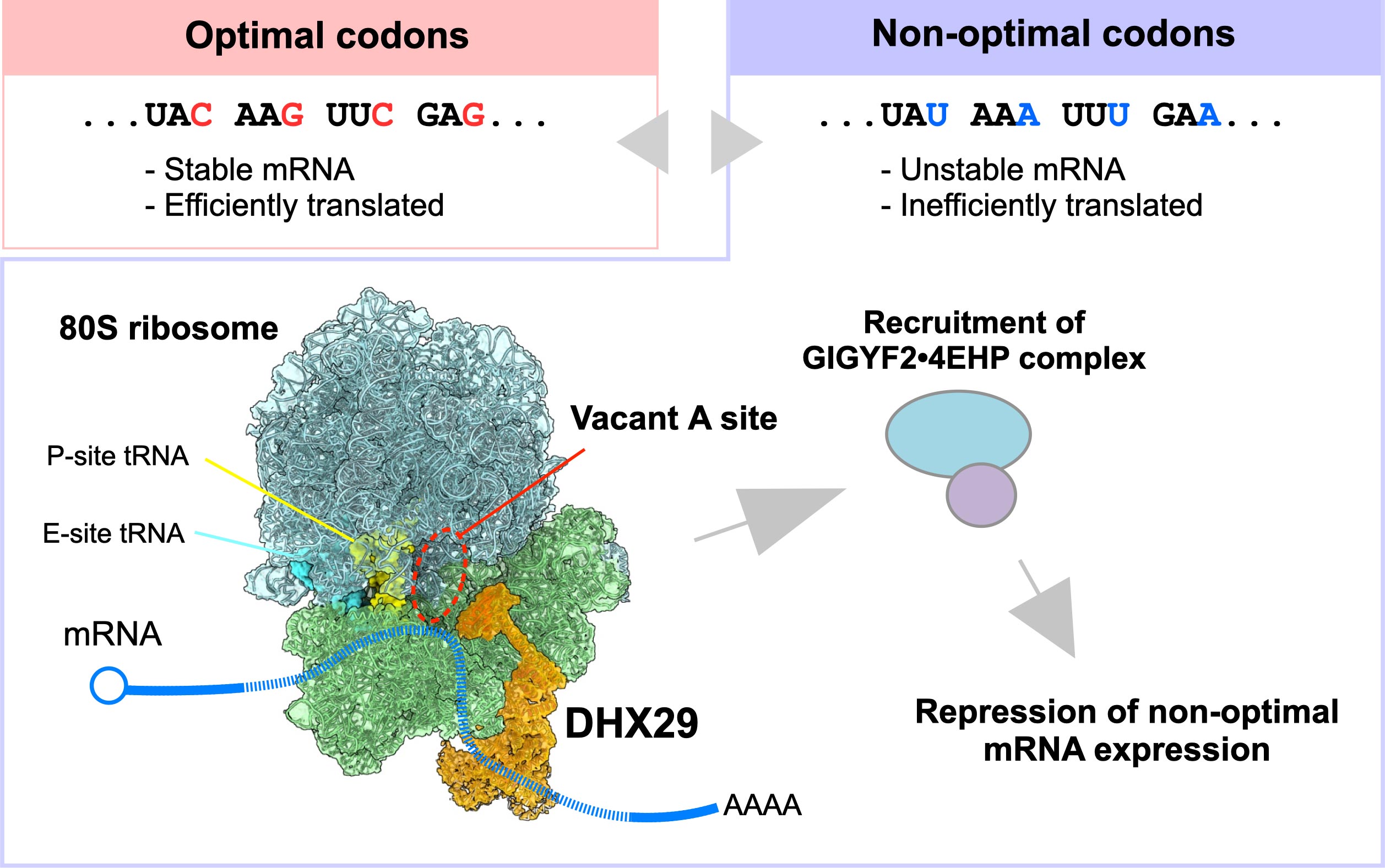
    That view has changed. Scientists now know that some of these synonymous codons help messenger RNA, or mRNA, remain stable and get translated efficiently, while others do not. In effect, two genetic sequences can encode the same protein but still behave differently inside a cell. mRNAs rich in non-optimal codons are translated less efficiently and are often broken down more quickly, but the mechanism human cells use to detect this difference has been unclear.

    Researchers at Kyoto University and RIKEN, led by Osamu Takeuchi and Takuhiro Ito, set out to solve that puzzle. Their work points to a protein called DHX29 as a key part of the system cells use to read this hidden layer of genetic information.

    Visualizing the Molecular Mechanism

    The team began with a genome-wide CRISPR screening to search for factors involved in codon-dependent gene expression. That search identified the RNA-binding protein DHX29 as a central regulator. Follow-up RNA sequencing showed that when DHX29 is lost, mRNAs enriched in non-optimal codons accumulate, indicating that the protein normally helps keep these transcripts in check.

    Using cryo-electron microscopy, the team observed how DHX29 directly interacts with the 80S ribosome. They also applied selective ribosome profiling to determine which codons were being read by ribosomes associated with DHX29.
    Optimus Protein Graphic
    Model of DHX29-mediated regulation of mRNAs enriched in non-optimal codons. Credit: KyotoU / Masanori Yoshinaga

    The results showed that DHX29 tends to bind ribosomes that are decoding non-optimal codons. Proteomic analyses further revealed that DHX29 recruits the GIGYF2•4EHP protein complex, which selectively suppresses mRNAs enriched in non-optimal codons.

    “Together, these findings reveal a direct molecular link between synonymous codon choice and the control of gene expression in human cells,” says co-corresponding author Masanori Yoshinaga.

    Broader Implications for Biology and Disease

    These findings change how scientists understand the role of codon choice in regulating gene expression in human cells. The DHX29-driven mechanism may influence important biological processes such as cell differentiation, cellular homeostasis, and cancer development, suggesting wide-ranging significance. The researchers now plan to explore how DHX29 affects health and disease.

    “We have long been fascinated by how cells interpret the hidden layer of information embedded within the genetic code, so discovering the molecular factor that allows human cells to read and respond to this hidden code has been particularly rewarding,” says team leader Osamu Takeuchi.

    Reference: “Human DHX29 detects nonoptimal codon usage to regulate mRNA stability” by Fabian Hia, Yitong Wu, Masanori Yoshinaga, Sakurako Goto-Ito, Wakana Iwasaki, Koshi Imami, Hirotaka Toh, Peixun Han, Ting Cai, Takayuki Ohira, Akira Fukao, Daron M Standley, Yuichi Shichino, Masaki Takegawa, Toshinobu Fujiwara, Tsutomu Suzuki, Shintaro Iwasaki, Michael C. Bassik, Takuhiro Ito and Osamu Takeuchi, 19 March 2026, Science.
    DOI: 10.1126/science.adw0288

    Never miss a breakthrough: Join the SciTechDaily newsletter.
    Follow us on Google and Google News.

    DNA Genetics Kyoto University Molecular Biology Popular RNA
    Share. Facebook Twitter Pinterest LinkedIn Email Reddit

    Related Articles

    Decades-Old Mystery Solved: Scientists Crack the Code of DNA Repair

    Palindromic Puzzles Solved: The Hidden Mechanism of Gene Creation

    CRISPR Gene Editing Now Possible in Cockroaches

    Research Team Finds New Species of Coronaviruses in Some Unexpected Places

    DNAzymes – How Active DNA Biocatalysts That Destroy Unwanted RNA Molecules Work

    Need a New Tooth? Drug Discovered to Regenerate Lost Teeth

    Genetic Analysis Reveals Evolution of the Enigmatic Y Chromosome in Great Apes

    DNA May Not Be the Blueprint for Life – Just a Scrambled List of Ingredients

    Key Differences in Seemingly Synonymous Parts of the Genetic Code

    3 Comments

    1. Kayden Aaron Waltower on March 22, 2026 2:52 pm

      Sonic the hedgehog

      Reply
    2. danR2222 on March 23, 2026 6:53 am

      Where can I get this drug?!

      😛

      Reply
    3. Phil A. Shio on March 23, 2026 1:02 pm

      I would go to war for less.

      Reply
    Leave A Reply Cancel Reply

    • Facebook
    • Twitter
    • Pinterest
    • YouTube

    Don't Miss a Discovery

    Subscribe for the Latest in Science & Tech!

    Trending News

    The Universe Is Expanding Too Fast and Scientists Can’t Explain Why

    “Like Liquid Metal”: Scientists Create Strange Shape-Shifting Material

    Early Warning Signals of Esophageal Cancer May Be Hiding in Plain Sight

    Common Blood Pressure Drug Shows Surprising Power Against Deadly Antibiotic-Resistant Superbug

    Scientists Uncover Dangerous Connection Between Serotonin and Heart Valve Disease

    Scientists Discover a “Protector” Protein That Could Help Reverse Hair Loss

    Bone-Strengthening Discovery Could Reverse Osteoporosis

    Scientists Uncover Hidden Trigger Behind Stem Cell Aging

    Follow SciTechDaily
    • Facebook
    • Twitter
    • YouTube
    • Pinterest
    • Newsletter
    • RSS
    SciTech News
    • Biology News
    • Chemistry News
    • Earth News
    • Health News
    • Physics News
    • Science News
    • Space News
    • Technology News
    Recent Posts
    • Scientists Overcome Major Quantum Bottleneck, Potentially Transforming Teleportation and Computing
    • Quantum Physics’ Strangest Problem May Hold the Key to Time Itself
    • Scientists Create “Liquid Gears” That Spin Without Touching
    • The Simple Habit That Could Help Prevent Cancer
    • Forgotten Medicinal Plant Shows Promise in Fighting Dangerous Superbugs
    Copyright © 1998 - 2026 SciTechDaily. All Rights Reserved.
    • Science News
    • About
    • Contact
    • Editorial Board
    • Privacy Policy
    • Terms of Use

    Type above and press Enter to search. Press Esc to cancel.