
Close Menu
    Facebook X (Twitter) Instagram
    SciTechDaily
    • Biology
    • Chemistry
    • Earth
    • Health
    • Physics
    • Science
    • Space
    • Technology
    Facebook X (Twitter) Pinterest YouTube RSS
    SciTechDaily
    Home»Technology»Scientists Use Cosmetic Ingredient To Transform Battery Protection
    Technology

    Scientists Use Cosmetic Ingredient To Transform Battery Protection

    By Pohang University of Science & Technology (POSTECH)January 7, 2024No Comments3 Mins Read
    Facebook Twitter Pinterest Telegram LinkedIn WhatsApp Email Reddit
    Share
    Facebook Twitter LinkedIn Pinterest Telegram Email Reddit
    Solid State Battery Technology Concept
    Researchers at POSTECH have developed a xanthan gum-based protective film for battery electrodes, enhancing the durability and efficiency of zinc-ion batteries. This innovation marks a significant step towards sustainable green energy solutions and addresses key challenges in energy storage technology.

    Xanthan gum, a substance originally obtained from plants such as cabbage and recognized for its carbohydrate composition, is commonly used in cosmetics as a natural barrier to maintain their skin benefits. In an innovative advancement, xanthan gum has now been harnessed to create a protective shield for battery electrodes, rather than for the skin.

    Professor Changshin Jo from the Graduate Institute of Ferrous & Eco Materials Technology and the Department of Chemical Engineering and Jooyoung Jang, a PhD candidate, from the Department of Chemical Engineering at Pohang University of Science and Technology (POSTECH), have crafted a protective film by blending polymers. This film enhances the durability of battery electrodes, and their research findings have been featured in the international journal Energy Storage Materials.

    The Growing Importance of Energy Storage Systems

    With renewable energy sources like solar power being inherently intermittent, the importance of energy storage systems (ESS) is steadily growing. ESS technology enables the capture and efficient use of electricity when needed, making it a crucial element in harnessing renewable energy. While lithium-ion (Li-ion) batteries have traditionally been employed for ESS applications, their high cost and concerns about lithium depletion have prompted ongoing research into alternative solutions.
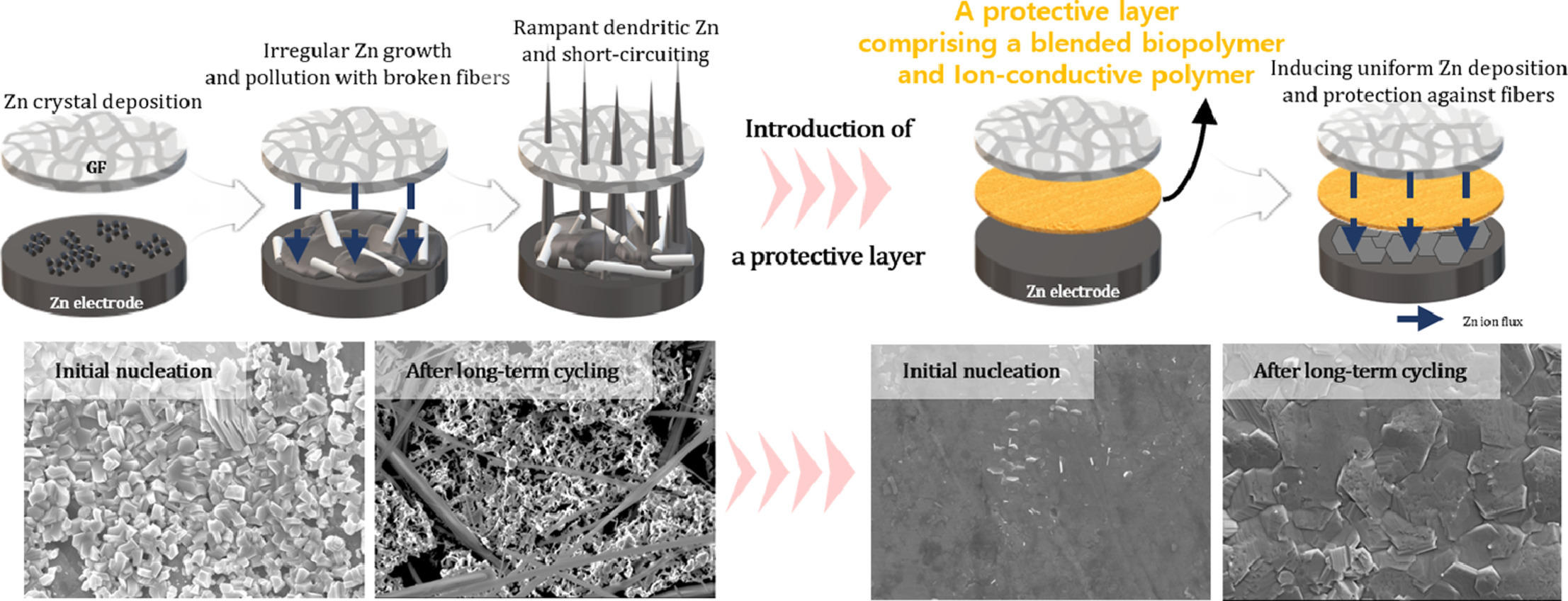
    Introducing a Xanthan Gum Based Shield To Drive Uniform Zinc Deposition Graphic
    Introducing a xanthan gum-based shield to drive uniform zinc deposition. Credit: POSTECH

    One promising alternative to lithium is zinc (Zn), an abundant element on Earth. Zinc-ion batteries have the capacity to store significant amounts of energy and are safer in terms of fire risks compared to lithium-ion batteries. Nonetheless, achieving a consistent deposition of zinc on the electrodes in ESS batteries is a challenging task, and the repeated charging and discharging cycles tend to lead to the formation of twig-like crystals on the zinc surface, reducing the battery’s longevity.

    Breakthrough in Battery Technology Using Xanthan Gum

    In this investigation, the research team employed the biopolymer xanthan gum in combination with an ionically conductive polymer to fashion a protective film for the battery electrode. The interaction between these two polymers yielded a smooth protective layer on the electrode’s surface, effectively shielding it from physical impacts and chemical contaminants.

    Furthermore, this protective film was rich in oxygen functional groups, which played a crucial role in facilitating the uniform nucleation of zinc, resulting in the efficient deposition of zinc on the electrode surface. Consequently, the formation of twig-like crystals on the zinc surface was significantly mitigated, and the film demonstrated remarkable stability even after enduring 200 days of repeated charging and discharging.

    Professor Changshin Jo stated, “I hope this research will contribute to the advancement of ESS technology for sustainable green energy production.”

    Reference: “Biopolymer-blended protective layer for use in stabilizing the zinc anode in metal battery applications” by Jooyoung Jang, Jinyoung Chun and Changshin Jo, 29 August 2023, Energy Storage Materials.
    DOI: 10.1016/j.ensm.2023.102948

    The research was sponsored by the National Research Foundation of Korea and the Korea Institute of Energy Technology Evaluation and Planning.

    Never miss a breakthrough: Join the SciTechDaily newsletter.
    Follow us on Google and Google News.

    Battery Technology Electrical Engineering Energy Pohang University of Science & Technology
    Share. Facebook Twitter Pinterest LinkedIn Email Reddit

    Related Articles

    Battery Technology Breakthrough: An Atomic Look at Lithium-Rich Batteries

    New Wearable Device Turns Your Body Into a Biological Battery

    Researchers Watch Solid-State Batteries Charge and Discharge Using X-ray Tomography

    Supercapacitors Challenge Batteries: Powerful Graphene Hybrid Material for Highly Efficient Energy Storage

    Batteries Mimic Multilayer Geometry of Mammal Bones for Structural Stability

    Improving Lithium-Ion Battery Performance, Cell Lifetime for Renewable Energy Applications

    New Battery Technology Enables Charging Electric Cars Up to 90% in Just 6 Minutes

    Revolutionizing Large-Scale Energy Storage: Better Multivalent Metal Batteries

    New Battery Can Self-Charge Without Losing Energy

    Leave A Reply Cancel Reply

    • Facebook
    • Twitter
    • Pinterest
    • YouTube

    Don't Miss a Discovery

    Subscribe for the Latest in Science & Tech!

    Trending News

    Largest-Ever Study Finds Medicinal Cannabis Ineffective for Anxiety, Depression, PTSD

    250-Million-Year-Old Egg Solves One of Evolution’s Biggest Mysteries

    Living With Roommates Might Be Changing Your Gut Microbiome Without You Knowing

    Century-Old Cleaning Chemical Linked to 500% Increased Risk of Parkinson’s Disease

    What if Your Memories Never Happened? Physicists Take a New Look at the Boltzmann Brain Paradox

    One of the Universe’s Largest Stars May Be Getting Ready To Explode

    Scientists Discover Enzyme That Could Supercharge Ozempic-Like Weight Loss Drugs

    Popular Sweetener Linked to DNA Damage – “It’s Something You Should Not Be Eating”

    Follow SciTechDaily
    • Facebook
    • Twitter
    • YouTube
    • Pinterest
    • Newsletter
    • RSS
    SciTech News
    • Biology News
    • Chemistry News
    • Earth News
    • Health News
    • Physics News
    • Science News
    • Space News
    • Technology News
    Recent Posts
    • Mystery Illness Kills 5 in Burundi As Doctors Scramble for Answers
    • Bone-Strengthening Discovery Could Reverse Osteoporosis
    • The Most Elusive Number in Physics Just Got Even More Mysterious
    • Scientists Uncover Hidden Trigger Behind Stem Cell Aging
    • Scientists Discover Coral Reefs Are Teeming With Previously Unknown Life
    Copyright © 1998 - 2026 SciTechDaily. All Rights Reserved.
    • Science News
    • About
    • Contact
    • Editorial Board
    • Privacy Policy
    • Terms of Use

    Type above and press Enter to search. Press Esc to cancel.