

A negative scan does not always mean recurrent prostate cancer is nowhere to be found. Sometimes, the disease may simply be too small or too faint to appear yet.
New research suggests that repeating a PSMA PET scan later can reveal cancer that was missed the first time. Among patients with rising prostate-specific antigen (PSA) levels but no visible disease on their initial scan, a second test detected cancer in 56 percent of cases. The results changed treatment plans for nearly half of the patients.
The findings were published in the July issue of The Journal of Nuclear Medicine.
Prostate cancer can return after surgery or radiation therapy without immediately producing symptoms or a tumor that doctors can see. Instead, the first warning may be a rising PSA level in the blood, a situation known as biochemical recurrence. The increase suggests that prostate cells remain somewhere in the body, but it does not reveal their location.
This can make treatment decisions difficult. Doctors may need to determine whether the cancer is confined to the area where it began, has reached nearby lymph nodes, or has spread to distant organs. Each pattern can require a different strategy.
PSMA PET imaging is designed to help solve that problem. A radioactive tracer attaches to prostate-specific membrane antigen, a protein often found at high levels on prostate cancer cells. The scan then highlights areas where the tracer accumulates, potentially exposing deposits that conventional imaging cannot easily detect.
Why Some Cancers Escape Detection
Even this sensitive technology has limits. About 30 percent of patients with suspected recurrence have no detectable cancer on their first PSMA PET scan, despite rising PSA levels. The disease may be microscopic, express too little PSMA, or not yet produce a signal strong enough to distinguish it from surrounding tissue.
“There is little information on the utility of repeating a PSMA PET after an initial negative scan,” said Ur Metser, BSc, MD, FRCPC, professor of radiology at the University of Toronto and head of the Division of Molecular Imaging at the Joint Department of Medical Imaging at Princess Margaret Cancer Centre in Toronto. “In our study, my colleagues and I sought to determine the benefit of a second PSMA PET scan, as well as to assess predictors for positive PSMA PET scans.”
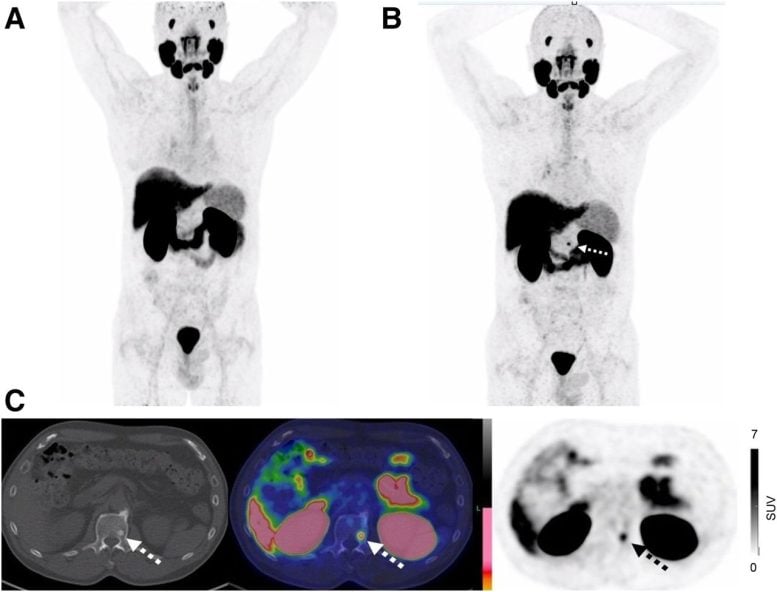
Metser and his colleagues examined 210 participants in the Registry for Recurrent Prostate Cancer in Ontario. Each patient had undergone more than one PSMA PET scan after the first produced a negative result.
Repeat Scans Reveal Hidden Cancer
The researchers tracked PSA levels, how quickly PSA concentrations doubled, whether the repeat scan found cancer, and whether the new information altered the patient’s care. They also classified the disease as local recurrence, locoregional, oligometastatic (fewer than five positive disease sites), or extensive metastatic (more than five positive disease sites).
The second scan uncovered recurrent cancer in 56 percent of the patients. Those discoveries prompted physicians to change management plans in nearly 50 percent of cases, with the greatest effect seen among patients with oligometastatic disease.
Finding a limited number of tumors can be particularly important because it may allow doctors to consider treatments directed at specific cancer sites rather than relying only on therapies that affect the entire body. The scan itself does not determine which treatment a patient should receive, but it can provide the map needed to choose among radiation, surgery, systemic therapy, or continued monitoring.
Who Benefits Most From Repeat Imaging
Repeat scans were most likely to find cancer when PSA levels were higher or when PSA doubled in less than 12 months. A rapidly rising PSA can indicate that the disease is becoming more active, increasing the likelihood that previously invisible tumors will become detectable.
“The findings in this study further strengthen the pivotal role of PSMA PET in the management of men with recurrence of prostate cancer after first-line therapy,” said Metser. “Understanding the extent of disease in patients who have initial negative PSMA PET scans provides valuable information for physicians as they create treatment plans,” said Metser.
Reference: “Utility of PSMA PET/CT After an Initial Negative Scan: Results from a Prospective Multicenter PSMA PET Registry” by Ur Metser, Glenn Bauman, Mohammed Rashid, Seyed Ali Mirshahvalad, Andres Kohan, Bo Green, Rosanna Chan and Robert Hamilton, 1 July 2026, Journal of Nuclear Medicine.
DOI:10.2967/jnumed.126.272204
Never miss a breakthrough: Join the SciTechDaily newsletter.
Follow us on Google and Google News.