
Close Menu
    Facebook X (Twitter) Instagram
    SciTechDaily
    • Biology
    • Chemistry
    • Earth
    • Health
    • Physics
    • Science
    • Space
    • Technology
    Facebook X (Twitter) Pinterest YouTube RSS
    SciTechDaily
    Home»Health»Researchers Develop New Approach to Personalized Cancer Treatment
    Health

    Researchers Develop New Approach to Personalized Cancer Treatment

    By Laurie Callahan, Society of Nuclear Medicine and Molecular ImagingMarch 1, 2018No Comments3 Mins Read
    Facebook Twitter Pinterest Telegram LinkedIn WhatsApp Email Reddit
    Share
    Facebook Twitter LinkedIn Pinterest Telegram Email Reddit
    Researchers Develop New Approach to Personalized Cancer Treatment
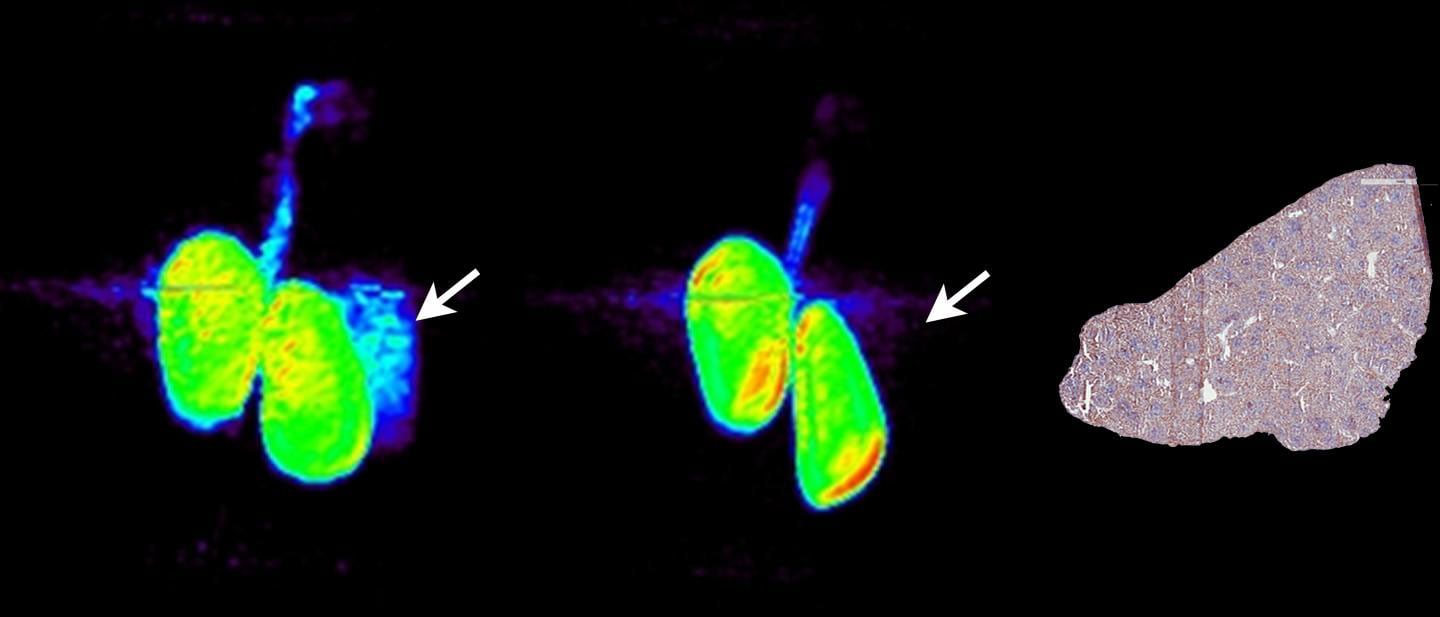
    Representative whole-body PET (maximal intensity projection) images of kidneys and spleen 90 minutes post injection of 18F-BMS-986192 only (left) and of 18F-BMS-986192 and co-administration of 1 mg/kg BMS-986192 in the same monkey (center). Representative anti-PD-L1 immunohistochemistry of healthy monkey spleen tissue (right). Credit: D Donnelly et al., Bristol-Myers Squibb Pharmaceutical Research and Development, Princeton, N.J.

    Researchers have developed a same-day, noninvasive positron emission tomography (PET)-based imaging approach to assess PD-L1 positive tumors, and the study is presented in the featured article of The Journal of Nuclear Medicine’s March issue.

    A healthy immune system strikes a delicate balance between eradicating infections and cancers and not overreacting to damage one’s own tissue. Immune checkpoints help control the immune response, but tumors exploit these checkpoint pathways by expressing special proteins that evade antitumor immune responses. One major checkpoint inhibitor pathway is the PD-1 pathway, and its ligand is PD-L1.

    In this study, the PD-L1 ligand, which enables cancer to evade a person’s immune system, has been successfully targeted for the first time with a fluorine-18 (18F)-labeled PD-L1 radioligand. Until now, efforts to predict response to treatments targeting PD-1 or PD-L1 have typically been limited to the evaluation of a single patient biopsy sample.

    “This approach represents an opportunity for physicians to noninvasively assess all of a patient’s tumors for PD-L1 expression with a single PET scan and timely readout,” explains David J. Donnelly, Ph.D., at Bristol-Myers Squibb Research and Development in Princeton, New Jersey. “This may help guide treatment decisions and assess treatment response, to help identify the right treatment for the right patient at the right time and right dose.”

    For the study, an anti-PD-L1 adnectin (an engineered, target-binding protein) was labeled with 18F to generate 18F-BMS-986192, which was then evaluated in mice bearing bilateral PD-L1(-) and PD-L1(+) subcutaneous tumors. 18F-BMS-986192 was also evaluated for distribution, binding, and radiation dosimetry in the healthy cynomolgus monkey. The results of the study demonstrate the feasibility of the approach, and the radiation dosimetry estimates indicate that the tracer is safe to administer in human studies. Clinical studies are now underway to measure PD-L1 expression in human tumors.

    Reference: “Synthesis and Biologic Evaluation of a Novel 18F-Labeled Adnectin as a PET Radioligand for Imaging PD-L1 Expression” by David J. Donnelly, R. Adam Smith, Paul Morin, Daša Lipovšek, Jochem Gokemeijer, Daniel Cohen, Virginie Lafont, Tritin Tran, Erin L. Cole, Martin Wright, Joonyoung Kim, Adrienne Pena, Daniel Kukral, Douglas D. Dischino, Patrick Chow, Jinping Gan, Olufemi Adelakun, Xi-Tao Wang, Kai Cao, David Leung, Samuel J. Bonacorsi and Wendy Hayes, 1 March 2018, Journal of Nuclear Medicine.
    DOI: 10.2967/jnumed.117.199596

    Never miss a breakthrough: Join the SciTechDaily newsletter.
    Follow us on Google and Google News.

    Cancer Medicine Molecular Biology Society of Nuclear Medicine and Molecular Imaging
    Share. Facebook Twitter Pinterest LinkedIn Email Reddit

    Related Articles

    Chemists Discover Unexpected Synergy Between Two Cancer Drugs

    Molecular Switch Serves as New Target Point for Cancer and Diabetes Therapies

    New Strategy for the Elimination of Cancer Stem Cells and Cancer Recurrence

    Scientists Reveal a New Therapeutic Target To Fight Metastasis in Ovarian Cancer

    New Research Shows Cellular Clean-Up Can Also Sweep Away Forms of Cancer

    Newly Discovered Protein Offers Vast Potential for Cancer Treatment

    Researchers Find a New Target to Treat a Wide Spectrum of Cancers

    New Drug Candidate Kills Cancer Cells Better Than Cisplatin

    Protein NLRP12 Protects Against Colon Cancer

    Leave A Reply Cancel Reply

    • Facebook
    • Twitter
    • Pinterest
    • YouTube

    Don't Miss a Discovery

    Subscribe for the Latest in Science & Tech!

    Trending News

    Just a Few Breathless Minutes a Day Could Slash Your Risk of 8 Major Diseases

    This Simple Habit Could Cut Your Risk of Dementia by 30%

    Scientists Debunk Rattlesnake Myth That Fooled Hikers and Doctors for Decades

    Scientists Discover Plants Can “Count” – and May Be Smarter Than We Thought

    New Research Reveals Ancient Mars May Have Been Warm, Wet – and Possibly Alive

    This Surprising Daily Habit Could Cut Dementia Risk by 35%

    Just 10 Minutes a Day: Scientists Say This Ancient Chinese Practice Shows Powerful Blood Pressure Benefits

    Scientists Say This Popular Food Could Help Your Body Get Rid of Microplastics

    Follow SciTechDaily
    • Facebook
    • Twitter
    • YouTube
    • Pinterest
    • Newsletter
    • RSS
    SciTech News
    • Biology News
    • Chemistry News
    • Earth News
    • Health News
    • Physics News
    • Science News
    • Space News
    • Technology News
    Recent Posts
    • Scientists Uncover Massive Climate Secret Beneath Sweden’s Forests
    • Scientists Unlock 3 Million Years of Climate Secrets Hidden in Antarctic Ice
    • “We Were Truly Astonished”: New Discovery Rewrites Earth’s Origin Story
    • A Simple Nose Swab Could Detect Alzheimer’s Years Before Symptoms Appear
    • Scientists Warn: Vaping Likely Causes Cancer
    Copyright © 1998 - 2026 SciTechDaily. All Rights Reserved.
    • Science News
    • About
    • Contact
    • Editorial Board
    • Privacy Policy
    • Terms of Use

    Type above and press Enter to search. Press Esc to cancel.