
Appearance Shapes Perceptions of Harassment Victims
Women who are young, “conventionally attractive” and appear and act feminine are more likely to be believed when making accusations of sexual harassment, a new University of Washington-led study finds.
That leaves women who don’t fit the prototype potentially facing greater hurdles when trying to convince a workplace or court that they have been harassed.
The study, involving more than 4,000 participants, reveals perceptions that primarily “prototypical” women are likely to be harassed. The research also showed that women outside of those socially determined norms — or “nonprototypical” women — are more likely perceived as not being harmed by harassment.
“The consequences of that are very severe for women who fall outside of the narrow representation of who a victim is,” said Bryn Bandt-Law, a graduate student in psychology at the UW and one of the study’s lead authors.
“Nonprototypical women are neglected in ways that could contribute to them having discriminatory treatment under the law; people think they’re less credible — and less harmed — when they make a claim, and think their perpetrators deserve less punishment.”
The study, published today (January 14, 2021) in the Journal of Personality and Social Psychology, is co-led by Jin Goh, a former postdoctoral researcher at the UW now at Colby College, and Nathan Cheek of Princeton University.
The Impact of #MeToo on the Study’s Motivation
The researchers said the idea for the study came from the #MeToo movement, founded by Tarana Burke and popularized in 2017 after a number of actresses accused movie producer Harvey Weinstein of sexual harassment and abuse. #MeToo and related movements empowered individuals to come forward about their experiences with sexual harassment, which the U.S. Equal Employment Opportunity Commission defines as gender discrimination and/or unwelcome sexual behavior that can affect a person’s job performance and work environment. The movement also encourages people to name perpetrators and in some cases pursue legal action.
But as the study’s authors reflected on the celebrities who stepped forward, they wanted to explore further the notion of credibility. They set up a series of experiments to be divided among the 4,000 participants to address three research questions: who we think is sexually harassed; what constitutes harassment; and how claims of harassment are perceived. The experiments largely consisted of written scenarios and digitally manipulated headshots.
Examining Prototypes and Harassment Scenarios
The team started with the research-supported premise that more women are sexually harassed than men. They employed a psychological framing of group membership, whereby a behavior — in this case, sexual harassment — is linked to a specific group, in this case women. Each group has prototypes for who is considered part of it: Past research has identified characteristics perpetuated in pop culture and society of the prototypical woman: young, feminine, conventionally attractive, and even weak and incompetent.
Researchers’ scenarios drew upon different ways that psychologists say sexual harassment can manifest: coercion, with a quid pro quo expectation; unwanted advances, with no quid pro quo; and gender harassment, which are hostile comments and behaviors tied to a person’s gender. In one scenario, for example, a supervisor puts his hand around a female employee’s waist; in another, a supervisor asks about a female employee’s boyfriend. Some scenarios were clear and egregious violations of the law, some were clearly benign, and some were appropriately vague.
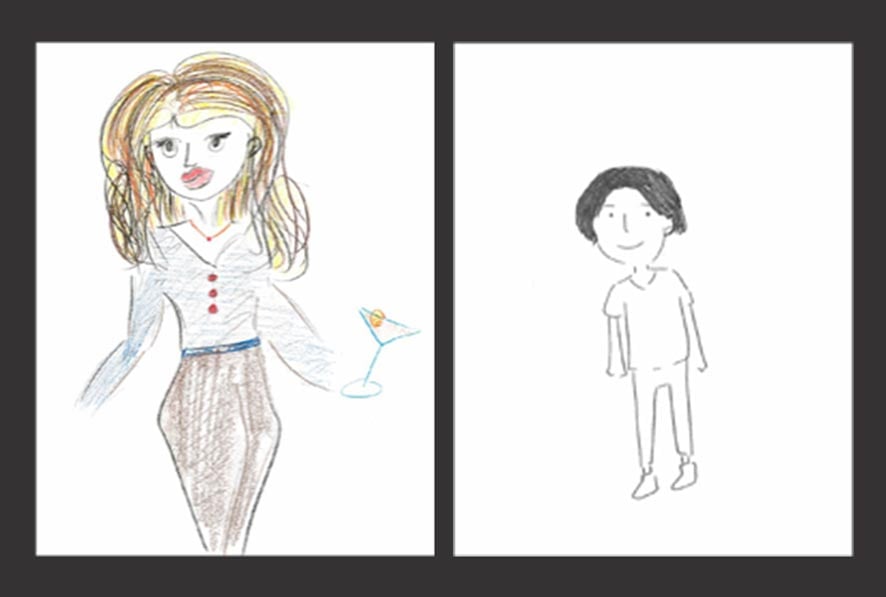
To address the research question of who we think is likely to be harassed, some participants were asked to draw a woman who was harassed — or not harassed, depending on the assignment. This approach reveals people’s conceptions and biases at a basic, freeform level, explained senior author and UW psychology professor Cheryl Kaiser. It has been used in other well-known experiments such as “draw a scientist,” which often reveals gender bias.
Additional tests included presenting participants with digital headshots, in some cases manipulated to look more masculine or feminine, and asking them to choose, for example, which image best represented the woman in the scenario they read about. Some participants were asked to determine whether a scenario constituted harassment, to what degree a victim was harmed and whether the potential perpetrator deserved punishment.
The overall results were clear: Participants generally perceived sexual harassment victims to be prototypical women. In fact, the association between sexual harassment and prototypical women is so strong that the exact same woman was seen as more prototypical when people were told she was sexually harassed. In consequence, the exact same scenarios, presented with nonprototypical women, were less likely to be considered harassment, and nonprototypical victims are seen as less credible, less harmed by the harassment, and their harasser is seen as less deserving of punishment.
This is why the idea of a prototypical woman matters, Kaiser said. Sexual harassment most commonly happens to women. If only those women displaying certain characteristics are viewed as “women,” then the belief persists that those without prototypical characteristics must not be subject to harassment.
“When you make a perception of harassment, you also make a connection to womanhood, but the way we understand womanhood is very narrowly defined. So for anyone who falls outside of that definition, it makes it hard to make that connection to harassment,” Kaiser said.
Toward Inclusive Recognition of Victims
One area that merits further study of harassment prototypes, the researchers said, are the many other between-group variations among women — specifically, race, ethnicity, sexual orientation, and gender identity. Because white women are perceived as prototypical women, the researchers are currently exploring whether Black women are perceived as less credible and less harmed by sexual harassment. Such a finding would be consistent with Tarana Burke’s criticism that the mainstream #MeToo movement has disproportionately centered and benefited a narrow group of women, such as white, conventionally feminine celebrities.
Overall, researchers believe their findings help illustrate how laws may not always protect the people they’re designed to. Accusations must be deemed credible, and the incidents harmful, for harassment claims to lead to legal resolution. By recognizing that harassment can happen regardless of a person’s fit within a prototype, the chances for justice are improved.
“If we have biased perceptions of harm for nonprototypical women, it will drastically change their legal outcomes,” Bandt-Law said. “If they’re not being believed, they’re effectively being silenced.”
Reference: “Narrow prototypes and neglected victims: Understanding perceptions of sexual harassment” by Goh, Jin X. Bandt-Law, Bryn Cheek, Nathan N. Sinclair, Stacey Kaiser, Cheryl R., 14 January 2021, Journal of Personality and Social Psychology.
DOI: 10.1037/pspi0000260
The study was funded by a National Science Foundation grant to Kaiser, and NSF Graduate Research Fellowships to Bandt-Law and Cheek. Stacey Sinclair of Princeton was also a co-author.
Never miss a breakthrough: Join the SciTechDaily newsletter.
Follow us on Google and Google News.