
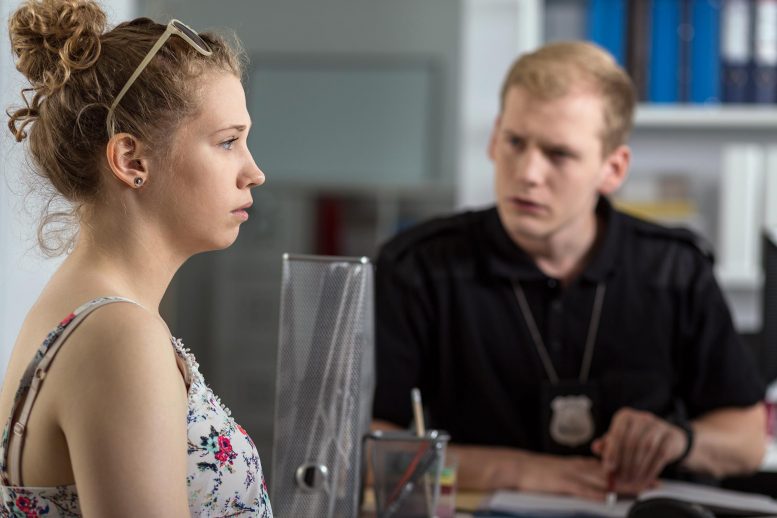
People are no better than chance at identifying when someone else is recounting a false or real memory of a crime, according to a new University College London (UCL) study.
The findings, published today (April 8, 2020) in Frontiers in Psychology, build on a previous study that was the first to successfully implant false memories of committing a crime — involving either assault or assault with a weapon that resulted in police contact.
Study author Dr. Julia Shaw (UCL Psychology & Language Sciences) said: “Everyone thinks that they couldn’t be tricked into believing they have done something they never did, and that if someone were telling them about a false memory, they would be able to spot it. But we found that actually, people tend to be quite susceptible to having false memories, and they sound just like real memories.”
For the previous study, published in 2015, Dr. Shaw and a colleague invited young adults into a study about emotional memories, and also spoke with a member of their family to learn about events from the participants’ early adolescence, in as much detail as possible.
The researchers spoke to the participants about their past, and used leading questions and suggestive tactics, as well as visualization techniques to convince the participants that they were helping them recover a forgotten memory — while in fact they were implanting a false memory that the participant had committed a crime when they were young, such as theft or assault.
“We were essentially doing exactly ‘what not to do’ when conducting a police interview,” explained Dr. Shaw.
The 2015 study reported that the majority of participants developed a false memory of committing a crime, and the participants consistently reported that the false memories felt incredibly real.
“Legal professionals and police officers need to realize how easy it is to manipulate someone’s memories.” Dr. Julia Shaw
The current research involves two studies that used videos from the 2015 study, of the study participants recounting their false memories of a crime, which they believed to be real. The new participants watched those videos and were asked if the person was describing an event that actually happened or not.
Participants were only 53% accurate (no better than chance) at identifying false memories of committing a crime. These results were replicated in the second study. Even when participants were explicitly told that one of the memories they watched was false, their judgment was still no better than tossing a coin.
In addition to incorrectly believing false memories to be true, participants were just as likely to watch someone recount a genuine memory, and then misidentify it as false, once the research team told them that some of the videos would feature false memories. In other words, many true memories looked like false memories.
“Legal professionals and police officers need to realize how easy it is to manipulate someone’s memories. Judges, in particular, should never assume that they can tell when someone has a false memory, and should consider the entire process to see if there was any risk of contamination of a defendant or witness’ memories,” Dr. Shaw said.
“The findings really highlight how important it is to ensure that criminal proceedings are done right. The questioning process should be evidence-based, to reduce the risk of implanting false memories in people being questioned by the police.”
Reference: “Do False Memories Look Real? Evidence That People Struggle to Identify Rich False Memories of Committing Crime and Other Emotional Events” by Julia Shaw, 8 April 2020, Frontiers in Psychology.
DOI: 10.3389/fpsyg.2020.00650
Never miss a breakthrough: Join the SciTechDaily newsletter.
Follow us on Google and Google News.
2 Comments
The way of discovering the false memories regarding crime is really appreciating and behavioral science has been helping the law enforcement department a lot in this regard. I am a senior advisor at this https://flirtymania.plus/ website and help people across the world so that modern people could get connected to each other. I hope more study and research should be conducted in the behavioral science field.
And the false memories described here are just the tip of the iceberg. All of this can easily be applied in social engineering to extract illegal profits.
I have also detailed this issue on my blog https://ulive.chat/es/p, you can read and leave comments there.