
Close Menu
    Facebook X (Twitter) Instagram
    SciTechDaily
    • Biology
    • Chemistry
    • Earth
    • Health
    • Physics
    • Science
    • Space
    • Technology
    Facebook X (Twitter) Pinterest YouTube RSS
    SciTechDaily
    Home»Space»A Significant Step Towards Explaining the Cosmic Origins of the Seeds of Galaxies
    Space

    A Significant Step Towards Explaining the Cosmic Origins of the Seeds of Galaxies

    By Harvard-Smithsonian Center for AstrophysicsJanuary 16, 20151 Comment3 Mins Read
    Facebook Twitter Pinterest Telegram LinkedIn WhatsApp Email Reddit
    Share
    Facebook Twitter LinkedIn Pinterest Telegram Email Reddit
    3D Simulation Shows Small Protostellar-Like Core Can Grow into a Supermassive Black Hole
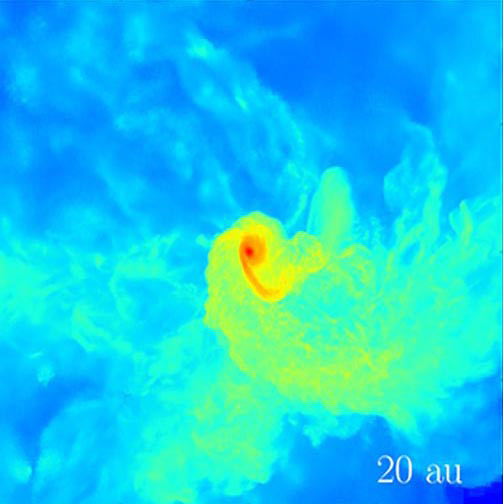
    Simulation of the collapse of gas in the very early universe into a small black hole, the first step in producing a more massive black hole that will become the seed for the future development of a galaxy. (The scale of the image is 20 au; one au – astronomical unit – is the average distance of the Earth from the Sun. Credit: Fernando Becerra, et al.

    In a new study, astronomers from Harvard-Smithsonian Center for Astrophysics found that a small protostellar-like core of only 0.1 solar masses can develop in only a few years from a suitable environment and then can grow into a supermassive black hole in only millions of years.

    Supermassive black holes with millions or billions of solar masses of material are found at the nuclei of most galaxies. During the embryonic stages of these galaxies they are thought to play an important role, acting as seeds around which material is collected. During the later lifetime of galaxies they can power dramatic outflowing jets of material (among other phenomena) as infalling dust and gas accretes onto the disks that typically surround them. These active, later phases of supermassive black holes can result in turning galaxies into extremely bright objects like quasars, whose luminosities allow them to be seen at cosmic distances. In fact, quasars have recently been detected from eras less than a billion years after the Big Bang.

    But where do all these black holes come from – especially the ones present in the early universe!? The explosive death of massive stars, one nominal route, can take many hundreds of millions of years while the star itself coalesces from ambient gas and then evolves, after which material must be added to the black hole seed to grow it into a supermassive monster. It is not clear that there is enough time in the early universe for this to happen. A second method has been proposed for these cosmic seeds, the direct collapse of primordial gas into seedlings that are much more massive – about ten thousand solar masses – than are those present in stellar ashes.

    Computer simulations have struggled for years to predict what happens in direct collapse, with mixed successes. CfA astronomers Fernando Becerra, Thomas Greif, and Lars Hernquist, and a colleague, have just published the most detailed 3-D simulation of the process in the early universe with an amazingly fine spatial scale precision — as small as the solar system — and spanning a factor of over ten trillion in size and twenty orders of magnitude (a factor of one hundred million trillion) in gas density. They find that a small protostellar-like core of only 0.1 solar masses can develop in only a few years from a suitable environment and then can grow into a supermassive black hole in only millions of years. In particular, they find that fragmentation, which had been predicted to disrupt the growth of these seedlings, is not a serious problem. Their result is a significant step towards explaining the cosmic origins of the seeds of galaxies.

    Reference: “Formation of massive protostars in atomic cooling haloes” by Fernando Becerra, Thomas H. Greif, Volker Springel and Lars Hernquist, 21 January 2015, MNRAS.
    DOI: 10.1093/mnras/stu2284
    arXiv: 1409.3572

    Never miss a breakthrough: Join the SciTechDaily newsletter.
    Follow us on Google and Google News.

    Astronomy Astrophysics Black Hole Cosmology Harvard-Smithsonian Center for Astrophysics
    Share. Facebook Twitter Pinterest LinkedIn Email Reddit

    Related Articles

    Invisible Storm Lights Up Galaxy Cluster With Record-Breaking Radio Glow

    Astronomers Put Basic Principle of Black Holes to the Test

    Radio Weak Blazars Challenge the Basic Explanation of Blazars

    Astronomers Discover a Cosmic Particle Accelerator in Abell 3411 and 3412

    NASA’s Chandra Views a Stellar Circle of Life, Cygnus X-3

    Astrophysicists Show Milky Way Had a Blowout Bash 6 Million Years Ago

    Astronomers Discover Evidence of a ‘Direct-Collapse Black Hole’

    New Research Shows LIGO’s Twin Black Holes Might Have Been Born Inside a Single Star

    Astronomers Use G1 and G2 to Probe the Accretion Flow Feeding Sgr A*

    1 Comment

    1. Douglas Dwyer on January 17, 2015 10:19 am

      Two or more black holes sharing a gravitational well will orbit and have momentum.
      This momentum is available by sling shot to project hydrogen and dust into a ring (like a garden sprinkler) around the common gravity well hence forming the familiar galaxy spiral, 50% of the material will be captured by the two or more black holes steadily increasing their mass

      Reply
    Leave A Reply Cancel Reply

    • Facebook
    • Twitter
    • Pinterest
    • YouTube

    Don't Miss a Discovery

    Subscribe for the Latest in Science & Tech!

    Trending News

    The Universe Is Expanding Too Fast and Scientists Can’t Explain Why

    “Like Liquid Metal”: Scientists Create Strange Shape-Shifting Material

    Early Warning Signals of Esophageal Cancer May Be Hiding in Plain Sight

    Common Blood Pressure Drug Shows Surprising Power Against Deadly Antibiotic-Resistant Superbug

    Scientists Uncover Dangerous Connection Between Serotonin and Heart Valve Disease

    Scientists Discover a “Protector” Protein That Could Help Reverse Hair Loss

    Bone-Strengthening Discovery Could Reverse Osteoporosis

    Scientists Uncover Hidden Trigger Behind Stem Cell Aging

    Follow SciTechDaily
    • Facebook
    • Twitter
    • YouTube
    • Pinterest
    • Newsletter
    • RSS
    SciTech News
    • Biology News
    • Chemistry News
    • Earth News
    • Health News
    • Physics News
    • Science News
    • Space News
    • Technology News
    Recent Posts
    • Scientists Overcome Major Quantum Bottleneck, Potentially Transforming Teleportation and Computing
    • Quantum Physics’ Strangest Problem May Hold the Key to Time Itself
    • Scientists Create “Liquid Gears” That Spin Without Touching
    • The Simple Habit That Could Help Prevent Cancer
    • Forgotten Medicinal Plant Shows Promise in Fighting Dangerous Superbugs
    Copyright © 1998 - 2026 SciTechDaily. All Rights Reserved.
    • Science News
    • About
    • Contact
    • Editorial Board
    • Privacy Policy
    • Terms of Use

    Type above and press Enter to search. Press Esc to cancel.