
Close Menu
    Facebook X (Twitter) Instagram
    SciTechDaily
    • Biology
    • Chemistry
    • Earth
    • Health
    • Physics
    • Science
    • Space
    • Technology
    Facebook X (Twitter) Pinterest YouTube RSS
    SciTechDaily
    Home»Space»Hubble Views the Dust Filaments of Spiral Galaxy NGC 4217
    Space

    Hubble Views the Dust Filaments of Spiral Galaxy NGC 4217

    By Hubble Space TelescopeJanuary 19, 20151 Comment2 Mins Read
    Facebook Twitter Pinterest Telegram LinkedIn WhatsApp Email Reddit
    Share
    Facebook Twitter LinkedIn Pinterest Telegram Email Reddit
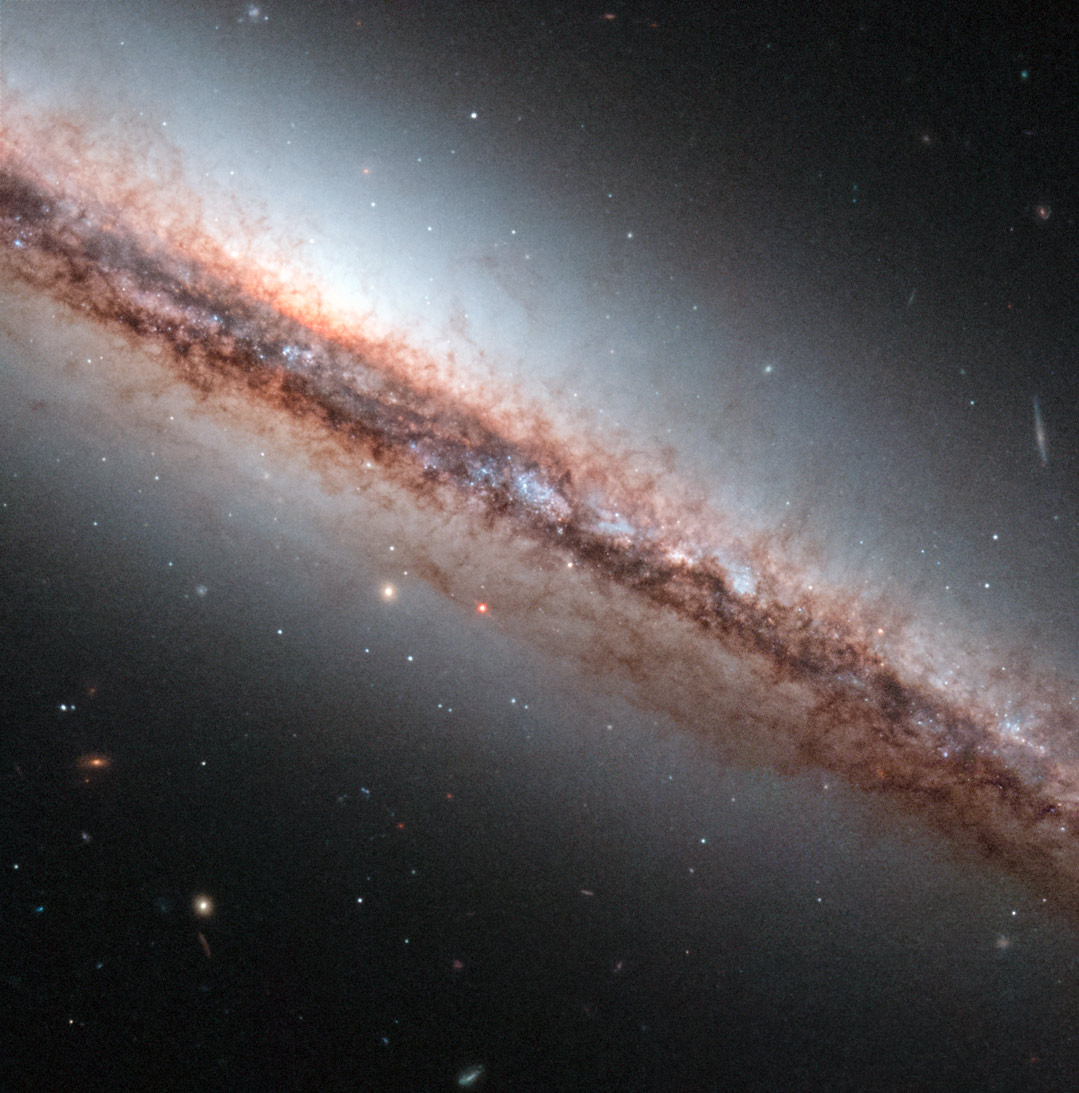
    Hubble Views Dust Filaments of NGC 4217
    NGC 4217  located 60 million light-years away. Credit: ESA/Hubble & NASA; Acknowledgement: R. Schoofs

    In this newly released image, NASA’s Hubble Space Telescope takes a close look at the spiral galaxy NGC 4217 – which is located 60 million light-years away.

    The galaxy is seen almost perfectly edge on and is a perfect candidate for studying the nature of extraplanar dust structures — the patterns of gas and dust above and below the plane on the galaxy, seen here as brown wisps coming off NGC 4217.

    These tentacle-like filaments are visible in the Hubble image only because the contrast with their surroundings is so high. This implies that the structures are denser than their surroundings. The image shows dozens of dust structures some of which reach as far as 7000 light-years away from the central plane. Typically the structures have a length of about 1000 light-years and are about 400 light-years in width.

    Some of the dust filaments are round or irregular clouds, others are vertical columns, loop-like structures, or vertical cones. These structures can help astronomers to identify the mechanisms responsible for the ejection of gas and dust from the galactic plane of spiral galaxies and reveal information on the transport of the interstellar medium to large distances away from galactic discs.

    The properties of the observed dust structures in NGC 4217 suggest that the gas and dust were driven out of the midplane of the galaxy by powerful stellar winds resulting from supernovae — explosions that mark the deaths of massive stars.

    This image was entered into the Hubble Hidden Treasures competition by contestant Ralf Schoofs.


    Never miss a breakthrough: Join the SciTechDaily newsletter.
    Follow us on Google and Google News.

    Astronomy Hubble Space Telescope
    Share. Facebook Twitter Pinterest LinkedIn Email Reddit

    Related Articles

    A Morphing Spiral Galaxy Amongst Friends

    Hubble Views Magnificent Lopsided Galaxy NGC 2276

    Hubble Captures Fantastic Detail of Eponymous Spiral Galaxy NGC 691

    Spectacular Image Captured by Hubble Shows a Strangely Contorted Spiral Galaxy

    A Distant Spiral in Virgo: Extraordinary Detail Seen in a Galaxy 150 Million Light-Years Away From Earth

    Magnetic Monsters: Hubble Tracks Down Location of Mysterious Radio Signals From Intergalactic Space

    A Menagerie of Galaxies: Hubble Captures a Cluster With Galaxies of All Shapes and Sizes

    How Habitable Are Planets That Orbit Red Dwarfs – The Most Common Type of Stars in the Galaxy?

    Cosmic Silver Lining: Hubble Spots V565 Surrounded by Four Prominent Diffraction Spikes

    1 Comment

    1. Peter K on January 19, 2015 8:46 am

      Driven out by supernova? I don’t think so! Check how consistent the spikes are! Supernova are anything but consistent, happening randomly over vast periods of time. I doubt the science actually postulated that and I’ll bet the writer paraphrased. This is clearly a predictable, consistent force acting on this dust. Do we even know it’s being driven outwards as opposed to falling in?

      Reply
    Leave A Reply Cancel Reply

    • Facebook
    • Twitter
    • Pinterest
    • YouTube

    Don't Miss a Discovery

    Subscribe for the Latest in Science & Tech!

    Trending News

    Popular Sugar-Free Sweetener Linked to Liver Disease, Study Warns

    What Is Hantavirus? The Deadly Disease Raising Alarm Worldwide

    Scientists Just Discovered How the Universe Builds Monster Black Holes

    Scientists Unveil New Treatment Strategy That Could Outsmart Cancer

    A Simple Vitamin May Hold the Key to Treating Rare Genetic Diseases

    Scientists Think the Real Fountain of Youth May Be Hiding in Your Gut

    Ravens Don’t Follow Wolves, They Predict Them

    This Common Knee Surgery May Be Doing More Harm Than Good

    Follow SciTechDaily
    • Facebook
    • Twitter
    • YouTube
    • Pinterest
    • Newsletter
    • RSS
    SciTech News
    • Biology News
    • Chemistry News
    • Earth News
    • Health News
    • Physics News
    • Science News
    • Space News
    • Technology News
    Recent Posts
    • Scientists Build a Living AI Device Using Real Brain Cells
    • Why Are So Many New Fathers Dying? Scientists Say the U.S. Has a Dangerous Blind Spot
    • Scientists Identify Simple Supplement That Greatly Reduces Alzheimer’s Damage
    • You May Have a Dangerous Type of Cholesterol Even if Your Tests Look Normal
    • Study Reveals Dangerous Flaw in AI Symptom Checkers
    Copyright © 1998 - 2026 SciTechDaily. All Rights Reserved.
    • Science News
    • About
    • Contact
    • Editorial Board
    • Privacy Policy
    • Terms of Use

    Type above and press Enter to search. Press Esc to cancel.