
Close Menu
    Facebook X (Twitter) Instagram
    SciTechDaily
    • Biology
    • Chemistry
    • Earth
    • Health
    • Physics
    • Science
    • Space
    • Technology
    Facebook X (Twitter) Pinterest YouTube RSS
    SciTechDaily
    Home»Space»Solar Conjunction: NASA’s Mars Fleet Lies Low With Sun Between Earth and Red Planet
    Space

    Solar Conjunction: NASA’s Mars Fleet Lies Low With Sun Between Earth and Red Planet

    By Jet Propulsion LaboratorySeptember 30, 2021No Comments3 Mins Read
    Facebook Twitter Pinterest Telegram LinkedIn WhatsApp Email Reddit
    Share
    Facebook Twitter LinkedIn Pinterest Telegram Email Reddit
    NASA’s Mars Missions
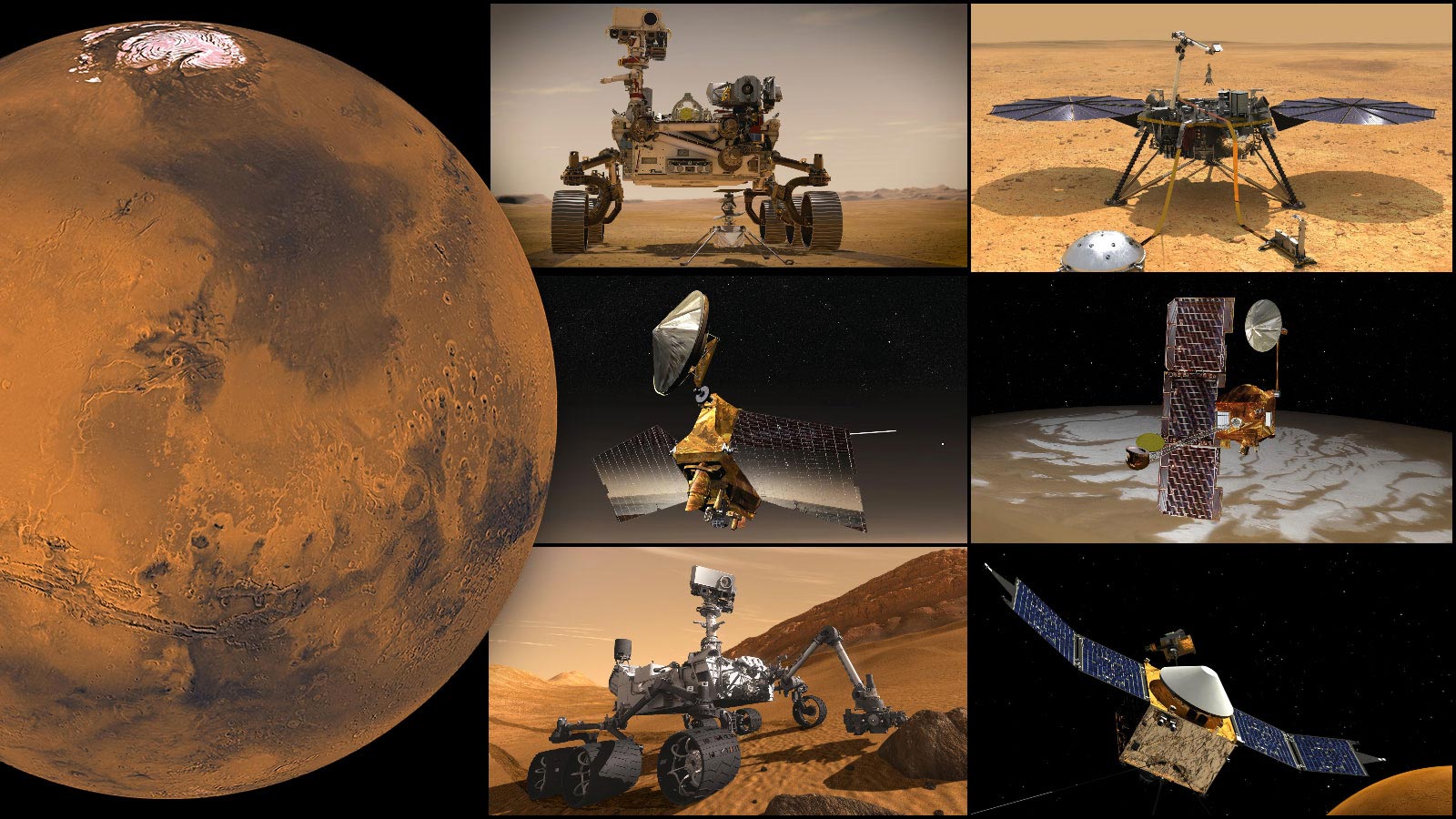
    NASA’s Mars missions, clockwise from top left: Perseverance rover and Ingenuity Mars Helicopter, InSight lander, Odyssey orbiter, MAVEN orbiter, Curiosity rover, and Mars Reconnaissance Orbiter. Credit: NASA/JPL-Caltech

    The missions will continue collecting data about the Red Planet, though engineers back on Earth will stop sending commands to them until mid-October.

    NASA will stand down from commanding its Mars missions for the next few weeks while Earth and the Red Planet are on opposite sides of the Sun. This period, called Mars solar conjunction, happens every two years.

    The Sun expels hot, ionized gas from its corona, which extends far into space. During solar conjunction, when Earth and Mars can’t “see” each other, this gas can interfere with radio signals if engineers try to communicate with spacecraft at Mars. That could corrupt commands and result in unexpected behavior from our deep space explorers.

    To be safe, NASA engineers send Mars spacecraft a list of simple commands to carry out for a few weeks. This year, most missions will stop sending commands between October 2 and October 16. A few extend that commanding moratorium, as it’s called, a day or two in either direction, depending on the angular distance between Mars and the Sun in Earth’s sky.

    “Though our Mars missions won’t be as active these next few weeks, they’ll still let us know their state of health,” said Roy Gladden, manager of the Mars Relay Network at NASA’s Jet Propulsion Laboratory in Southern California. “Each mission has been given some homework to do until they hear from us again.”

    Mission-Specific Activities During Conjunction

    Here’s how some of those Mars missions will be spending that time:

    • Perseverance will take weather measurements with its MEDA (short for Mars Environmental Dynamics Analyzer) sensors, look for dust devils with its cameras (though it won’t move its mast, or “head”), run its RIMFAX (Radar Imager for Mars’ Subsurface Experiment) radar, and capture new sounds with its microphones.
    • The Ingenuity Mars Helicopter will remain stationary at its location 575 feet (175 meters) away from Perseverance and communicate its status weekly to the rover.
    • The Curiosity rover will take weather measurements using its REMS (Rover Environmental Monitoring Station) sensors, take radiation measurements with its RAD (Radiation Assessment Detector) and DAN (Dynamic Albedo of Neutrons) sensors, and look for dust devils with its suite of cameras.
    • The stationary InSight lander will continue using its seismometer to detect temblors like the large marsquakes it captured recently.
    • NASA’s three orbiters – Odyssey, Mars Reconnaissance Orbiter, and MAVEN – will all continue relaying some data from the agency’s surface missions back to Earth, in addition to gathering their own science.

    While a limited amount of science data will reach Earth during conjunction, the spacecraft will save most of it until after the moratorium. (That means there will be a temporary pause in the stream of raw images available from Perseverance, Curiosity, and InSight.)

    Then, they’ll beam their remaining data to NASA’s Deep Space Network, a system of massive Earth-based radio antennas managed by JPL. Engineers will spend about a week downloading the information before normal spacecraft operations resume. If the teams monitoring these missions determine any of the collected science data has been corrupted, they can usually have that data retransmitted.

    Never miss a breakthrough: Join the SciTechDaily newsletter.
    Follow us on Google and Google News.

    Curiosity Rover Ingenuity Mars Helicopter JPL Mars Mars 2020 Perseverance Rover NASA NASA InSight Lander Popular
    Share. Facebook Twitter Pinterest LinkedIn Email Reddit

    Related Articles

    NASA’s Ingenuity Mars Helicopter Concludes Mission After 3 Epic Years

    Sun’s Curtain Call: Mars Missions Go Rogue During Solar Conjunction

    NASA’s Ingenuity Mars Helicopter Flies Again After Premature Landing

    Communications Blackout Over: NASA’s Ingenuity Mars Helicopter Finally Phones Home

    Lost in Space? Why – and How – NASA Gives a Name to Every Spot It Studies on Mars

    Ingenuity Soars: NASA’s Mars Helicopter Aces 50th Flight – “We Are Not in Martian Kansas Anymore”

    NASA’s Ingenuity Mars Helicopter in Contact With Perseverance Rover After Communications Dropout

    NASA’s Ingenuity Mars Helicopter Scouts Ridgeline for Perseverance Science Team

    NASA Ingenuity Helicopter Spots Spacecraft Wreckage on Mars – Perseverance’s Cone-Shaped Backshell

    Leave A Reply Cancel Reply

    • Facebook
    • Twitter
    • Pinterest
    • YouTube

    Don't Miss a Discovery

    Subscribe for the Latest in Science & Tech!

    Trending News

    Bone-Strengthening Discovery Could Reverse Osteoporosis

    Scientists Uncover Hidden Trigger Behind Stem Cell Aging

    Scientists Find Way to Reverse Fatty Liver Disease Without Changing Diet

    Could Humans Regrow Limbs? New Study Reveals Promising Genetic Pathway

    Scientists Reveal Eating Fruits and Vegetables May Increase Your Risk of Lung Cancer

    Scientists Reverse Brain Aging With Simple Nasal Spray

    Scientists Uncover Potential Brain Risks of Popular Fish Oil Supplements

    Scientists Discover a Surprising Way To Make Bread Healthier and More Nutritious

    Follow SciTechDaily
    • Facebook
    • Twitter
    • YouTube
    • Pinterest
    • Newsletter
    • RSS
    SciTech News
    • Biology News
    • Chemistry News
    • Earth News
    • Health News
    • Physics News
    • Science News
    • Space News
    • Technology News
    Recent Posts
    • Why Are Giant Ants Letting Tiny Ants Crawl All Over Them?
    • Revolutionary Technique Sends Healthy Mitochondria Exactly Where They’re Needed
    • This Student Recreated the Universe in a Bottle. What She Discovered Could Help Reveal How Life Started on Earth
    • Alzheimer’s Symptoms May Start Outside the Brain, Study Finds
    • Cancer’s Secret Weapon? Scientists Reveal How Tumors “Learn” To Survive Treatment
    Copyright © 1998 - 2026 SciTechDaily. All Rights Reserved.
    • Science News
    • About
    • Contact
    • Editorial Board
    • Privacy Policy
    • Terms of Use

    Type above and press Enter to search. Press Esc to cancel.