
Close Menu
    Facebook X (Twitter) Instagram
    SciTechDaily
    • Biology
    • Chemistry
    • Earth
    • Health
    • Physics
    • Science
    • Space
    • Technology
    Facebook X (Twitter) Pinterest YouTube RSS
    SciTechDaily
    Home»Space»Mars Solar Conjunction: What Happens When the Sun Blocks our Signal?
    Space

    Mars Solar Conjunction: What Happens When the Sun Blocks our Signal?

    By NASASeptember 30, 2021No Comments2 Mins Read
    Facebook Twitter Pinterest Telegram LinkedIn WhatsApp Email Reddit
    Share
    Facebook Twitter LinkedIn Pinterest Telegram Email Reddit
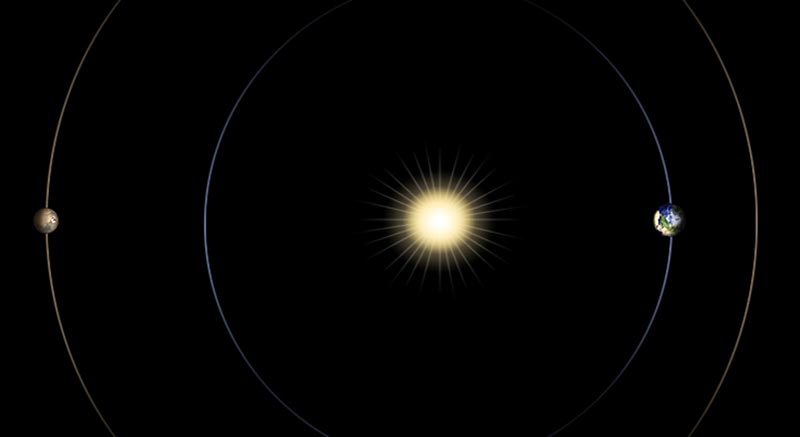
    Mars Solar Conjunction
    Mars solar conjunction. Credit: NASA

    Solar conjunction halts Mars-Earth contact; NASA spacecraft run safely on preprogrammed autopilot.

    Every day for over two decades, the U.S. has had a presence at Mars, using spacecraft to understand this extreme world and its potential as a past or present habitat for life.

    During that time, all spacecraft have become virtually incommunicado for about two weeks every two years. The reason is solar conjunction.

    Solar conjunction is the period when Earth and Mars, in their eternal march around the Sun, are obscured from each other by the fiery orb of the Sun itself. Like dancers on either side of a huge bonfire, the two planets are temporarily invisible to each other.

    The solar conjunction moratorium on commanding all Mars spacecraft is between October 2 and October 14, 2021, when Mars is within 2 degrees of the Sun.

    Mission controllers at NASA’s Jet Propulsion Laboratory respond in a variety of ways. They turn off some instruments. They collect data from others and store it. In some cases, they continue sending data to Earth, knowing that some data will be lost. Whether they get a break from everyday operations depends on what mission they’re supporting.

    No one attempts to send new instructions to Mars during solar conjunction. It’s impossible to predict what information might be lost due to interference from charged particles from the Sun, and that lost information could potentially endanger the spacecraft. Instead, prior to solar conjunction, engineers send two weeks’ worth of instructions and wait.

    While that may seem risky, automatic pilot has come a long way. Engineers have become skilled at letting spacecraft be on their own. Like parents who raise youngsters to be responsible and let them go on a short vacation with their friends, they’ve done all they can to ensure the voyagers will be healthy and safe. Before solar conjunction, the mission team sends up any necessary commands. Many then consider it an opportune time to take a few, well-deserved vacation days.

    Never miss a breakthrough: Join the SciTechDaily newsletter.
    Follow us on Google and Google News.

    Astronomy JPL Mars NASA
    Share. Facebook Twitter Pinterest LinkedIn Email Reddit

    Related Articles

    NASA Flips a Mars Orbiter Upside Down – And Discovers a Hidden World

    NASA’s Curiosity Readies for First Drive on Mars

    New NASA InSight Mission Set to Explore the Depths of Mars

    Curiosity’s ChemCam Laser Analyzes Its First Martian Rock

    Color HiRISE Image of Curiosity Rover on Mars

    First 360-Degree Color Panorama From NASA’s Curiosity Mars Rover

    Curiosity’s First Color Image of Mars

    Image of NASA’s Curiosity and its Parachute Heading Towards the Surface of Mars

    Mission Engineers Prepare for Curiosity’s Landing on Mars

    Leave A Reply Cancel Reply

    • Facebook
    • Twitter
    • Pinterest
    • YouTube

    Don't Miss a Discovery

    Subscribe for the Latest in Science & Tech!

    Trending News

    These Toads Are Surviving a Deadly Fungus – Scientists May Finally Know Why

    These Brain Cells May Explain Why We Eventually Have To Sleep

    Tomatoes Contain an Invisible Ingredient With Surprising Effects on Liver Health

    World’s First Heat-Powered Cooling System Turns Waste Heat Into Cold

    Antarctica Gained a Record 695 Billion Tons of Ice in Just Two Years

    Don’t Miss: A Brilliant Venus and Glowing Harvest Moon Light Up the Sky

    New Twist on the Einstein Problem Reveals Unexpected Physics

    JWST Captures Stunning Evidence of How Supermassive Black Holes Feed

    Follow SciTechDaily
    • Facebook
    • Twitter
    • YouTube
    • Pinterest
    • Newsletter
    • RSS
    SciTech News
    • Biology News
    • Chemistry News
    • Earth News
    • Health News
    • Physics News
    • Science News
    • Space News
    • Technology News
    Recent Posts
    • Largest-Ever Physics Survey Raises New Doubts About Our Model of the Universe
    • Scientists Discover the 7 Stages a Meteoroid Goes Through Before Hitting Earth
    • Scientists Bring a Galápagos Plant Back From the Brink of Extinction
    • Scientists Discover a Bacterial Molecule That “Disarms” a Dangerous Fungus
    • Bats May Hold the Secret to Fighting Aging, Cancer, and Infection
    Copyright © 1998 - 2026 SciTechDaily. All Rights Reserved.
    • Science News
    • About
    • Contact
    • Editorial Board
    • Privacy Policy
    • Terms of Use

    Type above and press Enter to search. Press Esc to cancel.