
Close Menu
    Facebook X (Twitter) Instagram
    SciTechDaily
    • Biology
    • Chemistry
    • Earth
    • Health
    • Physics
    • Science
    • Space
    • Technology
    Facebook X (Twitter) Pinterest YouTube RSS
    SciTechDaily
    Home»Earth»How Solar Wind Breaks Through Earth’s Magnetic Field
    Earth

    How Solar Wind Breaks Through Earth’s Magnetic Field

    By Swedish Institute of Space Physics (IRF)June 10, 2014No Comments3 Mins Read
    Facebook Twitter Pinterest Telegram LinkedIn WhatsApp Email Reddit
    Share
    Facebook Twitter LinkedIn Pinterest Telegram Email Reddit
    How Solar Wind Breaks Through Earths Magnetic Field
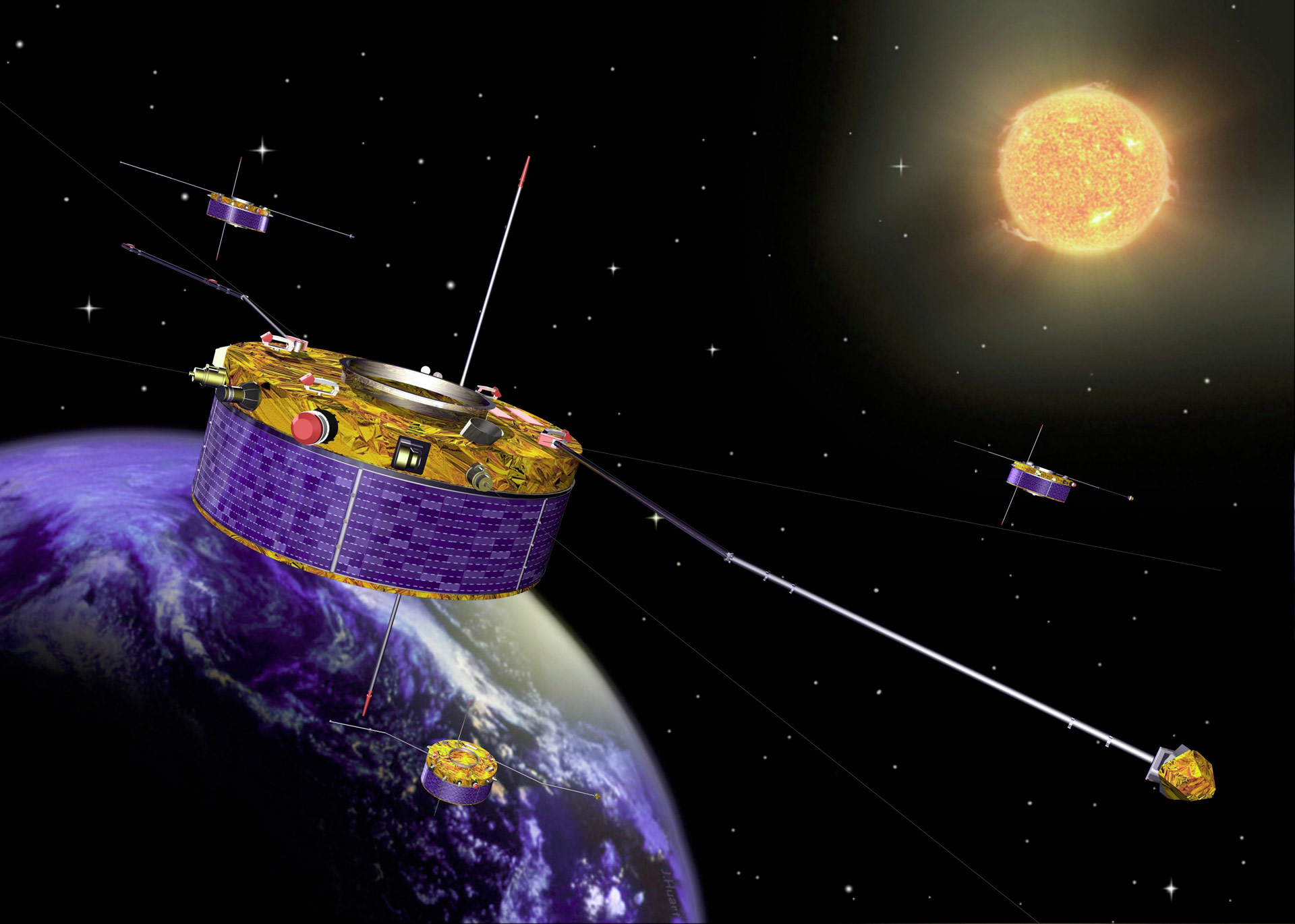
    The four Cluster satellites orbit in Earth’s magnetic field. Credit: ESA

    A new study uses data from the four European Space Agency satellites in the Cluster mission to reveal how solar wind breaks through the Earth’s magnetic field.

    Space is not empty. A wind of charged particles blows outwards from the Sun, carrying a magnetic field with it. Sometimes this solar wind can break through the Earth’s magnetic field. Researchers at the Swedish Institute of Space Physics (IRF) in Uppsala now have an answer to one of the questions about how this actually occurs.

    When two areas with plasma (electrically charged gas) and magnetic fields with different orientations collide, the magnetic fields can be “clipped off” and “reconnected” so that the topology of the magnetic field is changed. This magnetic reconnection can give energy to eruptions on the solar surface, it can change the energy from the solar wind so that it then creates aurora, and it is one of the obstacles to storing energy through processes in fusion reactors.

    If two colliding regions of plasma have the same density, temperature, and strength (but different orientation) of their magnetic fields, symmetrical reconnection begins. Scientists understand much about this process. But more usual in reality is that two regions of plasma have different characteristics, for example when the solar wind meets the environment around the Earth. Daniel Graham at IRF has recently published a detailed study of this asymmetrical magnetic reconnection in Physical Review Letters 112, 215004 (2014).

    The study uses data from the four European Space Agency satellites in the Cluster mission, satellites which fly in formation in the Earth’s magnetic field.

    “Especially important were measurements with two satellites only a few tens of kilometers from each other, in the region where the solar wind meets the Earth’s magnetic field,” says Daniel Graham. “We can thus do detailed measurements to understand plasma physics at a height of 60,000 km.”

    Heating of electrons parallel to the magnetic field in conjunction with magnetic reconnection is of special interest.

    “We believe that this is an important piece of the puzzle for understanding how magnetic reconnection works, how charged particles are accelerated, and how particles from different regions can be mixed with each other,” says Daniel Graham. “Our detailed measurements in the Earth’s magnetic field can be used to understand the physics even in fusion reactors on Earth, and in far distant regions in space that we can’t reach with satellites.”

    Reference: “Electron Dynamics in the Diffusion Region of an Asymmetric Magnetic Reconnection” by D.B. Graham, Yu.V. Khotyaintsev, A. Vaivads, M. André and A.N. Fazakerley, 28 May 2014, Physical Review Letters.
    DOI: 10.1103/PhysRevLett.112.215004


    Never miss a breakthrough: Join the SciTechDaily newsletter.
    Follow us on Google and Google News.

    Astrophysics Magnetic Fields Planetary Science Swedish Institute of Space Physics
    Share. Facebook Twitter Pinterest LinkedIn Email Reddit

    Related Articles

    Hidden Oceans of Magma Could Be Protecting Alien Life

    Scientists Discover the Hidden Ingredient That Helped Form Earth’s Inner Core

    Scientists Develop New Way to Measure Earth’s Magnetic Field

    Magnetospheric Multiscale Mission Explores the Microphysics of Magnetic Reconnection

    Researchers Observed 13 Equally Spaced, Zebra-Like Stripes of Plasma in Space

    A Magnetic Field Flip Could Occur Over a Short Period of Time

    Vaporization Simulation of Earth Helps Explain the Atmospheres of Super-Earths

    NASA’s Magnetospheric Multiscale Mission to Study Portals in Earth’s Magnetic Field

    Lasers Mimic Supernova to Explain Cosmic Magnetic Fields

    Leave A Reply Cancel Reply

    • Facebook
    • Twitter
    • Pinterest
    • YouTube

    Don't Miss a Discovery

    Subscribe for the Latest in Science & Tech!

    Trending News

    Beyond Pain Relief: Scientists Discover a Protein That Could Stop Osteoarthritis in Its Tracks

    Scientists Discover Why Alcohol Prevents the Liver From Healing, Even After You Quit

    Scientists Stunned As Volcano Removes Methane From the Air

    Scientists Discover Signs Africa May Be Splitting Apart Beneath Zambia

    Common Blood Pressure Drug Supercharges Cancer Treatment in Surprising New Study

    540-Million-Year-Old Fossils Reveal a Huge Surprise About Early Life on Earth

    Scientists Reverse Stroke Damage Using Stem Cells in Breakthrough Study

    Eating One Egg a Day Could Cut Alzheimer’s Risk by 27%

    Follow SciTechDaily
    • Facebook
    • Twitter
    • YouTube
    • Pinterest
    • Newsletter
    • RSS
    SciTech News
    • Biology News
    • Chemistry News
    • Earth News
    • Health News
    • Physics News
    • Science News
    • Space News
    • Technology News
    Recent Posts
    • Giant “Last Titan” Dinosaur Discovered in Thailand Was Bigger Than 9 Elephants
    • This “Longevity Gene” May Protect the Brain From Aging and Dementia
    • Scientists Discover Surprising Effect of Ultra-Processed Foods Inside Thigh Muscles
    • Common Cleaning Chemical Could Triple Your Risk of a Dangerous Liver Disease
    • New Brain “Bypass” Technology Could Transform Treatment for Neurological Disorders
    Copyright © 1998 - 2026 SciTechDaily. All Rights Reserved.
    • Science News
    • About
    • Contact
    • Editorial Board
    • Privacy Policy
    • Terms of Use

    Type above and press Enter to search. Press Esc to cancel.