
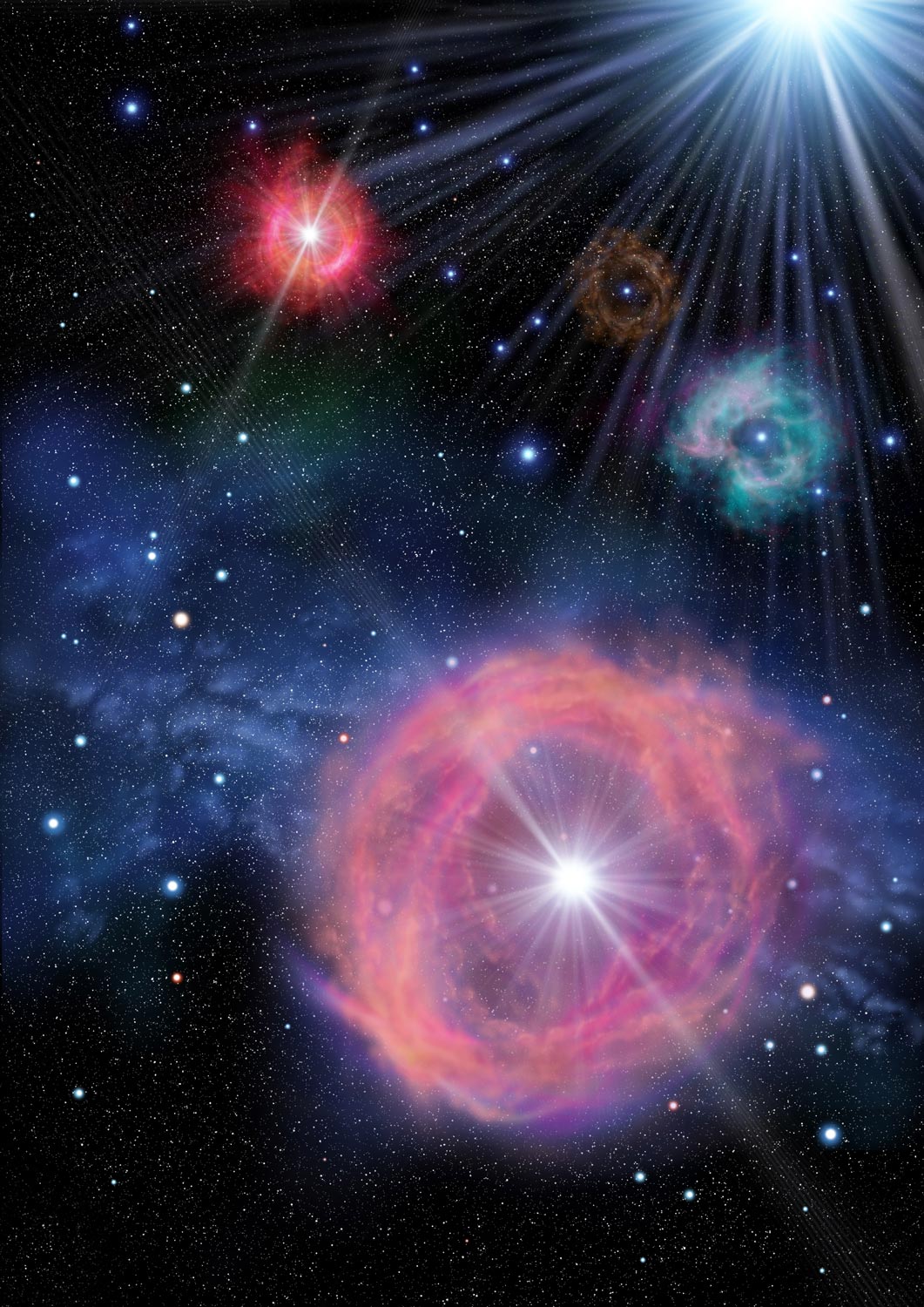
Scientists from the Chinese Academy of Sciences and international collaborators have discovered a star, LAMOST J1010+2358, that provides the first tangible evidence of Pair-Instability Supernovae (PISNe) from the Universe’s earliest stars. This finding, published in Nature, sheds light on the evolution of massive stars and the early Universe’s initial mass function.
The first stars illuminated the Universe during the Cosmic Dawn and put an end to the cosmic “dark ages” that followed the Big Bang. However, the distribution of their mass is one of the great unsolved mysteries of the cosmos.
Numerical simulations of the formation of the first stars estimate that the mass of the first stars reached up to several hundred solar masses. Among them, the first stars with masses between 140 and 260 solar masses ended up as pair-instability supernovae (PISNe). PISNe are quite different from ordinary supernovae (i.e., Type II and Type Ia supernovae) and would have imprinted a unique chemical signature in the atmosphere of the next-generation stars. However, no such signature has been found.
A new study led by Prof. Gang Zhao from the National Astronomical Observatories of the Chinese Academy of Sciences (NAOC) has identified a chemically peculiar star (LAMOST J1010+2358) in the Galactic halo as clear evidence of the existence of PISNe from very massive first stars in the early Universe, based on the Large Sky Area Multi-Object Fiber Spectroscopic Telescope (LAMOST) survey and follow-up high-resolution spectra observation by Subaru Telescope. It has been confirmed that this star was formed in the gas cloud dominated by the yields of a PISN with 260 solar masses.
The team also includes researchers from Yunnan Observatories of CAS, National Astronomical Observatory of Japan, and Monash University, Australia.
This study will be published online in Nature today (June 7, 2023).
Evidence of Pair-Instability Supernovae
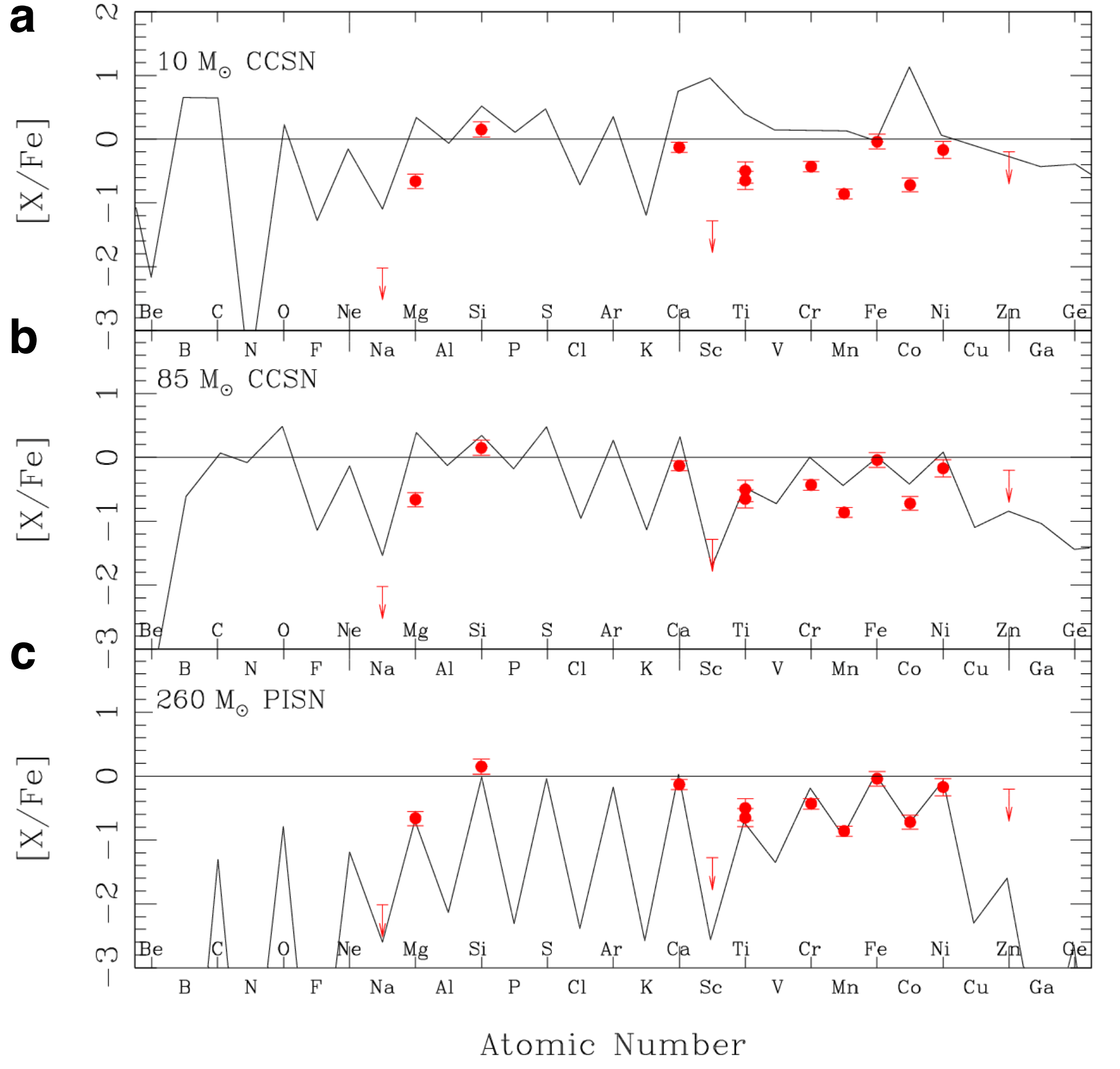
The research team has performed follow-up high-resolution spectroscopic observation for J1010+2358 with the Subaru telescope and derived abundances for more than ten elements. The most significant feature of this star is its extremely low sodium and cobalt abundances. Its sodium-to-iron ratio is lower than 1/100 of the solar value. This star also exhibits a very large abundance variance between the odd and even charge number elements, such as sodium/magnesium and cobalt/nickel.
“The peculiar odd-even variance, along with deficiencies of sodium and α-elements in this star, are consistent with the prediction of primordial PISN from first-generation stars with 260 solar masses,” said Dr. Qianfan Xing, first author of the study.
The discovery of J1010+2358 is direct evidence of the hydrodynamical instability due to electron–positron pair production in the theory of very massive star evolution. The creation of electron–positron pairs reduces thermal pressure inside the core of a very massive star and leads to a partial collapse.
A Breakthrough in Understanding the Early Universe
“It provides an essential clue to constraining the initial mass function in the early universe,” said Prof. Gang Zhao, corresponding author of the study. “Before this study, no evidence of supernovae from such massive stars has been found in the metal-poor stars.”
Moreover, the iron abundance of LAMOST J1010+2358 ([Fe/H] = -2.42) is much higher than the most metal-poor stars in the Galactic halo, suggesting that the second-generation stars formed in the PISN-dominated gas may be more metal-rich than expected.
“One of the holy grails of searching for metal-poor stars is to find evidence for these early pair-instability supernovae,” said Prof. Avi Loeb, former chair of the Astronomy Department at Harvard University.
Prof. Timothy Beers, the provost’s chair of astrophysics at Notre Dame University, commented on the results: “This paper presents what is, to my knowledge, the first definitive association of a Galactic halo star with an abundance pattern originating from a PISN.”
Reference: “A metal-poor star with abundances from a pair instability supernova” by Qian-Fan Xing, Gang Zhao, Zheng-Wei Liu, Alexander Heger, Zhan-Wen Han, Wako Aoki, Yu-Qin Chen, Miho N. Ishigaki, Hai-Ning Li and Jing-Kun Zhao, 7 June 2023, Nature.
DOI: 10.1038/s41586-023-06028-1
Never miss a breakthrough: Join the SciTechDaily newsletter.
Follow us on Google and Google News.