
Close Menu
    Facebook X (Twitter) Instagram
    SciTechDaily
    • Biology
    • Chemistry
    • Earth
    • Health
    • Physics
    • Science
    • Space
    • Technology
    Facebook X (Twitter) Pinterest YouTube RSS
    SciTechDaily
    Home»Space»Study of Supergiant Star Betelgeuse Unveils the Cause of Its Pulsations – Not at All Close to Exploding
    Space

    Study of Supergiant Star Betelgeuse Unveils the Cause of Its Pulsations – Not at All Close to Exploding

    By Kavli Institute for the Physics and Mathematics of the UniverseFebruary 8, 2021No Comments4 Mins Read
    Facebook Twitter Pinterest Telegram LinkedIn WhatsApp Email Reddit
    Share
    Facebook Twitter LinkedIn Pinterest Telegram Email Reddit
    Betelgeuse Southern Region Evolving
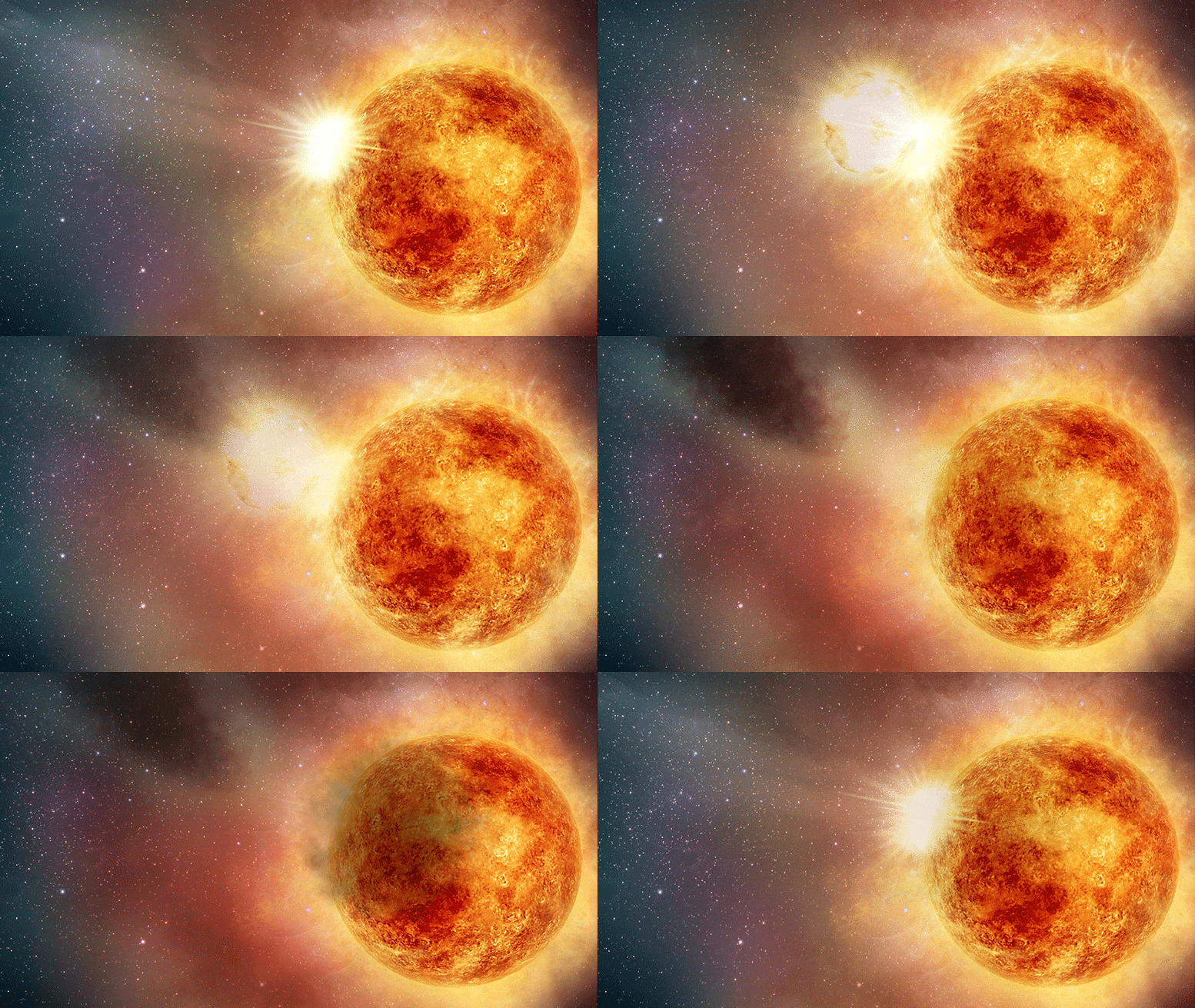
    This graphic illustrates how the southern region of the rapidly evolving, bright, red supergiant star Betelgeuse may have suddenly become fainter for several months during late 2019 and early 2020. Illustration credit: NASA, ESA, and E. Wheatley (STScI)

    Recalibrated Betelgeuse’s Mass, Radius, and Distance

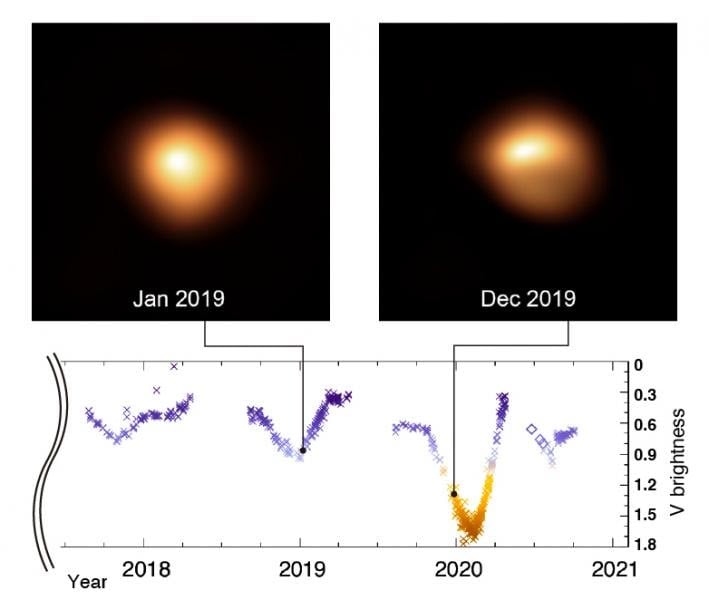
    Betelgeuse is normally one of the brightest, most recognizable stars of the winter sky, marking the left shoulder of the constellation Orion. But lately, it has been behaving strangely: an unprecedentedly large drop in its brightness has been observed in early 2020 (Figure 1), which has prompted speculation that Betelgeuse may be about to explode. 

    To find out more, an international team of scientists, including Ken’ichi Nomoto at the Kavli Institute for the Physics and Mathematics of the Universe (Kavli IPMU), conducted a rigorous examination of Betelgeuse. They concluded that the star is in the early core helium-burning phase (which is more than 100,000 years before an explosion happens) and has a smaller mass and radius—and is closer to Earth—than previously thought. They also showed that smaller brightness variations of Betelgeuse have been driven by stellar pulsations, and suggested that the recent large dimming event involved a dust cloud. 
    Recent Brightness Variations of Betelgeuse
    Figure 1: Recent brightness variations of Betelgeuse. Stellar pulsation causes the star’s brightness to vary, but the large dip in brightness in early 2020 is unprecedented. A comparison of direct images of the surface of Betelgeuse between January 2019 and December 2019 show that large portions of the star faded in December 2019, which could indicate a dust cloud appearing in front of it. The images were taken by the European Southern Observatory’s (ESO’s) Very Large Telescope. For brightness data, see the caption of Fig 2. Credit: ESO/M. Montargès et al.

    The research team is led by Dr. Meridith Joyce from the Australian National University (ANU), who was an invited speaker at Kavli IPMU in January 2020, and includes Dr. Shing-Chi Leung, a former Kavli IPMU project researcher and a current postdoctoral scholar at the California Institute of Technology, and Dr. Chiaki Kobayashi, an associate professor at the University of Hertfordshire, who has been an affiliate member of Kavli IPMU. 

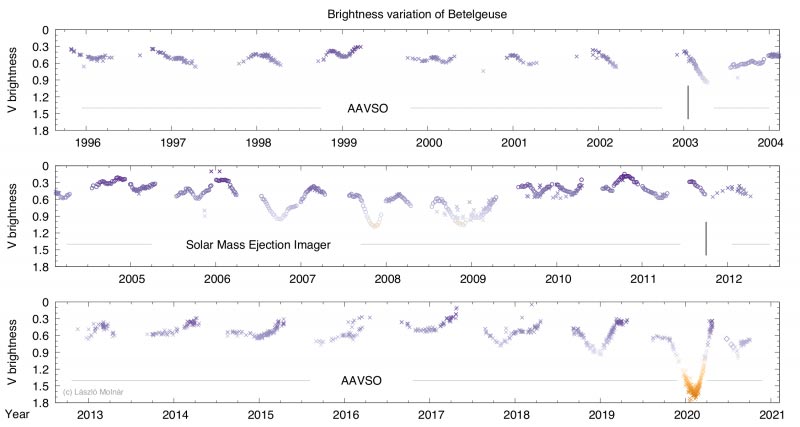
    The team analyzed the brightness variation of Betelgeuse (Figure 2) by using evolutionary, hydrodynamic, and seismic modeling. They achieved a clearer idea than before that Betelgeuse is currently burning helium in its core. They also showed that stellar pulsations driven by the so-called kappa-mechanism is causing the star to continuously brighten or fade with two periods of 185 (±13.5) days and approximately 400 days. But the large dip in brightness in early 2020 is unprecedented, likely due to a dust cloud in front of Betelgeuse, as seen in the image (Figure 1).
    Brightness Variations of Betelgeuse
    Figure 2: Variation in brightness of Betelgeuse over the previous 15 years. Gaps in the data are periods when Betelgeuse is not visible in the night sky each year. The brightness data was collected by the observers of the American Association of Variable Star Observers (AAVSO) and the Solar Mass-Ejection Imager instrument in space. Data from the latter was processed by László Molnár from the Konkoly Observatory of CSFK in Budapest, Hungary. Credit: L. Molnár, AAVSO, UCSD/SMEI, NASA/STEREO/HI

    Their analysis reported a present-day mass of 16.5 to 19 solar mass—which is slightly lower than the most recent estimates. The study also revealed how big Betelgeuse is, as well as its distance from Earth. The star’s actual size has been a bit of a mystery: earlier studies, for instance, suggested it could be bigger than the orbit of Jupiter. However, the team’s results showed Betelgeuse only extends out to two-thirds of that, with a radius 750 times the radius of the sun. Once the physical size of the star is known, it will be possible to determine its distance from Earth. Thus far, the team’s results show it is a mere 530 light-years from us, or 25 percent closer than previously thought. 

    Their results imply that Betelgeuse is not at all close to exploding, and that it is too far from Earth for the eventual explosion to have a significant impact here, even though it is still a really big deal when a supernova goes off. And as Betelgeuse is the closest candidate for such an explosion, it gives us a rare opportunity to study what happens to stars like this before they explode.

    Reference: “Standing on the Shoulders of Giants: New Mass and Distance Estimates for Betelgeuse through Combined Evolutionary, Asteroseismic, and Hydrodynamic Simulations with MESA” by Meridith Joyce, Shing-Chi Leung, László Molnár, Michael Ireland, Chiaki Kobayashi and Ken’ichi Nomoto, 13 October 2020, The Astrophysical Journal.
    DOI: 10.3847/1538-4357/abb8db
    arXiv: 2006.09837

    Never miss a breakthrough: Join the SciTechDaily newsletter.
    Follow us on Google and Google News.

    Astronomy Astrophysics Betelgeuse Kavli Institute Popular Stars
    Share. Facebook Twitter Pinterest LinkedIn Email Reddit

    Related Articles

    Betelgeuse’s Brightness Mystery Explained: Meet the Hidden “Betelbuddy” Star

    Watching the Violent Death of a Rare, Extreme Supergiant Star

    Hubble Solves Mystery of Monster Star’s Dimming – Red Hypergiant Is As Bright as 300,000 Suns

    NASA STEREO Spacecraft’s Lone View of Betelgeuse Reveals More Strange Behavior – Is Supernova Imminent?

    Is Betelgeuse About to Explode? Dimming Red Supergiant Isn’t That Cool

    New Planck Data Challenges Our Understanding of the Universe

    New e-MERLIN Image of Betelgeuse Reveals Mysterious Hot Spots

    WISE Discovers Mystery Dust Around an Unusual Class of Interacting Binary Stars

    NASA Data Reveals Significant Changes in Exoplanet’s Atmosphere

    Leave A Reply Cancel Reply

    • Facebook
    • Twitter
    • Pinterest
    • YouTube

    Don't Miss a Discovery

    Subscribe for the Latest in Science & Tech!

    Trending News

    First-of-Its-Kind Discovery: Homer’s Iliad Found Embedded in a 1,600-Year-Old Egyptian Mummy

    Beyond Inflammation: Scientists Uncover New Cause of Persistent Rheumatoid Arthritis

    A Simple Molecule Could Unlock Safer, Easier Weight Loss

    Scientists Just Built a Quantum Battery That Charges Almost Instantly

    Researchers Unveil Groundbreaking Sustainable Solution to Vitamin B12 Deficiency

    Millions of People Have Osteopenia Without Realizing It – Here’s What You Need To Know

    Researchers Discover Boosting a Single Protein Helps the Brain Fight Alzheimer’s

    World-First Study Reveals Human Hearts Can Regenerate After a Heart Attack

    Follow SciTechDaily
    • Facebook
    • Twitter
    • YouTube
    • Pinterest
    • Newsletter
    • RSS
    SciTech News
    • Biology News
    • Chemistry News
    • Earth News
    • Health News
    • Physics News
    • Science News
    • Space News
    • Technology News
    Recent Posts
    • Middle Age Is Becoming a Breaking Point in America, Study Reveals
    • Scientists Discover How Coffee Impacts Memory, Mood, and Gut Health
    • How Cells Copy DNA Might Matter More Than We Ever Realized
    • Scientists Just Solved the Mystery of the Twelve Apostles
    • Stone Age Mystery: DNA Reveals Ancient Population Wipeout in France
    Copyright © 1998 - 2026 SciTechDaily. All Rights Reserved.
    • Science News
    • About
    • Contact
    • Editorial Board
    • Privacy Policy
    • Terms of Use

    Type above and press Enter to search. Press Esc to cancel.