
Sunrise observatory provides the first high-resolution images of the chromosphere in ultraviolet light.
Three months after the flight of the balloon-borne solar observatory Sunrise, scientists from the Max Planck Institute for Solar System Research (MPS) in Germany now present unique insights into the central layer of the Sun’s atmosphere, the chromosphere. The Sunrise-data provide the first high-resolution images of this region, lying between the Sun’s visible surface and the corona, in ultraviolet light. More prominently than in earlier images, structures with a size of a few hundred kilometers such as bright points or strongly elongated fibrils occurring in close proximity to sunspots become visible in these wavelengths.
The chromosphere still continues to puzzle scientists. How is it possible that with increasing distance from the Sun’s hot core the temperature in this layer increases on average by 6000 Kelvin? “At first sight, this temperature distribution contradicts basic physical concepts”, says Sami K. Solanki, head of the Sunrise mission and director at the MPS. The situation can be compared to a heated room in which it gets warmer with increasing distance to the heater. “Apparently, the chromosphere witnesses huge energy transformations”, he adds. “Processes not yet understood in detail must provide enough energy to heat up the plasma.” Data from Sunrise’s first mission in 2009 had revealed acoustic waves to supply a considerable fraction of this energy. In addition, research carried out in recent years has characterized the chromosphere as a very dynamical place where hot and colder regions may lie in close proximity and are constantly in motion.
“In order to solve this riddle it is necessary to take as close a look as possible at the chromosphere – in all accessible wavelengths”, Solanki explains. Together with colleagues from the Kiepenheuer-Institut für Sonnenphysik (Freiburg, Germany), the High Altitude Observatory (Boulder, USA), and the Instituto de Astrofísica de Andalucía (Granada, Spain) the MPS researchers were now able to fit another piece into the puzzle: the first high-resolution observations of the chromosphere in ultraviolet light.
The images were made possible by Sunrise, a balloon-borne solar observatory studying the Sun from the stratosphere. Once it reaches its float altitude of more than 37 kilometers, Sunrise has risen above the greatest part of the Earth’s atmosphere. These layers absorb the Sun’s ultraviolet radiation, making it inaccessible to ground-based solar observations. At the beginning of June of this year, Sunrise was launched from Kiruna in the north of Sweden and embarked on its second journey. After five days the observatory landed on the remote Boothia Peninsula in northern Canada.
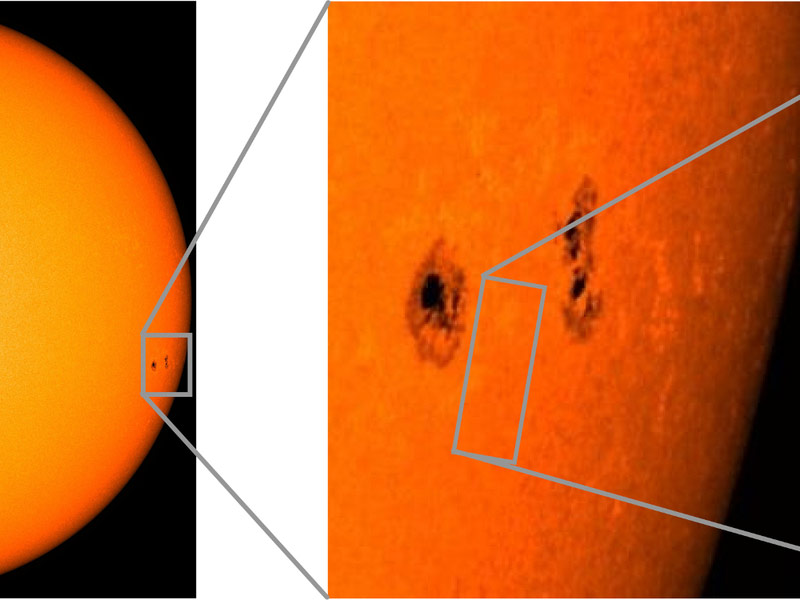
“Of course, in the past space probes have analyzed the Sun’s ultraviolet light from space”, says Solanki. However, they provide a lower spatial resolution. And Sunrise offers another decisive advantage: the Sunrise Filter Imager, one of the onboard scientific instruments, is able to filter certain ultraviolet parts out of the solar spectrum – for example the radiation with a wavelength of 279.6 nanometers. “Only the magnesium atoms in the chromosphere emit this radiation”, says Tino Riethmüller from the MPS, the new study’s leading author. “Even though magnesium constitutes only 0.0024 percent of the Sun’s mass, it gives us direct access to this region”, he adds.
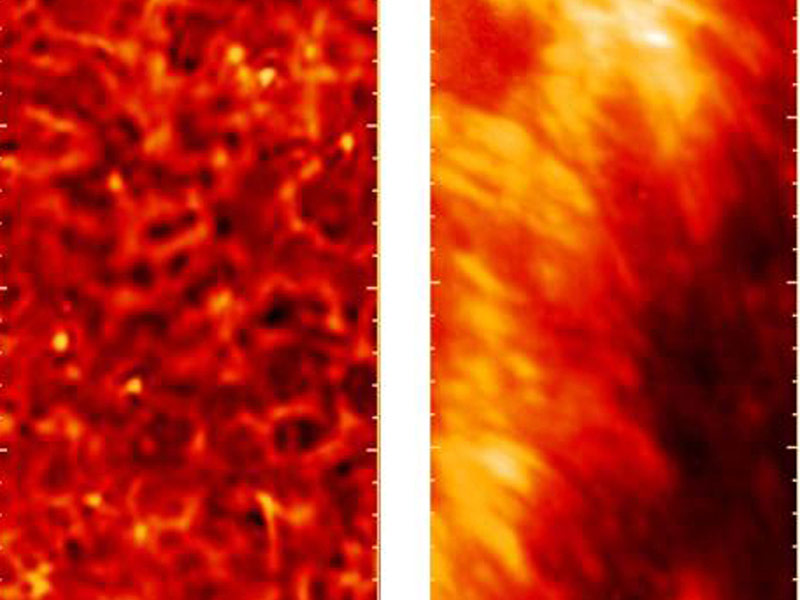
The new data paint a complex picture of the chromosphere: where the Sun is quiet and inactive, dark regions with a diameter of around a thousand kilometers can be discerned surrounded by bright rims. This pattern is created by the enormous plasma flows rising up within the Sun, cooling off, and sinking down again. Especially eye-catching are bright points that flash up occasionally. In the ultraviolet images they are much richer in contrast than before. Scientists believe these bright points to be signs of single magnetic flux tubes in the photosphere, the building blocks of the solar magnetic field. The Sun’s magnetic field is of particular interest to scientists since it is responsible for all of the star’s activity.
Apart from these quiet regions the researchers also focused on areas in close proximity to sunspots. These huge structures cover the Sun’s surface especially abundantly in times of high solar activity. “In our images we find bright, strongly elongated structures called fibrils”, says Riethmüller.
“These first analyses are extremely promising”, Solanki comments on the new results. “They show that the ultraviolet radiation from the chromosphere is highly suitable for visualizing detailed structures and processes.” The researchers now hope that the next months will provide more new insights – and are looking forward to a close collaboration with colleagues from NASA’s IRIS mission. The space telescope was launched on 28 June, only weeks after the end of the Sunrise mission, and also studies the ultraviolet radiation from chromosphere and corona.
Reference: “First high-resolution images of the Sun in the 2796 Å Mg II k line” by T. L. Riethmüller, S. K. Solanki, J. Hirzberger, S. Danilovic, P. Barthol, T. Berkefeld, A. Gandorfer, L. Gizon, M. Knölker, W. Schmidt and J. C. Del Toro Iniesta, 26 September 2013, The Astrophysical Journal Letters.
DOI: 10.1088/2041-8205/776/1/L13
arXiv:1309.5213
Never miss a breakthrough: Join the SciTechDaily newsletter.
Follow us on Google and Google News.