

The Inouye Solar Telescope just activated its most powerful instrument, VTF—a massive precision tool designed to unveil the secrets of solar storms. Its first light image of a detailed sunspot signals a bold new era in solar observation.
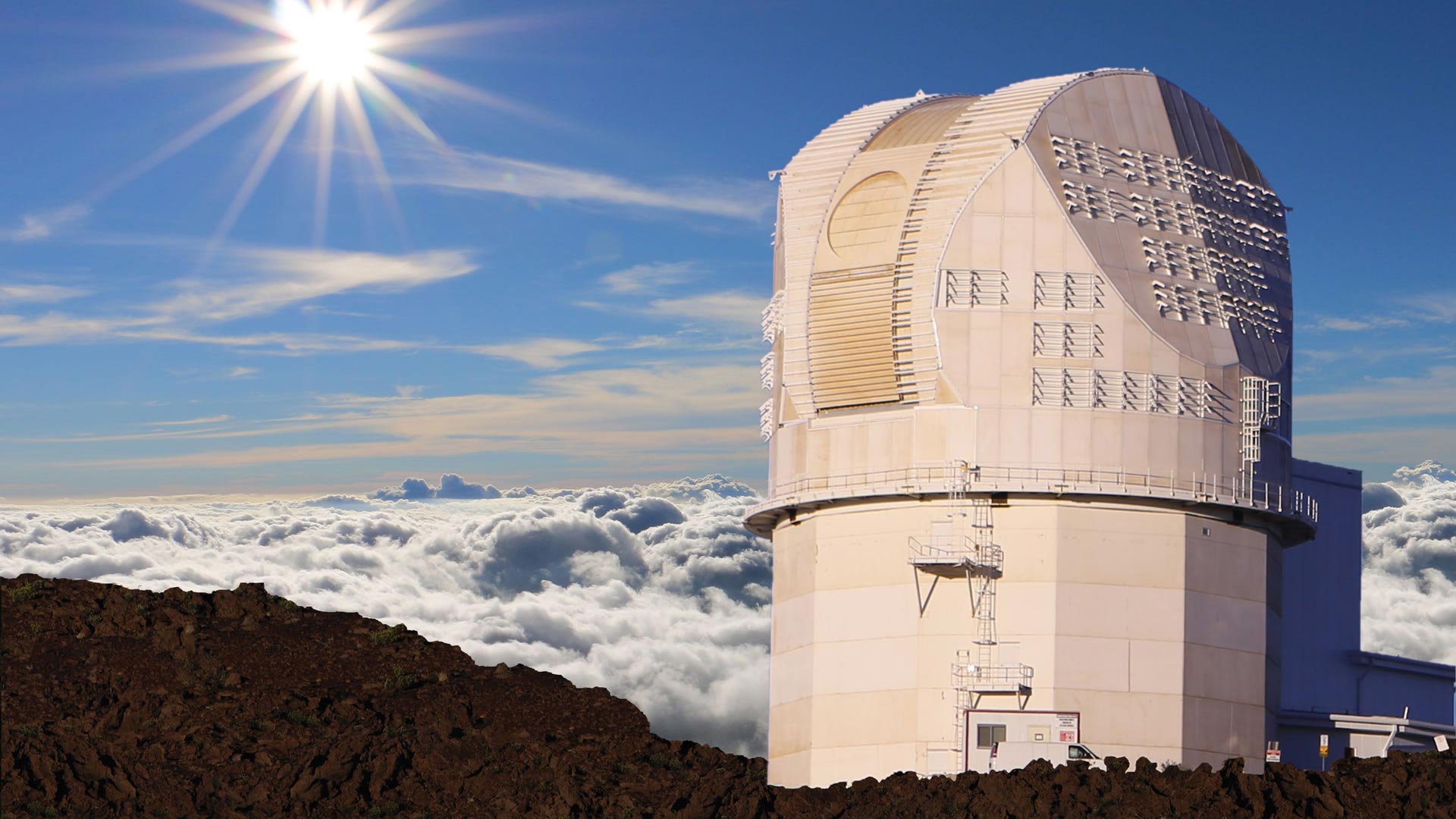
With its four-meter-wide primary mirror, the Inouye Solar Telescope is the largest solar telescope in the world. Located on the summit of Haleakalā in Hawaii, it benefits from exceptional viewing conditions and advanced techniques for image stabilization and reconstruction. Since becoming operational in 2022, it has delivered extraordinarily detailed images of the Sun, revealing even the smallest surface structures.
To maximize the scientific value of its observations, the telescope is being outfitted with a suite of specialized instruments. These tools analyze sunlight by isolating specific wavelengths and polarization states, allowing researchers to extract precise physical information. Four out of five planned instruments are now active.
The newest and most advanced of these is the VTF (Visible Tunable Filter), the world’s largest spectro-polarimeter. As part of its commissioning phase, VTF has now captured its first images of the Sun—a milestone known as a “technical first light.”
Unveiling Solar Mysteries With Cutting-Edge Tech
“The Inouye Solar Telescope was designed to study the underlying physics of the Sun as the driver of space weather. In pursuing this goal, the Inouye is an ideal platform for an unprecedented and pioneering instrument like the VTF,” said Christoph Keller, Director of the National Solar Observatory, which operates the Inouye Solar Telescope.

A Look at the Dynamic Nature of the Sun
The goal of the VTF team is to better understand the dynamic nature of our star. Time and again, the Sun displays powerful eruptions that hurl particles and radiation into space. On Earth, this solar bombardment can trigger spectacular auroras, but can also disrupt technical infrastructure and satellites.
With VTF, the Inouye Solar Telescope will peer more precisely than ever before into the region of the Sun where eruptions originate: the visible surface of the Sun, the photosphere, and the adjacent layer of the solar atmosphere, the chromosphere. The complex interaction of hot plasma flows and changing magnetic fields there holds the key to a better understanding of the processes that trigger eruptions. VFT can determine crucial properties such as plasma flow velocity, magnetic field strength, pressure, and temperature.

Engineering Marvel: The VTF Comes Alive
“The commissioning of VTF represents a significant technological advance for the Inouye Solar Telescope. The instrument is, so to speak, the heart of the solar telescope, which is now finally beating at its final destination,” says Matthias Schubert, VTF project scientist at KIS.
VTF is a true colossus. Weighing 5.6 tons and with a footprint roughly the size of a small garage, it occupies two floors. It was developed over the past years at the Institute for Solar Physics in Freiburg (Germany); installation on site at the Inouye Solar Telescope began at the beginning of last year. The total development time was about 15 years, almost as long as that of the solar telescope itself.

Precision Scanning the Solar Surface
The task of VFT is to image the Sun at the highest possible spatial, temporal, and spectral resolution. To filter out individual, very narrow wavelength ranges from the incoming visible sunlight, the instrument uses two Fabry-Pérot interferometers that are unique in the world in terms of their size and precision. This makes it possible to spectrally scan the sunlight with an accuracy of a few picometers.
In addition, VTF selects individual polarization states, i.e. the oscillation direction of the light. Two-dimensional images of the Sun are then created for each wavelength and polarization state, from which temperature, pressure, speed, and magnetic field strength at different altitudes of the Sun can be determined. The observational data achieves a spatial resolution of about 10 kilometers per pixel and a temporal resolution of hundreds of images per second.
“VTF enables images of unprecedented quality and thus heralds a new era in ground-based solar observation,” says Sami K. Solanki, director at the MPS.
First Light: A Sunspot in Stunning Detail
The newly published image utilizes sunlight with a wavelength of 588.9 nanometers. It shows a dark sunspot with its finely structured penumbra in a section of the solar surface measuring approximately 25,000 kilometers by 25,000 kilometers. Sunspots cover the surface of the Sun with varying frequency. They are associated with particularly strong magnetic fields that prevent hot plasma from rising from the interior of the Sun. The image achieves a spatial resolution of 10 kilometers per pixel.
About the Daniel K. Inouye Solar Telescope
The Daniel K. Inouye Solar Telescope is the world’s largest and most advanced solar observatory, designed to study the Sun in unprecedented detail. Funded by the U.S. National Science Foundation (NSF) and operated by the National Solar Observatory (NSO), the telescope is located atop Haleakalā in Hawaii, where optimal atmospheric conditions support its cutting-edge imaging capabilities.
Equipped with a four-meter primary mirror, the telescope is capable of resolving features on the Sun as small as 10 kilometers, providing critical insights into solar activity, magnetic fields, and space weather.
One of its most powerful instruments is the Visible Tunable Filtergraph (VTF), a high-precision spectro-polarimeter developed and built by the Institute for Solar Physics in Freiburg, Germany. The VTF project includes key international collaboration with the Max Planck Institute for Solar System Research (MPS) in Göttingen, Germany, and the Istituto ricerche solari Aldo e Cele Daccò (IRSOL) in Switzerland.
Together, these institutions are helping advance our understanding of the Sun’s behavior and its impact on Earth’s environment.
Never miss a breakthrough: Join the SciTechDaily newsletter.
Follow us on Google and Google News.