
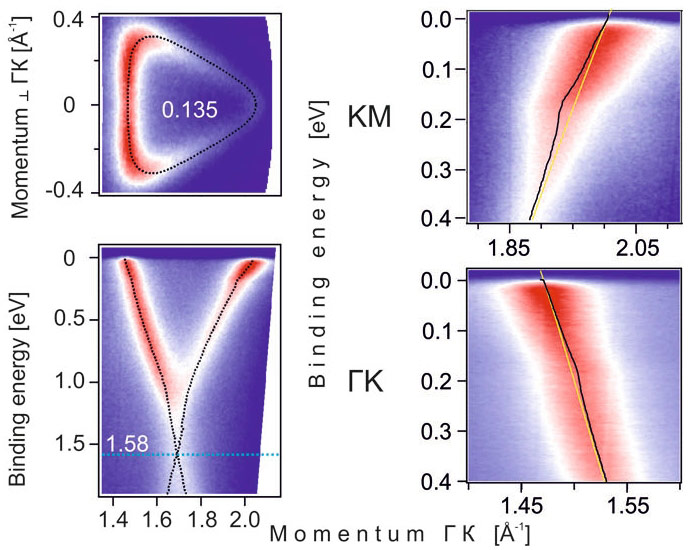
A newly published study details how a team of researchers unveiled the superconducting pairing mechanism in Calcium-doped graphene using the ARPES method.
Whenever a new material is discovered, scientists are eager to find out whether or not it can be superconducting. This applies particularly to the wonder material graphene. Now, an international team of researchers at the University of Vienna unveiled the superconducting pairing mechanism in Calcium doped graphene using the ARPES method. Their results are published in the reputed journal Nature Communications.
Superconducting materials exhibit an invaluable feature when cooled below a critical temperature – they allow the transport of an electric current without loss. Superconductivity is based on the fact that in certain materials electrons can pair up which – at a higher temperature – would otherwise repel each other. Scientists from the Electronic Properties of Materials Group at the Faculty of Physics (University of Vienna) and their collaboration partners teamed up to uncover the potential superconducting coupling mechanism of the wonder material graphene.
Graphene, a single-atom thick layer of carbon atoms was discovered in 2004 and is regarded as one of the most amazing and versatile substances available to mankind. The impact of the first real two-dimensional material is so significant that a Nobel Prize was awarded for its discovery. Until recently, there were no experimental reports of superconductivity in graphene although its close relatives, graphite and fullerenes can be made superconducting by intentionally introducing electrons in the material (doping).
The ARPES method – how light sheds light on superconductivity
In order to shed light on superconductivity in graphene, the scientists resorted to the powerful photoemission method: when a light particle interacts with a material it can transfer all its energy to an electron inside that material. If the energy of the light is sufficiently large, the electron acquires enough energy to escape from the material. Determining the angle under which the electrons escape from the material enables the scientists to extract valuable information on the electronic properties and the complex many-body interactions of the material. Nikolay Verbitskiy and Alexander Grüneis from the University of Vienna together with Alexander Fedorov and Denis Vyalikh from IFW-Dresden and TU-Dresden and Danny Haberer from the University of California at Berkeley and their colleagues employed this technique – the so-called Angle-resolved photoemission spectroscopy (ARPES) – at the Elettra synchrotron in Trieste where they researched the interaction of a series of electron dopants (Cs, Rb, K, Na, Li, Ca) with monolayer graphene.
Who makes the grade?
According to the findings of the scientists, calcium is the most promising candidate to induce superconductivity in graphene with a critical temperature of about 1.5K. This critical temperature is rather low compared to e.g. fullerenes which superconduct at 33K. However, graphene offers several huge advantages over many other materials. Since it consists only of carbon atoms arranged in single layers, it is easy to be chemically functionalized. Moreover, it can be grown in multiple numbers of atom layers in various stacking orders and can be doped in several different ways. Thereby, it gives a multitude of options to experiment with.
The scientists are confident that, while graphene will not set new record critical temperatures, the ease by which its properties can be modified will enhance our understanding of superconductivity in general and carbon materials in particular.
Reference: “Observation of a universal donor-dependent vibrational mode in graphene” by A. V. Fedorov, N. I. Verbitskiy, D. Haberer, C. Struzzi, L. Petaccia, D. Usachov, O. Y. Vilkov, D. V. Vyalikh, J. Fink, M. Knupfer, B. Büchner and A. Grüneis, 6 February 2014, Nature Communications.
DOI: 10.1038/ncomms4257
Never miss a breakthrough: Join the SciTechDaily newsletter.
Follow us on Google and Google News.