
Close Menu
    Facebook X (Twitter) Instagram
    SciTechDaily
    • Biology
    • Chemistry
    • Earth
    • Health
    • Physics
    • Science
    • Space
    • Technology
    Facebook X (Twitter) Pinterest YouTube RSS
    SciTechDaily
    Home»Space»Supermassive Black Holes Feast Under Pressure
    Space

    Supermassive Black Holes Feast Under Pressure

    By Yale UniversityJune 1, 2020No Comments3 Mins Read
    Facebook Twitter Pinterest Telegram LinkedIn WhatsApp Email Reddit
    Share
    Facebook Twitter LinkedIn Pinterest Telegram Email Reddit
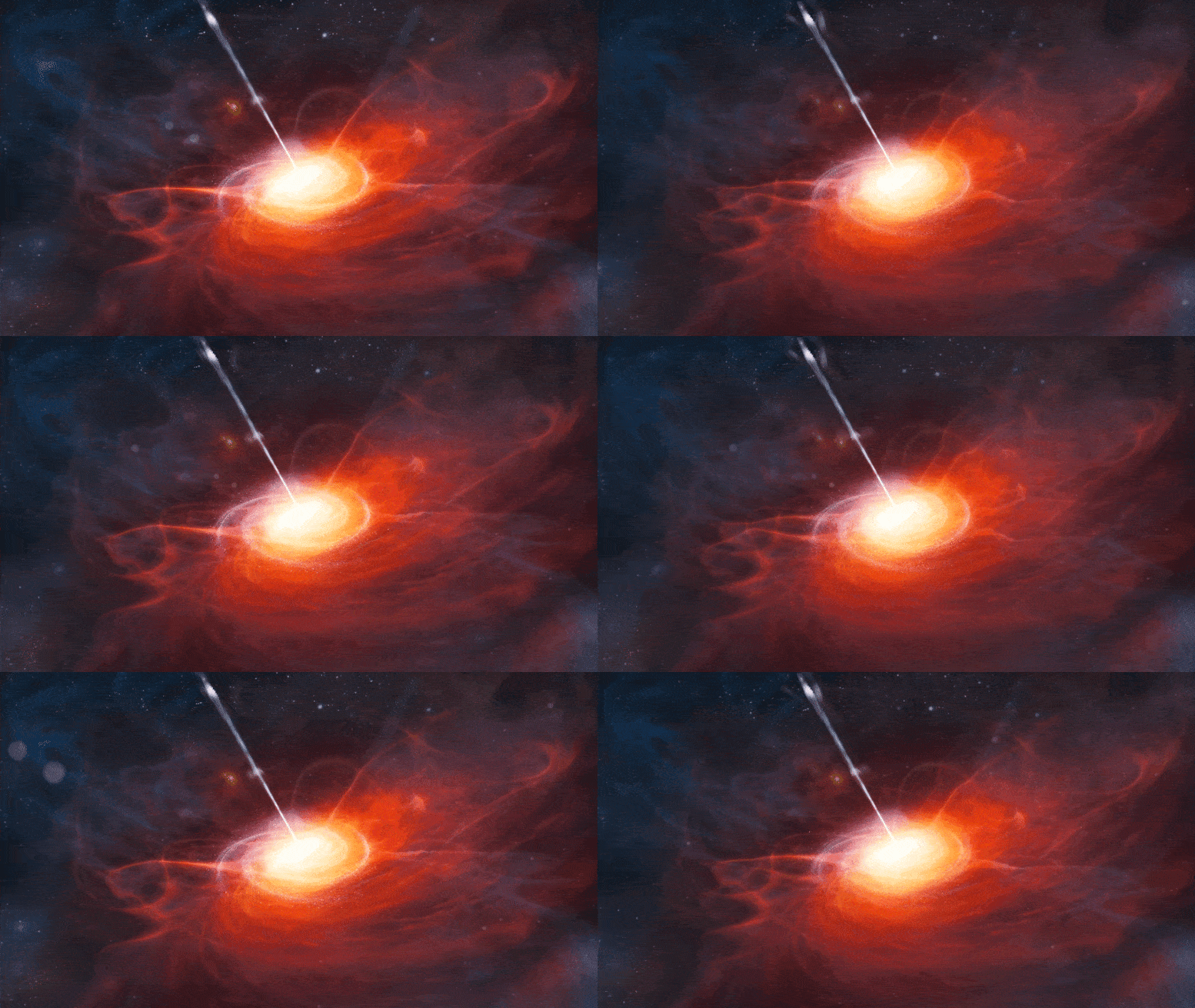
    Feasting Black Hole Animation
    Clusters of galaxies create a pressurized environment that deforms galaxies and stops the creation of new stars. Black holes can have a final feast of gas clouds and stars before this happens. Outflows of gas driven by the black holes may be responsible for shutting off star formation.

    A new, Yale-led study shows that some supermassive black holes actually thrive under pressure.

    It has been known for some time that when distant galaxies — and the supermassive black holes within their cores — aggregate into clusters, these clusters create a volatile, highly pressurized environment. Individual galaxies falling into clusters are often deformed during the process and begin to resemble cosmic jellyfish.

    Curiously, the intense pressure squelches the creation of new stars in these galaxies and eventually shuts off normal black hole feeding on nearby interstellar gas. But not before allowing the black holes one final feast of gas clouds and the occasional star.

    The researchers also suggested this rapid feeding might be responsible for the eventual lack of new stars in those environments. The research team said “outflows” of gas, driven by the black holes, might be shutting off star formation.

    “We know that the feeding habits of central supermassive black holes and the formation of stars in the host galaxy are intricately related. Understanding precisely how they operate in different larger-scale environments has been a challenge. Our study has revealed this complex interplay,” said astrophysicist Priyamvada Natarajan, whose team initiated the research. Natarajan is a professor of astronomy and physics in Yale’s Faculty of Arts and Sciences.

    The study is published in the Astrophysical Journal Letters. The first author is Angelo Ricarte, a former member of Natarajan’s lab now at Harvard, who started this work as a Yale doctoral student. Co-authors are Yale Center for Astronomy and Astrophysics Prize postdoctoral associate Michael Tremmel and Thomas Quinn of the University of Washington.

    The new study adds to a significant body of work from Natarajan’s research group regarding how supermassive black holes form, grow, and interact with their host galaxies in various cosmic environments.

    The researchers conducted sophisticated simulations of black holes within galaxy clusters using RomulusC, a cosmological simulation that Tremmel, Quinn and others developed.

    Ricarte developed new tools for extracting information from RomulusC. While analyzing black hole activity in the cluster simulation, he said, he noticed “something weird happening once their host galaxies stopped forming stars. Surprisingly, I often spotted a peak in black hole activity at the same time that the galaxy died.”

    That “peak” would be the black hole’s big, final feast, under pressure.

    Tremmel said that “RomulusC is unique because of its exquisite resolution and the detailed way in which it treats supermassive black holes and their environments, allowing us to track their growth.”

    Reference: “A Link between Ram Pressure Stripping and Active Galactic Nuclei” by Angelo Ricarte, Michael Tremmel, Priyamvada Natarajan and Thomas Quinn, 19 May 2020, Astrophysical Journal Letters.
    DOI: 10.3847/2041-8213/ab9022

    Support for the research came from a number of sources, including NASA and the National Science Foundation. The research is part of the Blue Waters computing project supported by the National Science Foundation and the University of Illinois at Urbana-Champaign.

    Never miss a breakthrough: Join the SciTechDaily newsletter.
    Follow us on Google and Google News.

    Astronomy Astrophysics Black Hole National Science Foundation Yale University
    Share. Facebook Twitter Pinterest LinkedIn Email Reddit

    Related Articles

    “Never Been Seen Before” – Astronomers Discover Bizarre “Infinity” Galaxy

    Gravitational Waves Detected Using “Cosmic Clocks” and Unseen Spatial Distortions

    Astronomers Observe Supermassive Black Hole Feeding on Cold Gas

    Astronomers Discover a Black Hole That Grew Much Quicker Than Its Host Galaxy

    Evidence of Galaxy Star Birth Regulated by Black Holes

    Massive Black Hole Outgrows Its Galaxy, Measures Nearly 7 Billion Solar Masses

    Yale Astronomers Identify the First “Changing Look” Quasar

    Simulations Re-Create the Complex Dynamics Near a Black Hole

    Discovery Provides Clues to How Galaxies and Black Holes Develop Together

    Leave A Reply Cancel Reply

    • Facebook
    • Twitter
    • Pinterest
    • YouTube

    Don't Miss a Discovery

    Subscribe for the Latest in Science & Tech!

    Trending News

    Popular Supplement Ingredient Linked to Shorter Lifespan in Men

    Scientists May Have Found a Way To Repair Nerve Damage in Multiple Sclerosis

    “Totally Unexpected” – Scientists Discover Pancreatic Cancer’s Fatal Addiction

    A Strange Quantum Effect May Explain One of Biology’s Greatest Mysteries

    James Webb Telescope Reveals the Universe’s Hidden Cosmic Web in Stunning Detail

    Scientists Identify Simple Supplement That Greatly Reduces Alzheimer’s Damage

    You May Have a Dangerous Type of Cholesterol Even if Your Tests Look Normal

    Your Blood Pressure Reading Could Be Wrong Because of One Simple Mistake

    Follow SciTechDaily
    • Facebook
    • Twitter
    • YouTube
    • Pinterest
    • Newsletter
    • RSS
    SciTech News
    • Biology News
    • Chemistry News
    • Earth News
    • Health News
    • Physics News
    • Science News
    • Space News
    • Technology News
    Recent Posts
    • Scientists Reveal That Eating Almonds Every Day Could Transform Your Gut, Metabolism, and Appetite
    • Researchers Found a Surprisingly Realistic Way To Mine Asteroids for Mars
    • Europe Just Unveiled a Serious Rival to SpaceX’s Starship
    • Scientists May Have Solved Two of Fusion Energy’s Biggest Problems at Once
    • Scientists Discover Hidden “Switch” That Burns Fat and Could Treat Bone Disease
    Copyright © 1998 - 2026 SciTechDaily. All Rights Reserved.
    • Science News
    • About
    • Contact
    • Editorial Board
    • Privacy Policy
    • Terms of Use

    Type above and press Enter to search. Press Esc to cancel.