
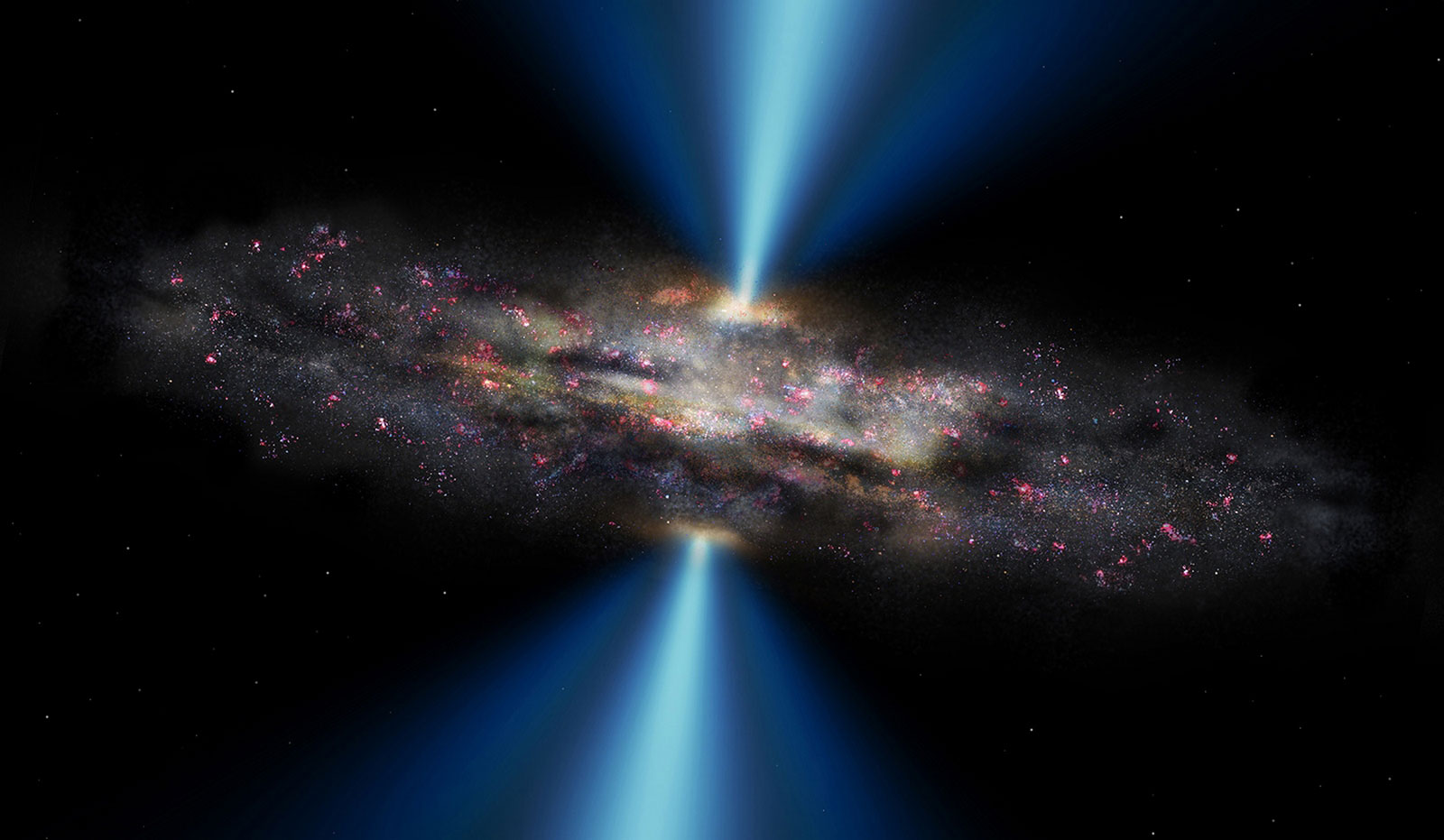
A team of scientists has discovered a black hole in the early universe that grew much faster than its host galaxy, resulting in a gigantic black hole within a normal-size galaxy.
The discovery runs counter to most observations about black holes, which are massive areas of space with extraordinarily strong gravity that can pull in anything — even light. In most cases, black holes and their host galaxies expand at the same rate.
This particular black hole formed in the early universe, roughly two billion years after the Big Bang. An international research group made the discovery during a project to map the growth of supermassive black holes across cosmic time. The team included astronomers from Yale University, ETH Zurich, the Max-Planck Institute in Germany, Harvard University, the University of Hawaii, INAF-Osservatorio Astronomico di Roma, and Oxford University.
“Our survey was designed to observe the average objects, not the exotic ones,” said C. Megan Urry, Yale’s Israel Munson Professor of Astrophysics and co-author of a study about the phenomenon in the journal Science. “This project specifically targeted moderate black holes that inhabit typical galaxies today. It was quite a shock to see such a ginormous black hole in such a deep field.”
Deep-field surveys are intended to look at faint galaxies; they point at small areas of the sky for a longer period of time, meaning the total volume of space being sampled is relatively small.
This particular black hole, located in the galaxy CID-947, is among the most massive black holes ever found. It measures nearly 7 billion solar masses (a solar mass is equivalent to the mass of our Sun).
However, it was the mass of the surrounding galaxy that most surprised the research team. “The measurements correspond to the mass of a typical galaxy,” said lead author Benny Trakhtenbrot, a researcher at ETH Zurich’s Institute for Astronomy. “We, therefore, have a gigantic black hole within a normal-size galaxy.”
Most galaxies, including our own Milky Way, have a black hole at their center, holding millions to billions of solar masses. Not only does the new study challenge previous notions about the way host galaxies grow in relation to black holes, it also challenges earlier suggestions that the radiation emitted by expanding black holes curtails the creation of stars.
Stars were still forming in CID-947, the researchers said, and the galaxy could continue to grow. They said CID-947 could be a precursor of the most extreme, massive systems observed in today’s local universe, such as the galaxy NGC 1277 in the Perseus constellation, 220 million light years from the Milky Way. But if so, they said, the growth of the black hole still greatly anticipated the growth of the surrounding galaxy, contrary to what astronomers thought previously.
Urry and her colleagues credited the W.M. Keck Observatory in Hawaii and the Chandra COSMOS legacy survey in aiding the team’s work. “The sensitivity and versatility of Keck’s new infrared spectrometer, MOSFIRE, was critical to this discovery,” Urry said.
Other co-authors of the paper include Francesca Civano, an associate research scientist at Yale; David Rosario, of the Max-Planck Institute; Martin Elvis, of Harvard; Kevin Schawinski, of ETH Zurich and a former Einstein Fellow at Yale; Hyewon Suh, of Harvard; Angela Bongiorno, of INAF-Osservatorio Astronomico di Roma; and Brooke Simmons, of Oxford and a former graduate student at Yale.
Reference: “An over-massive black hole in a typical star-forming galaxy, 2 billion years after the Big Bang” by Benny Trakhtenbrot, C. Megan Urry, Francesca Civano, David J. Rosario, Martin Elvis, Kevin Schawinski, Hyewon Suh, Angela Bongiorno and Brooke D. Simmons, 10 July 2015, Science.
DOI: 10.1126/science.aaa4506
arXiv: 1507.02290
Never miss a breakthrough: Join the SciTechDaily newsletter.
Follow us on Google and Google News.
2 Comments
The published article states that this super massive black hole accounts for approx. 10% of its host galaxy’s mass, whereas the “normal” SMBH is typically 0.2% – 0.5% of the galaxy’s mass.
The article also states this SMBH has stopped accreting material from the galaxy. This puzzles me. Logic suggests that this SMBH’s increased gravitational pull would be drawing in galactic material at an increased rate. Can someone explain to this layman what countervailing forces are holding the accretion rate in check?
thanks for the last information