
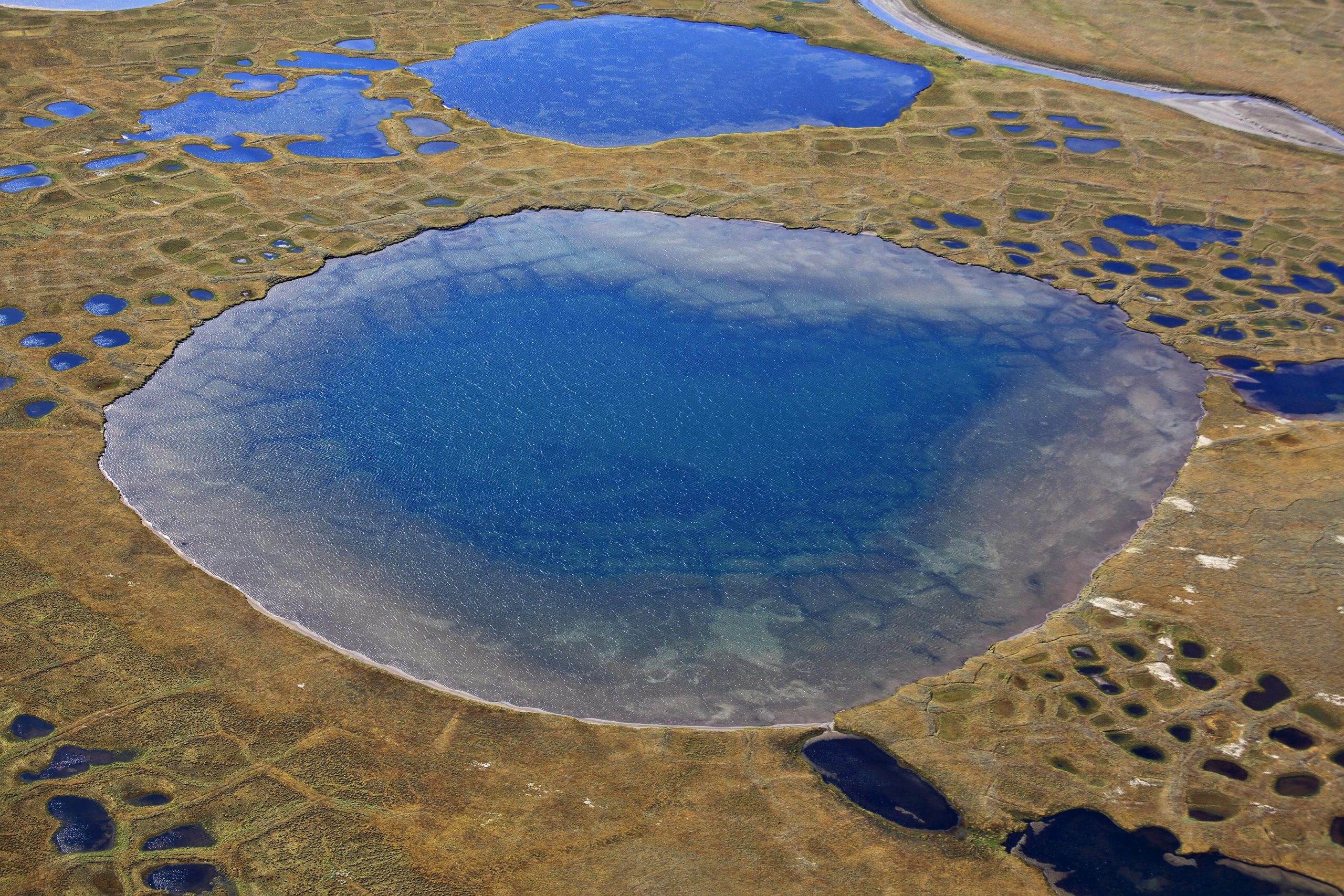
Melting Arctic permafrost could release antibiotic-resistant bacteria, ancient viruses, heavy metals, and banned chemicals like DDT, in addition to greenhouse gases.
When considering the implications of thawing permafrost, our initial worries are likely to turn to the major issue of methane being released into the atmosphere and exacerbating global warming or issues for local communities as the ground and infrastructure become unstable. While this is bad enough, new research reveals that the potential effects of permafrost thaw could also pose serious health threats.
As part of the ESA–NASA Arctic Methane and Permafrost Challenge, new research has revealed that rapidly thawing permafrost in the Arctic has the potential to release antibiotic-resistant bacteria, undiscovered viruses, and even radioactive waste from Cold War nuclear reactors and submarines.
Permafrost, or permanently frozen land, covers around 23 million square kilometers (8.9 million square miles) in the northern hemisphere. Most of the permafrost in the Arctic is up to a million years old – typically the deeper it is, the older it is.
In addition to microbes, it has housed a diverse range of chemical compounds over millennia whether through natural processes, accidents or deliberate storage. However, with climate change causing the Arctic to warm much faster than the rest of the world, it is estimated that up to two-thirds of the near-surface permafrost could be lost by 2100.

Thawing permafrost releases greenhouse gases – carbon dioxide and methane – to the atmosphere, as well as causing abrupt changes to the landscape.
However, research, published recently in Nature Climate Change, found the implications of waning permafrost could be much more widespread – with potential for the release of bacteria, unknown viruses, nuclear waste and radiation, and other chemicals of concern.
Antibiotic-Resistant Bacteria Emerging from the Ice
The paper describes how deep permafrost, at a depth of more than three meters, is one of the few environments on Earth that has not been exposed to modern antibiotics. More than 100 diverse microorganisms in Siberia’s deep permafrost have been found to be antibiotic-resistant. As the permafrost thaws, there is potential for these bacteria to mix with meltwater and create new antibiotic-resistant strains.
Another risk concerns the by-products of fossil fuels, which have been introduced into permafrost environments since the beginning of the industrial revolution. The Arctic also contains natural metal deposits, including arsenic, mercury, and nickel, which have been mined for decades and have caused huge contamination from waste material across tens of millions of hectares.
Now-banned pollutants and chemicals, such as the insecticide dichloro-diphenyl-trichloroethane, DDT, that were transported to the Arctic atmospherically and over time became trapped in permafrost, are at risk of re-permeating the atmosphere.
In addition, increased water flow means that pollutants can disperse widely, damaging animal and bird species as well as entering the human food chain.
There is also a greater scope for transportation of pollutants, bacteria, and viruses. More than 1000 settlements, whether resource extraction, military and scientific projects, have been created on permafrost during the last 70 years. That, coupled with the local populace, increases the likelihood of accidental contact or release. Despite the findings of the research, it says the risks from emergent microorganisms and chemicals within permafrost are poorly understood and largely unquantified. It states that further in-depth research in the area is vital to gain better insight into the risks and to develop mitigation strategies.
Unknown Microbes and Unpredictable Consequences
The review’s lead author, Kimberley Miner, from NASA Jet Propulsion Laboratory, said, “We have a very small understanding of what kind of extremophiles — microbes that live in lots of different conditions for a long time — have the potential to re-emerge. These are microbes that have coevolved with things like giant sloths or mammoths, and we have no idea what they could do when released into our ecosystems.
“It’s important to understand the secondary and tertiary impacts of these large-scale Earth changes such as permafrost thaw. While some of the hazards associated with the thaw of up to a million years of material have been captured, we are a long way from being able to model and predict exactly when and where they will happen. This research is critical.”
ESA’s Diego Fernandez added, “Research being conducted as part of the ESA–NASA Arctic Methane and Permafrost Challenge within our Science for Society program is vital to understanding the science of the changing Arctic. Thawing permafrost clearly poses huge challenges, but more research is needed. NASA and ESA are joining forces to foster scientific collaboration across the Atlantic to ensure we develop solid science and knowledge so that decision-makers are armed with the correct information to help address these issues.”
Reference: “Emergent biogeochemical risks from Arctic permafrost degradation” by Kimberley R. Miner, Juliana D’Andrilli, Rachel Mackelprang, Arwyn Edwards, Michael J. Malaska, Mark P. Waldrop and Charles E. Miller, 30 September 2021, Nature Climate Change.
DOI: 10.1038/s41558-021-01162-y
Never miss a breakthrough: Join the SciTechDaily newsletter.
Follow us on Google and Google News.
28 Comments
“The paper describes how deep permafrost, …, is one of the few environments on Earth that has not been exposed to modern antibiotics. More than 100 diverse microorganisms in Siberia’s deep permafrost have been found to be antibiotic resistant.”
These two statements appear to me to be contradictory. Modern bacteria develop resistance to antibiotics after exposures that are insufficient to kill all of the organisms, and the survivors proliferate into an antibiotic-resistant strain. Why should organisms that have never been exposed to modern antibiotics show resistance, other than just by chance? Why should we be concerned about bacteria or viruses that infected plants and animals that are now extinct, and were unlikely to have been pathogens for humans?
The lead title uses the word “could,” without which modern climatology would be severely handicapped! Why don’t these experts provide us with a numeric probability and their reasons for the estimate? As usual, there is a lot of hand waving and meaningless, unsupported assertions.
Climatology is to science what astrology is to astronomy!
I guess someone should have thought about it before they ALLEGEDLY commenced Weather MODIFICATION with an ALLEGED view TOWARD ALLEGEDLY opening a Sea Channel over the North Pole, in a short-sighted “it can’t hurt” Paradigm for ALLEGEDLY shipping OIL and other commodities at a meager savings of above-line costs and below-line tax advantage. ALLEGEDLY.
YADDA-YADDA… Someone told you so but that’s all water under the DAMN!… and maybe OVER OUR HEADS eventually ALLEGEDLY.
Who is “they?”
Shhhh don’t let Democrats see this. They have caused enough problems
So basically umbrella corp is brewing super viruses deep in the permafrost and if the Arctic thaws the planet is against cloned zombie mammoths and basic flu-like symptoms.
@Clyde I came here to say what you said initially about the antibiotic resistance. It’s exposure that leads to resistance… So ancient bacteria not being exposed to antibiotics would not confer resistance to them.
I suspect that these kinds of articles are written by newly-minted PhDs who are impressed with their credentials and don’t know what they don’t know.
These kinds of articles speak poorly for the peer review system. The reviewers should have pointed out that it is rare for pathogens to jump the species barrier unless the animals are living in close proximity to their human hosts, such as sharing a hut with piglets.
There is considerable wild speculation about what “could” happen, with no supporting evidence about the actual possibility of it happening. The cited potential issues about mining wastes overlooks the fact that many of the known issues such as arsenic, and even nickel in drinking water, are commonly associated with natural occurrences that have not been disturbed by mining. It is borderline hysteria!
Stop with the fear porn.
The fact that there were humans prior to the permafrost points to the fact that we could potentially have no issue furthermore at the time of those bacteria they were extremely basic meaning we have made worse in labs than what could be under those sheets of ice……y’all continually attempt to frighten people and it’s interesting when you point out the fact that at some point prior to the ice caps there were mammals, I have always wondered the purpose of using scare tactics to achieve a goal then again scare tactics get things done so kudo’s I guess but let’s keep in mind that most bacteria share common ancestors and we have multiple antibiotics for just about everything
Clyde Is correct. Bacteria that would come out of this soil would most likely be completely naive too antibiotics and easily taking care of by the weakest of our antibiotics given their lack of experience with them. There also is no reason to believe that viruses would exist in the soil that would be dangerous given that exact same reason.
Who or what is responsible for COVID?
Don’t tell the rotten evil Xi and CCP in China about new possible viruses. They’ll ask Fauci and the NIH for more funding on human transmission.
Typical pseudoscience reporting. The sky is falling.
Bla, bla, bla. Perverting science for a sensational headline.
Can’t do anything that man hasn’t done already with the help of Fauci and the CCP.
It “could” also unlock the cure for cancer or even worse…. Democrats.
It could also release symbiotic bacteria or nothing at all
That is the point! It is wild speculation about possibilities, without any evidence provided about the probability. We COULD all be killed tomorrow by a huge asteroid; however, the probability is infinitesimally small and not worth spending much time worrying about.
All that needs to happen is the article anyways. People see the title and deal out, toss in a couple words that sound scientific, then define those terms and processes used, not here peesay, but in general, and that’s the recipe for a convincing article if you’re last name is Thundberg. Seems legit! People sop this stuff up.
So dont thaw it ,f*cking idiot science clowns. How resistant are these virus and bacteria to our fukishima radioactive waters ? I mean it killed a ton of ocean life , wont it kill the other stuff too ? Heres an idea , we give the boomer virus that gets thawed out the rona and it goes back to sleep for 100 years .
“… it killed a ton of ocean life, …”
Do you have a citation that supports that claim? Or, are you just speculating as the authors of this article did?
Or how about we make pelosi drink it and all the scotch and gin and tequilla and rum kill whatever harmful bacteria enter pelosis bottemless long island abyss .
And pigs can fly too!
“Kimberley, Juliana, Rachel, Arwyn” Science moms…
Always have “could” in every climate discussion. Same sh*t they said 40 years ago!
Maybe if they would stop messing with the weather to create fake climate change then the permafrost would stop thawing. Why is nobody talking about weather manipulation and chem spraying.
Those stating that exposure to antibiotics causes resistance are not fully correct. Resistance is a chance mutation in the DNA that happens to make it resistant, exposure to antibacterial agents itself does nothing but kill the bacteria. However, any bacteria from a time before antibiotics frozen in permafrost could have any number of mutations including antibacterial resistance. Most mutations simply kill the virus or cell. Claiming that a species from the past cant have a resistance is just as incorrect as this article fear mongering. I might add that this article states that many bacteria found in the permafrost is already resistant. I can’t back that up because I haven’t read the research, but that is more attempt to back up opinion than any of the “facts” i am reading in comments.
There are a couple of things to consider. First of all, while mutations are random, and usually detrimental, antibiotics have to be present to provide selective evolutionary pressure for the mutation to become widely established. Except for natural occurrences, antibiotics would not have been as common as today. The authors apparently don’t specify what modern antibiotics are ineffective.
Secondly, not all bacteria are a threat to humans or even animals. Those are the two groups that would most commonly be administered antibiotics. The authors should have been more specific about just what kind of bacteria were supposedly resistant. If they are bacteria that decompose dead plant material, or extinct animals, then the ‘fact’ is unimportant.
At face value, the claims are a little scary, which I’m sure was the intent. However, like virtually all research tainted by the religion of climatology, the work leaves a lot to be desired!
Another “Global Warming” scare tactic story?? Where’s your story on who ACTUALLY unleashes deadly bacteria and viruses, after they gain function? Here’s a hint: he’s a politicized and overzealous Mengelean medical advisor- with the initials A.F.- in cahoots with American and Chinese communists and other globalists. I think he’s a wee bit more dangerous than the permafrost that’s been thawing on and off for at least the last 13000 years.