
Scientists have confirmed a rare “impossible” earthquake deep beneath Utah, revealing a hidden source of seismic activity inside Earth’s mantle.
Nearly five decades after a puzzling earthquake struck deep beneath northern Utah, scientists have confirmed that the event was real and part of a rare category of earthquakes that occur much deeper underground than researchers once thought possible.
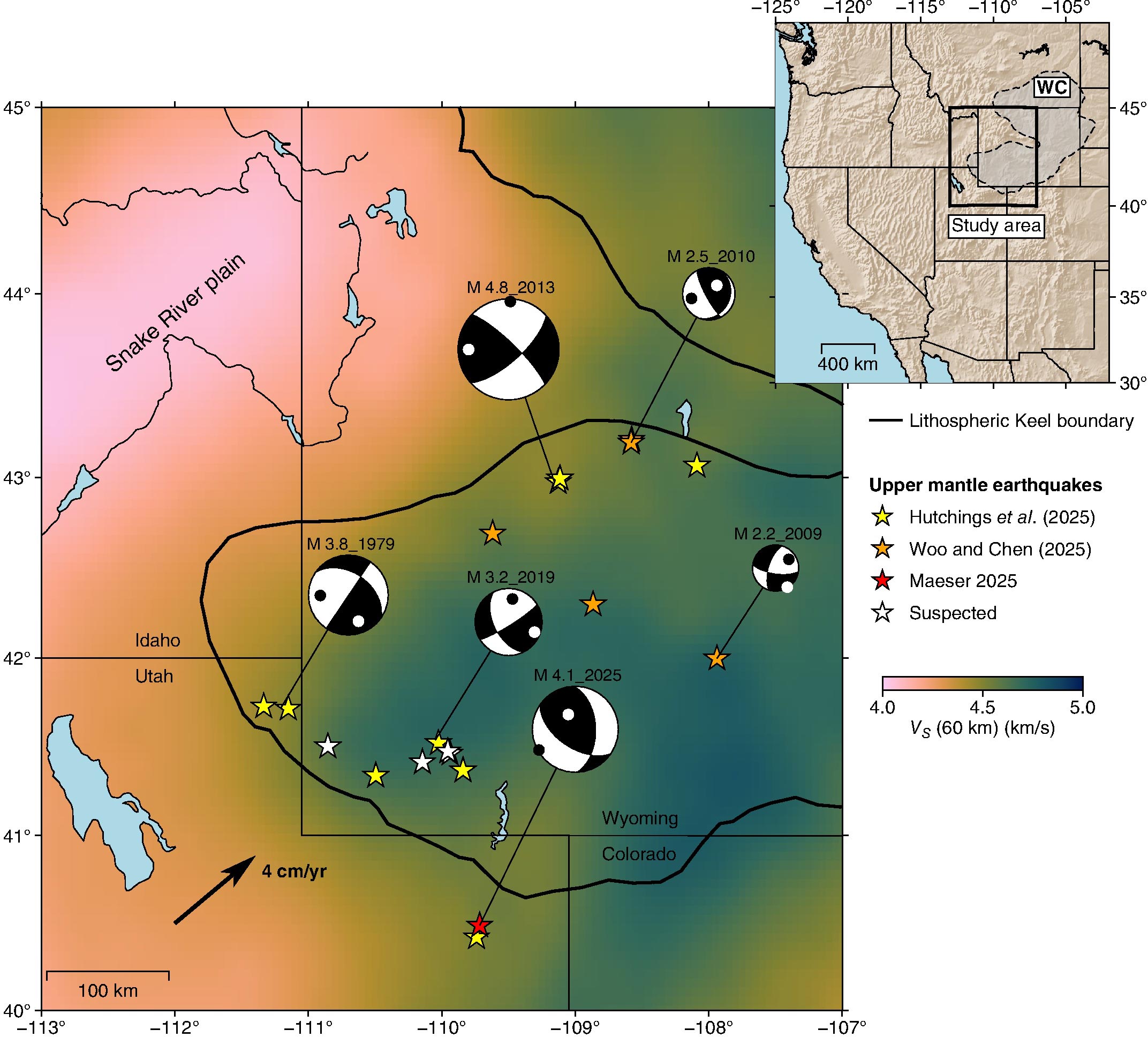
The unusual quake happened in the early hours of February 24, 1979, beneath the town of Randolph near Utah’s borders with Idaho and Wyoming. Although it registered a magnitude of 3.8, no one reported feeling it. The seismic data collected at the time also appeared highly unusual.
George Zandt, then a postdoctoral researcher in seismology at the University of Utah, took a closer look at the recordings. His analysis suggested the earthquake originated about 90 kilometers below sea level, far beneath Earth’s crust and deep within the upper mantle.
At the time, such a depth seemed almost impossible for an earthquake beneath a continent.
“The deep depth explained why it wasn’t felt by people at the surface,” said Zandt, who later spent much of his career on the geology faculty at the University of Arizona. “I did some other analysis that convinced me of the reality of the deep depth, but it was hard to convince others of the highly anomalous mantle earthquake occurring in a region where none should exist.”
Decades-Old Seismic Mystery Revisited
Although Zandt published an abstract about the event in Earthquake Notes, the finding attracted little attention. That changed last year when a new group of University of Utah seismologists revisited the 1979 data along with records from eight other suspected deep earthquakes that had occurred in northern Utah and southwestern Wyoming.
Led by geology professor Keith Koper, the team confirmed that all nine earthquakes originated well below the crust. Their findings provided strong evidence for the existence of so-called continental mantle earthquakes (CMEs), a rare type of earthquake that occurs within Earth’s mantle rather than its crust.
The evidence grew even stronger on September 10, 2025, when another deep earthquake struck near Maeser in Utah’s Uinta Basin. The magnitude 4.1 event originated at a depth of 68 kilometers.
That location placed it more than 20 kilometers below the Mohorovičić discontinuity, commonly called the Moho, which marks the boundary between Earth’s crust and mantle. In a later study published in The Seismic Record, researchers described the Maeser earthquake as an “archetypal continental mantle event.”
Earthquakes in an Unexpected Environment
The discovery is surprising because rocks at those depths are exposed to extreme temperatures and pressures. Scientists generally expect mantle rocks to deform slowly over long periods rather than fracture suddenly in an earthquake.
“This is an example of an earthquake that’s nucleating in very unusual conditions, the high temperature, the high pressure, and almost all the material at that depth is going to flow. It’s more like taffy, it’s taffy on long time scales, like millions of years,” said Koper, director of the University of Utah Seismograph Stations and a former student of Zandt. “Nevertheless, you can still see it in rocks that have made their way back up to the surface; you can see how they were stretched.”
Zandt came out of retirement to collaborate on the research and is listed as a co-author of the study.
A Different Kind of Earthquake
To determine where earthquakes begin, seismologists compare the arrival times of different types of seismic waves recorded at monitoring stations. Small differences in travel time help reveal the depth and location of an earthquake’s source.
The University of Utah Seismograph Stations has preserved decades of seismic records, creating a valuable archive for researchers. Graduate student Sean Hutchings used those records to study known deep earthquakes and identify several additional events that had previously been classified as shallower crustal earthquakes.
The findings point to a type of earthquake that behaves very differently from more familiar quakes.
“It’s sort of a mystery in terms of fundamental physics. How in the world can these things happen?” Koper said. “Another reason why it’s a big deal is that we have no idea how big they can be. With crustal earthquakes, we can measure what we think their maximum size is going to be. We measure the faults that we can map out near the surface. We can measure the length of a fault segment and that clues us into how big it can be, which helps us estimate seismic hazard.”
Unlike typical earthquakes, these deep mantle events occur alone. Researchers found no evidence of the foreshocks or aftershocks that commonly accompany crustal earthquakes.
Wyoming Craton May Hold the Answer
The earthquakes also appear concentrated near the western edge of the Wyoming Craton, an ancient and exceptionally old section of Earth’s lithosphere that lies beneath parts of Wyoming and neighboring states. The region is associated with very high temperatures, often exceeding 700 degrees Celsius.
Koper compares cratons to icebergs. Rather than floating in water, these ancient structures extend deep into Earth’s mantle like the keel of a ship.
The Wyoming Craton sits at the boundary between the tectonically active western United States and the more stable interior of the North American continent. Over time, erosion and geological processes have altered its structure, leaving the lithosphere thinner toward Idaho and Utah. This is also where the deep earthquakes have been observed.
“On the scale of millions of years, the mantle is hitting the craton and then flowing around it,” Koper said. “It’s that interaction where that mantle flow is being diverted around this hard cratonic root that’s causing the increased strain rate, the increased deformation and it’s also creating extra stresses. We think it’s that interaction between the keel of the iceberg and the medium around it that’s leading to these earthquakes.”
The research was published April 10 in The Seismic Record under the title “The 10 September 2025 4.1 Earthquake in Northeastern Utah, United States: An Archetypal Continental Mantle Event,” and May 5, 2025, in Geophysical Research Letters under the title “Upper Mantle Earthquakes Along the Edge of the Wyoming Craton.”
References:
“The 10 September 2025 Mw 4.1 Earthquake in Northeastern Utah, United States: An Archetypal Continental Mantle Event” by Keith D. Koper, Sean J. Hutchings, Relu Burlacu, Katherine Whidden, Valerie Springer, Rigobert Tibi and Guanning Pang, 10 April 2026, The Seismic Record.
DOI: 10.1785/0320260006
“Upper Mantle Earthquakes Along the Edge of the Wyoming Craton” by Sean J. Hutchings, Keith D. Koper, Relu Burlacu, Qicheng Zeng, Fan-Chi Lin and George Zandt, 3 May 2025, Geophysical Research Letters.
DOI: 10.1029/2024GL114073
Co-authors include Sean J. Hutchings, Fan-Chi Lin, Qicheng Zeng, Relu Burlacu, Katherine Whidden, and Valerie Springer of the University of Utah’s Department of Geology & Geophysics. The work was supported by the State of Utah, the U.S. Department of Energy, and the U.S. Geological Survey.
Never miss a breakthrough: Join the SciTechDaily newsletter.
Follow us on Google and Google News.
4 Comments
Another ridiculous article. Everyone knows that the region is seismically active. Yelllowstone is a subterranean super volcano waiting to erupt
Of course ‘everyone’ knows that the region is seismically active. The issue is the depth of the activity because at the calculated depth it is assumed that the rock deforms plastically, rather than brittlely.
At the depth it sounds like it happened the mantle should be highly plastic and flowing smoothly, including the crayton. What would keep the crayon solid? Could it be composed of a high melting point metal?
In the upper-mantle, the rocks are still mostly silicates, not nickel-iron alloys. They are found in the core. There might be some chromium oxides (chromite), but the alpine, podiform chromitites exposed at the surface are typically too small to cause earthquakes.