
In the early 2010s, LightSquared, a multibillion-dollar startup promising to revolutionize cellular communications, declared bankruptcy. The company couldn’t figure out how to prevent its signals from interfering with those of GPS systems.
Now, Penn Engineers have developed a new tool that could prevent such problems from ever happening again: an adjustable filter that can successfully prevent interference, even in higher-frequency bands of the electromagnetic spectrum.
“I hope it will enable the next generation of wireless communications,” says Troy Olsson, Associate Professor in Electrical and Systems Engineering (ESE) at Penn Engineering and the senior author of a new paper in Nature Communications that describes the filter.
The electromagnetic spectrum itself is one of the modern world’s most precious resources; only a tiny fraction of the spectrum, mostly radio waves, representing less than one billionth of one percent of the overall spectrum, is suitable for wireless communication.
Federal Regulations and Spectrum Usage
The bands of that fraction of the spectrum are carefully controlled by the Federal Communications Commission (FCC), which only recently made available the Frequency Range 3 (FR3) band, including frequencies from about 7 GHz to 24 GHz, for commercial use. (One hertz is equivalent to a single oscillation in an electromagnetic wave passing a point each second; one gigahertz, or GHz, is a billion such oscillations per second.)
To date, wireless communications have mostly used lower-frequency bands. “Right now we work from 600 MHz to 6 GHz,” says Olsson. “That’s 5G, 4G, 3G.” Wireless devices use different filters for different frequencies, with the effect that covering all frequencies or bands requires large numbers of filters that take up substantial space. (The typical smartphone includes upwards of 100 filters, to ensure that signals from different bands don’t interfere with one another.)
“The FR3 band is most likely to roll out for 6G or Next G,” says Olsson, referring to the next generation of cellular networks, “and right now the performance of small-filter and low-loss switch technologies in those bands is highly limited. Having a filter that could be tunable across those bands means not having to put in another 100+ filters in your phone with many different switches. A filter like the one we created is the most viable path to using the FR3 band.”
One complication posed by using higher-frequency bands is that many frequencies have already been reserved for satellites. “Elon Musk’s Starlink works in those bands,” notes Olsson. “The military—they’ve already been crowded out of many lower bands. They’re not going to give up radar frequencies that sit right in those bands, or their satellite communications.”
As a result, Olsson’s lab—in collaboration with colleagues Mark Allen, Alfred Fitler Moore Professor in ESE, and Firooz Aflatouni, Associate Professor in ESE, and their respective groups—designed the filter to be adjustable, so that engineers can use it to selectively filter different frequencies, rather than have to employ separate filters. “Being tunable is going to be really important,” Olsson continues, “because at these higher frequencies, you may not always have a dedicated block of spectrum just for commercial use.”
Innovative Material and Adjustable Technology
What makes the filter adjustable is a unique material, “yttrium iron garnet” (YIG), a blend of yttrium, a rare earth metal, along with iron and oxygen. “What’s special about YIG is that it propagates a magnetic spin wave,” says Olsson, referring to the type of wave created in magnetic materials when electrons spin in a synchronized fashion.
When exposed to a magnetic field, the magnetic spin wave generated by YIG changes frequency. “By adjusting the magnetic field,” says Xingyu Du, a doctoral student in Olsson’s lab and the first author of the paper, “the YIG filter achieves continuous frequency tuning across an extremely broad frequency band.”
As a result, the new filter can be tuned to any frequency between 3.4 GHz and 11.1 GHz, which covers much of the new territory the FCC has opened up in the FR3 band. “We hope to demonstrate that a single adaptable filter is sufficient for all the frequency bands,” says Du.
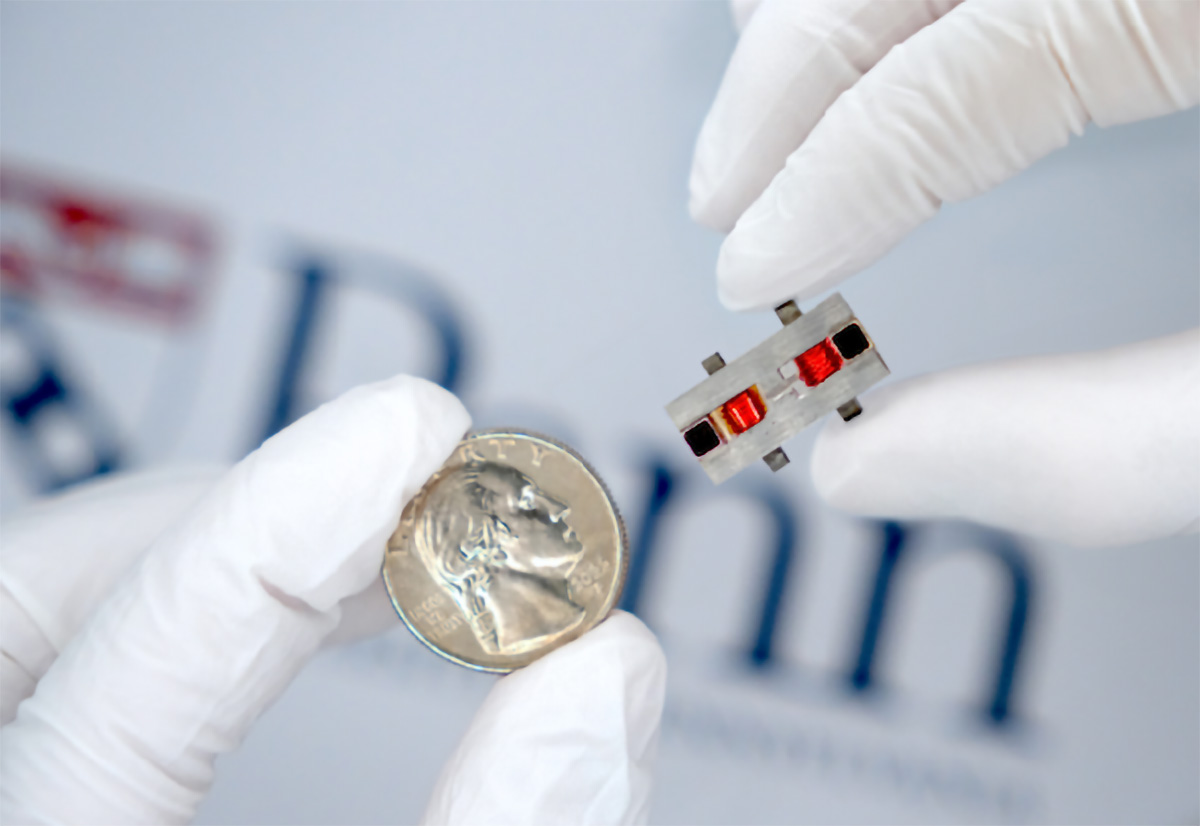
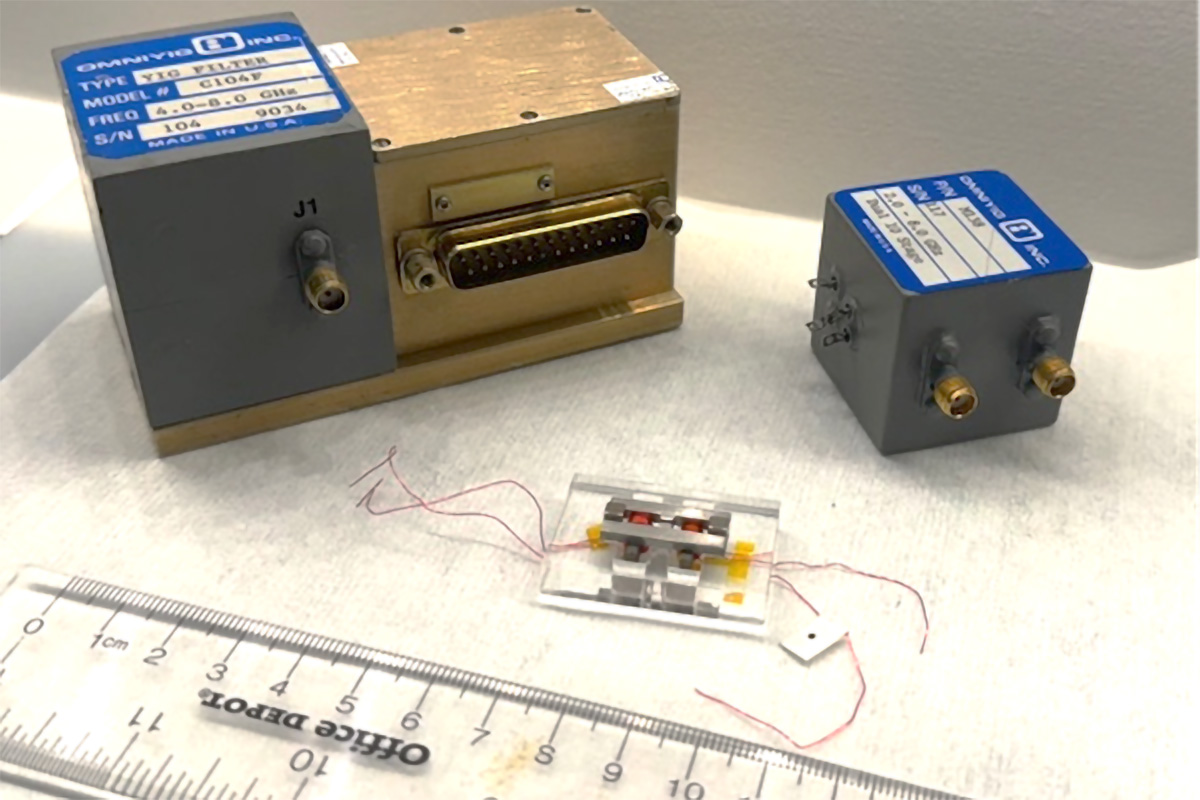
In addition to being tunable, the new filter is also tiny—about the same size as a quarter, in contrast to previous generations of YIG filters, which resembled large packs of index cards.
One reason the new filter is so small, and therefore could potentially be inserted into mobile phones in the future, is that it requires very little power. “We pioneered the design of a zero-static-power, magnetic-bias circuit,” says Du, referring to a type of circuit that creates a magnetic field without requiring any energy beyond the occasional pulse to readjust the field.
While YIG was discovered in the 1950s, and YIG filters have existed for decades, the combination of the novel circuit with extremely thin YIG films micromachined in the Singh Center for Nanotechnology dramatically reduced the new filter’s power consumption and size. “Our filter is 10 times smaller than current commercial YIG filters,” says Du.
Reference: “Frequency tunable magnetostatic wave filters with zero static power magnetic biasing circuitry” by Xingyu Du, Mohamad Hossein Idjadi, Yixiao Ding, Tao Zhang, Alexander J. Geers, Shun Yao, Jun Beom Pyo, Firooz Aflatouni, Mark Allen and Roy H. Olsson III, 27 April 2024, Nature Communications.
DOI: 10.1038/s41467-024-47822-3
In June, Olsson and Du will present the new filter at the 2024 Institute of Electrical and Electronics Engineers (IEEE) Microwave Theory and Techniques Society (MTT-S) International Microwave Symposium, in Washington, D.C.
This study was conducted at the University of Pennsylvania School of Engineering and Applied Science. It was supported by a grant from the Defense Advanced Research Projects Agency (FA8650-21-1-7010) and made use of resources sponsored by the National Science Foundation National Nanotechnology Coordinated Infrastructure Program (NNCI-1542153).
Never miss a breakthrough: Join the SciTechDaily newsletter.
Follow us on Google and Google News.
1 Comment
5G when announced was advertised to deliver 100Gb data speeds and is delivering 2% at best, the 256 bit QAM signal used at the 22 and 39GHz spectrum allocations had a range of 200M and required multi element antennas that tracked users. The quadrature amplitude modulation required very good phase and amplitude resolution at the cell site and user locations, and in low population settings was cost prohibitive. None the less, the use of the new modulation waveform required using the lower frequency bands where the previous generations of signals were being used, effectively forcing the older users to upgrade in order to maintain operational capabilities. I would expect 6G to be no less burdensome to users and more problematic to implement than 5G is proving to be. In ultra dense population areas, these new encoding waveforms are valuable while 98% of users were doing okay on 3G and 4G. GSNS systems are within these bands and the issues with the 3.5 GHz aircraft radio altimeters was an issue as C-band cellular signals began to populate nearby allocations. A problem not addressed is the generation of spurious products produced by the intermodulation components of other transmitters or even passively when corrosion effects on metal structures allows mixing of the products to occur. Our navy sees a degradation of their various systems on older ships that is difficult to find and correct, but the effects of dissimilar metals at radio sites is well known.