

Close Menu
    Facebook X (Twitter) Instagram
    SciTechDaily
    • Biology
    • Chemistry
    • Earth
    • Health
    • Physics
    • Science
    • Space
    • Technology
    Facebook X (Twitter) Pinterest YouTube RSS
    SciTechDaily
    Home»Technology»The Next-Generation of Memory Technology – New Material Shows Promise
    Technology

    The Next-Generation of Memory Technology – New Material Shows Promise

    By Tohoku UniversitySeptember 4, 2023No Comments3 Mins Read
    Facebook Twitter Pinterest Telegram LinkedIn WhatsApp Email Reddit
    Share
    Facebook Twitter LinkedIn Pinterest Telegram Email Reddit
    Advanced Computer Memory Chip Artist Concept
    Tohoku University researchers have advanced phase change memory by using sputtering to create niobium telluride (NbTe4), a material with superior storage and thermal capabilities.

    Niobium telluride (NbTe4) improves phase change memory with better thermal stability and efficiency, enabling next-generation data storage.

    Phase change memory is a type of nonvolatile memory that utilizes the capability of phase change materials (PCM) to transition between an amorphous state, where atoms are scattered, and a crystalline state, where atoms are closely aligned. This change produces a reversible electrical property that can be engineered to store and retrieve data.

    Whilst this field is in its infancy, phase change memory could potentially revolutionize data storage because of its high storage density, and faster read and write capabilities. But still, the complex switching mechanism and intricate fabrication methods associated with these materials have posed challenges for mass production.
    Comparison of TC and Tm Values of Various 2D TM Chalcogenides
    A comparison of Tc (crystallization temperature) and Tm (melting point) values of various 2D TM chalcogenides; The Tc and Tm values of NbTe4 were defined by the onset temperature of crystallization and melting peaks in this study. Credit: Yi Shuang et al.

    In recent years, two-dimensional (2D) Van Der Waals (vdW) transition metal di-chalcogenides have emerged as a promising PCM for usage in phase change memory. Now, a group of researchers from Tohoku University has highlighted the potential use of sputtering to fabricate large-area 2D vdW tetra-chalcogenides. Using this technique, they fabricated and identified an exceptionally promising materialーniobium telluride (NbTe4)ーthat exhibits an ultra-low melting point of approximately 447 ºC or 837 ºF (onset temperature), setting it apart from other TMDs.

    “Sputtering is a widely used technique that involves depositing thin films of a material onto a substrate, enabling precise control over film thickness and composition,” explains Yi Shuang, assistant professor at Tohoku University’s Advanced Institute for Materials Research and co-author of the paper. “Our deposited NbTe4 films were initially amorphous, but could be crystallized to a 2D layered crystalline phase by annealing at temperatures above 272 ºC (522 ºF).”
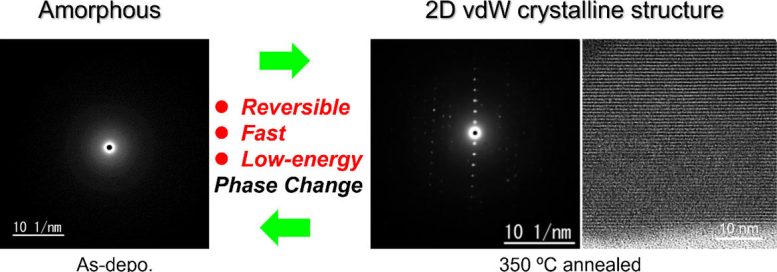
    A Selected Area Electron Diffraction and Crossectional TEM Image of As Deposited and 350 Annealed NbTe4 Thin Films
    A selected area electron diffraction and crossectional TEM image of as-deposited and 350 ℃ annealed NbTe4 thin films. Credit: Yi Shuang et al.

    Advantages of NbTe4 Over Conventional PCMs

    Unlike conventional amorphous-crystalline PCMs, such as Ge2Sb2Te5 (GST), NbTe4 demonstrates both a low melting point and a high crystallization temperature. This unique combination offers reduced reset energies and improved thermal stability at the amorphous phase.

    After fabricating the NbTe4s, the researchers then evaluated its switching performance. It exhibited a significant reduction in operation energy compared to conventional phase-change memory compounds. The estimated 10-year data retention temperature was found to be as high as 135 ºC (275 ºF) – better than the 85 ºC (185 ºF) of GST – suggesting excellent thermal stability and the possibility of NbTe4 being used in high-temperature environments such as in the automotive industry. Additionally, NbTe4 demonstrated a fast-switching speed of approximately 30 nanoseconds, further highlighting its potential as a next-generation phase change memory.

    “We have opened up new possibilities for developing high-performance phase change memories,” adds Shuang. “With NbTe4‘s low melting point, high crystallization temperature, and excellent switching performances, it is positioned as the ideal material to address some of the current challenges faced by current PCMs.”

    Reference: “NbTe4 Phase-Change Material: Breaking the Phase-Change Temperature Balance in 2D Van der Waals Transition-Metal Binary Chalcogenide” by Yi Shuang, Qian Chen, Mihyeon Kim, Yinli Wang, Yuta Saito, Shogo Hatayama, Paul Fons, Daisuke Ando, Momoji Kubo and Yuji Sutou, 20 June 2023, Advanced Materials.
    DOI: 10.1002/adma.202303646

    Never miss a breakthrough: Join the SciTechDaily newsletter.
    Follow us on Google and Google News.

    Materials Science Tohoku University
    Share. Facebook Twitter Pinterest LinkedIn Email Reddit

    Related Articles

    Just Hype? New Study Challenges Core Assumptions About Solid-State Lithium Metal Batteries

    Terahertz Waves Supercharged: A Breakthrough With Magnetic Materials

    Laser-Powered Leap: Next-Generation Magnetic Devices That Control Light

    Powering the Future: Innovative Device Harvests Vibrational Energy

    Light-Speed Advances: Graphene Nanoprocessing With a Femtosecond Laser

    SnS Crystals Open Pathway for Improved Next Generation Solar Cells

    3D Self-Assembling Polymer Materials Could Lead to New Microchips

    Elastomeric “Soft” Robots Running on Pneumatic Actuators

    Researchers Develop World’s Lightest Material

    Leave A Reply Cancel Reply

    • Facebook
    • Twitter
    • Pinterest
    • YouTube

    Don't Miss a Discovery

    Subscribe for the Latest in Science & Tech!

    Trending News

    Bone-Strengthening Discovery Could Reverse Osteoporosis

    Scientists Uncover Hidden Trigger Behind Stem Cell Aging

    Scientists Find Way to Reverse Fatty Liver Disease Without Changing Diet

    Could Humans Regrow Limbs? New Study Reveals Promising Genetic Pathway

    Scientists Reveal Eating Fruits and Vegetables May Increase Your Risk of Lung Cancer

    Scientists Reverse Brain Aging With Simple Nasal Spray

    Scientists Uncover Potential Brain Risks of Popular Fish Oil Supplements

    Scientists Discover a Surprising Way To Make Bread Healthier and More Nutritious

    Follow SciTechDaily
    • Facebook
    • Twitter
    • YouTube
    • Pinterest
    • Newsletter
    • RSS
    SciTech News
    • Biology News
    • Chemistry News
    • Earth News
    • Health News
    • Physics News
    • Science News
    • Space News
    • Technology News
    Recent Posts
    • Alzheimer’s Symptoms May Start Outside the Brain, Study Finds
    • Cancer’s Secret Weapon? Scientists Reveal How Tumors “Learn” To Survive Treatment
    • Millions Take This Popular Supplement – Scientists Discover a Concerning Link to Heart Failure
    • What Makes Rubber So Strong? Scientists Finally Solve 100-Year-Old Mystery
    • Scientists Decode Mysterious Magnetic “Maze Domains” To Boost EV Efficiency
    Copyright © 1998 - 2026 SciTechDaily. All Rights Reserved.
    • Science News
    • About
    • Contact
    • Editorial Board
    • Privacy Policy
    • Terms of Use

    Type above and press Enter to search. Press Esc to cancel.