

The discovery of Ahvaytum bahndooiveche, a 230-million-year-old dinosaur in Wyoming, reveals dinosaurs existed in the northern hemisphere earlier than believed, challenging past theories.
When and how did dinosaurs first appear and spread across the planet over 200 million years ago? This question has long sparked debate among paleontologists, who must rely on incomplete fossil records. The prevailing theory suggests that dinosaurs first emerged in the southern region of the ancient supercontinent Pangea, known as Gondwana, before eventually expanding into the northern portion, called Laurasia.
However, this view is being challenged by the discovery of a newly identified dinosaur species, unearthed by paleontologists from the University of Wisconsin–Madison. This evidence suggests that dinosaurs existed in the northern hemisphere millions of years earlier than previously believed.
The UW–Madison research team has been studying these fossil remains since their discovery in 2013 in present-day Wyoming, a region that was near the equator on Laurasia during the Triassic period. The species, named Ahvaytum bahndooiveche, is now recognized as the oldest known dinosaur from Laurasia. Dating back approximately 230 million years, its fossils are as old as the earliest known dinosaurs from Gondwana.
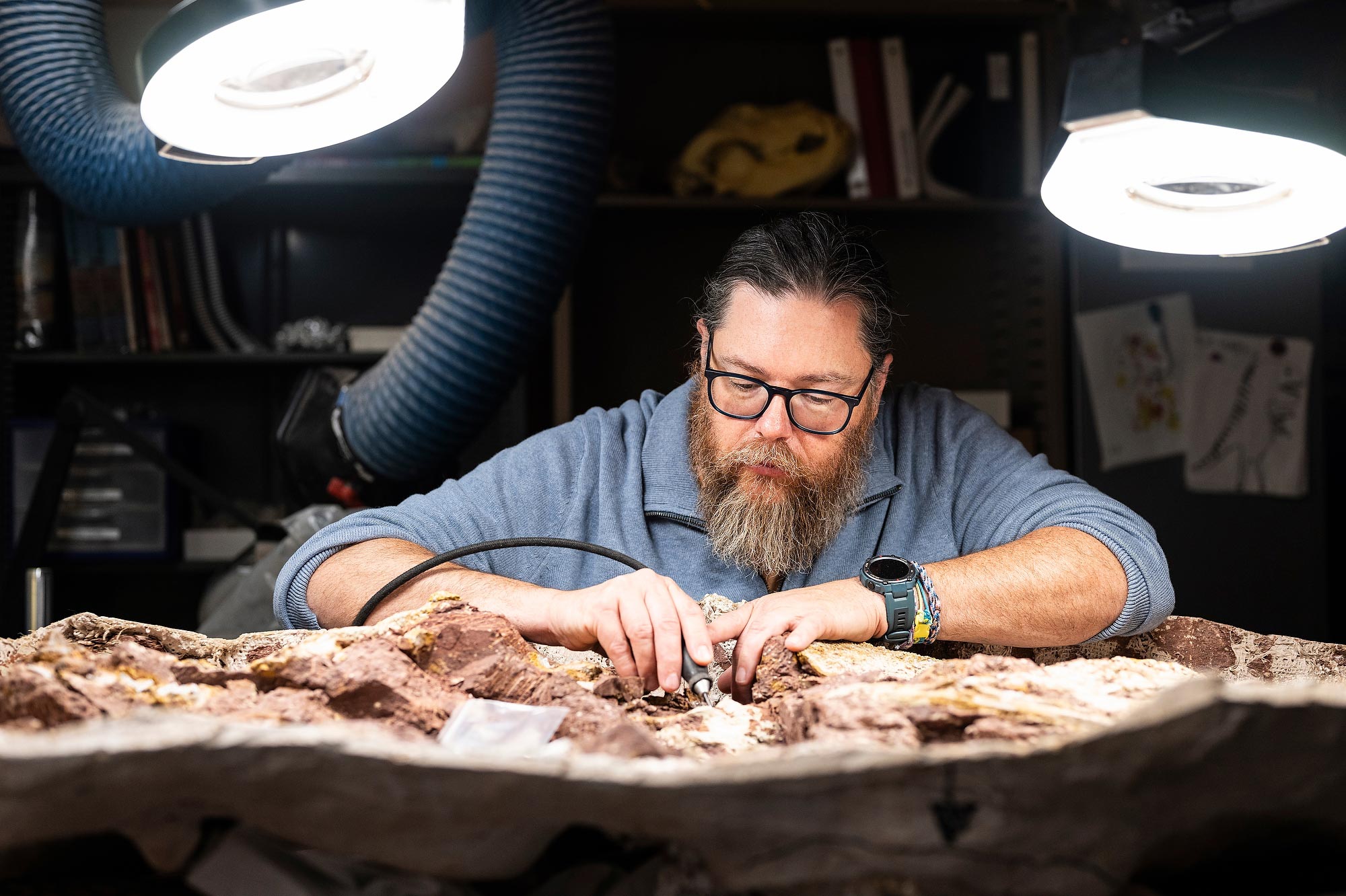
UW–Madison scientists and their research partners detail their discovery Jan. 8, 2025, in the Zoological Journal of the Linnean Society.
“We have, with these fossils, the oldest equatorial dinosaur in the world — it’s also North America’s oldest dinosaur,” says Dave Lovelace, a research scientist at the University of Wisconsin Geology Museum who co-led the work with graduate student Aaron Kufner.
A Small Yet Significant Discovery
Discovered in a layer of rock known as the Popo Agie Formation, it took years of careful work by Lovelace and his colleagues to analyze the fossils, establish them as a new dinosaur species, and determine their estimated age.
While the team doesn’t have a complete specimen — that’s an exceedingly rare occurrence for early dinosaurs — they did find enough fossils, particularly parts of the species’ legs, to positively identify Ahvaytum bahndooiveche as a dinosaur, and likely as a very early sauropod relative. Sauropods were a group of herbivorous dinosaurs that included some famously gigantic species like those in the aptly named group of titanosaurs. The distantly related Ahvaytum bahndooiveche lived millions of years earlier and was smaller — much smaller.
“It was basically the size of a chicken but with a really long tail,” says Lovelace. “We think of dinosaurs as these giant behemoths, but they didn’t start out that way.”
Indeed, the type specimen of Ahvaytum bahndooiveche, which was full-grown but could have been slightly bigger at its maximum age, stood a little over one foot tall and was around three feet long from head to tail. Although scientists haven’t found its skull material, which could help illuminate what it ate, other closely related early sauropod-line dinosaurs were eating meat and would likely have been omnivorous.
A Dinosaur Shaped by Climate Change
The researchers found the few known bones of Ahvaytum in a layer of rock just a little bit above those of a newly described amphibian that they also discovered. The evidence suggests that Ahvaytum bahndooiveche lived in Laurasia during or soon after a period of immense climatic change known as the Carnian pluvial episode that has previously been connected to an early period of diversification of dinosaur species.
The climate during that period, lasting from about 234 to 232 million years ago, was much wetter than it had been previously, transforming large, hot stretches of desert into more hospitable habitats for early dinosaurs.
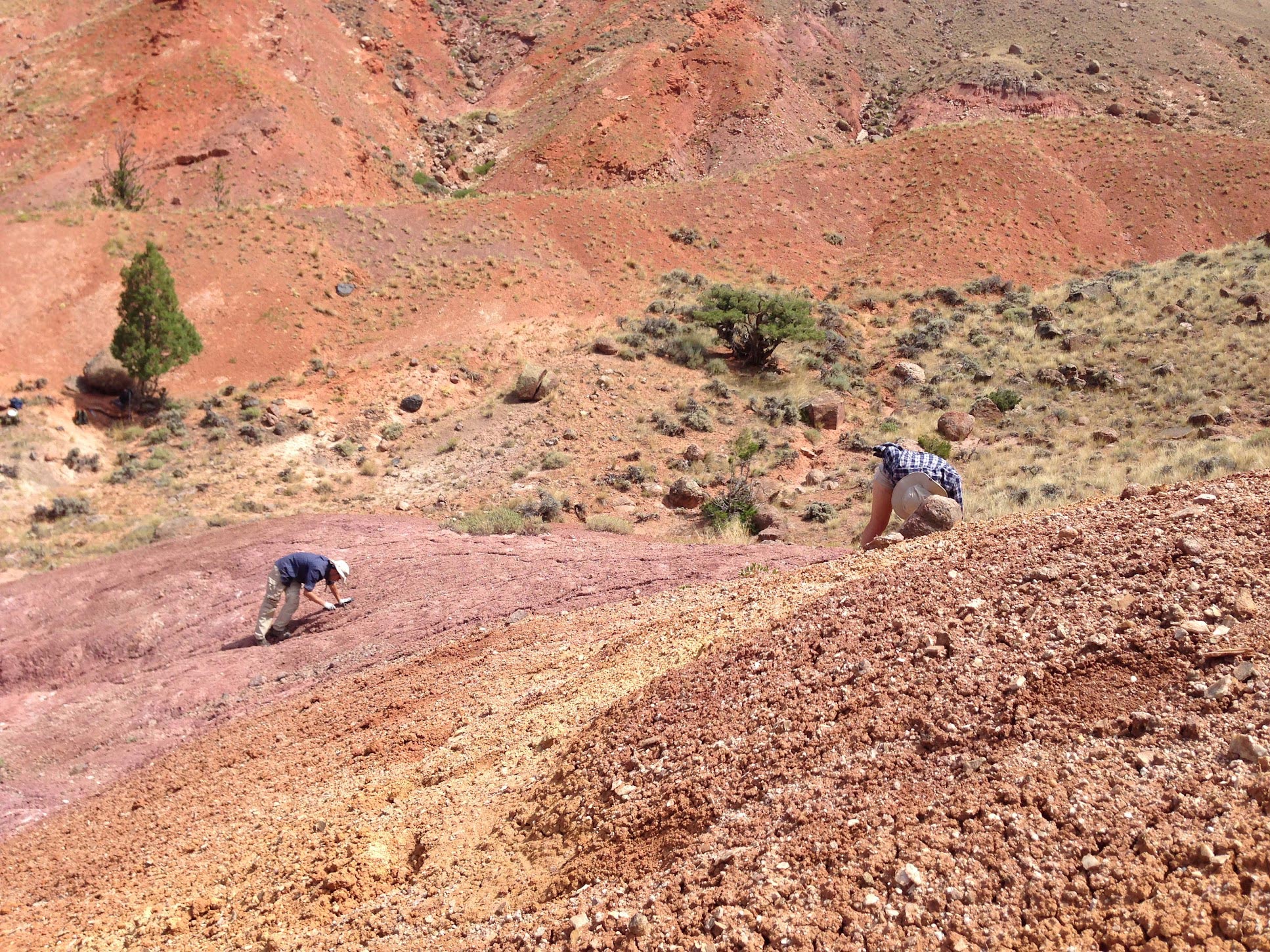
Lovelace and his colleagues performed high-precision radioisotopic dating of rocks in the formation that held Ahvaytum’s fossils, which revealed that the dinosaur was present in the northern hemisphere around 230 million years ago. The researchers also found an early dinosaur-like track in slightly older rocks, demonstrating that dinosaurs or their cousins were already in the region a few million years prior to Ahvaytum.
“We’re kind of filling in some of this story, and we’re showing that the ideas that we’ve held for so long — ideas that were supported by the fragmented evidence that we had — weren’t quite right,” Lovelace says. “We now have this piece of evidence that shows dinosaurs were here in the northern hemisphere much earlier than we thought.”
Honoring Indigenous Heritage in Scientific Discovery
While the scientific team is confident they’ve discovered North America’s oldest dinosaur, it’s also the first dinosaur species to be named in the language of the Eastern Shoshone Tribe, whose ancestral lands include the site where the fossils were found. Eastern Shoshone tribal elders and middle school students were integral to the naming process. Ahvaytum bahndooiveche broadly translates to “long ago dinosaur” in the Shoshone language.
Several tribal members also partnered with Lovelace and his UW–Madison colleagues as the researchers sought to evolve their field practices and better respect the land by incorporating the knowledge and perspectives of the Indigenous peoples into their work.
“The continuous relationship developed between Dr. Lovelace, his team, our school district, and our community is one of the most important outcomes of the discovery and naming of Ahvaytum bahndooiveche,” says Amanda LeClair-Diaz, a co-author on the paper and a member of the Eastern Shoshone and Northern Arapaho Tribes. LeClair-Diaz is the Indian education coordinator at Fort Washakie school and coordinated the naming process with students and tribal elders — a process that started under her predecessor, Lynette St. Clair.
“Typically, the research process in communities, especially Indigenous communities, has been one-sided, with the researchers fully benefiting from studies,” says LeClair-Diaz. “The work we have done with Dr. Lovelace breaks this cycle and creates an opportunity for reciprocity in the research process.”
Reference: “Rethinking dinosaur origins: oldest known equatorial dinosaur-bearing assemblage (mid-late Carnian Popo Agie FM, Wyoming, USA)” by David M Lovelace, Aaron M Kufner, Adam J Fitch, Kristina Curry Rogers, Mark Schmitz, Darin M Schwartz, Amanda LeClair-Diaz, Lynette St.Clair, Joshua Mann and Reba Teran, 8 January 2025, Zoological Journal of the Linnean Society.
DOI: 10.1093/zoolinnean/zlae153
Never miss a breakthrough: Join the SciTechDaily newsletter.
Follow us on Google and Google News.
3 Comments
Pterosaur is 252 million years ago one of oldest dinosaur are they from North American or South America.sauropod have gar fish vertebrae a advance fish vertebrae the opisthocoelous vertebrae allso found in the land mammal giraffe I thought all mammal have there own unique vertebrae .sauropod allso have modern crocodilian vertebrae allso found in lizard it’s strange that lizard has this feature it’s like a warm blooded feature a fast feature the procoelous vertebrae. in mesoeucrocodylia mostly found in eusuchian .dinosaur clearly continue show it’s ancestor of modern crocodilian and show they share unique feature .most dinosaur have primitive fish vertebra like the tuatara by cladistic I do not know what tuatara vertebrae is the tuatara is the most primitive reptile alive
They cliam procoelous vertebrae is aquatic feature they are many land lizard .sauropod has it in neck and tail the tail has crocodilian skin fossil a aquatic feature they allso has opisthocoelous on the tail some of them. sauropod procoelous a fast swimming tail these cruiseship can swim .there neck not are flexible like most reptile while walking they can not put the head on ground they sprawl to do that I have to check ankle
Are not flexible…….. .there neck does not move like the tail only up and down the tail a theropod bipedal feature that not a good swimming feature but dinosaur can swim but not very good. by walking under water they go bipedal to breathe .modern crocodilian can use there tail to side dinosaur can not like the neck in the movie cliam it had mammal neck or bird s neck which is impossible there neck is not straight most reptile it is straight it was like modern crocodilian the gator neck is not very reptile.the modern crocodilian neck can not go to side there neck ribs are too big it and sauropod reduce some of rib they have best neck movement in dinosaur the sauropod allso has odontoid neck like the gator some of them a death roll feature in gator it allso found in bird and mammal.