

A study at one of Earth’s most isolated research stations offers new clues about how teams adapt during long periods of confinement.
When people are isolated in extreme environments, it seems intuitive that spending more time together would strengthen social bonds. But new research suggests that under the right conditions, constant contact may actually create new sources of tension.
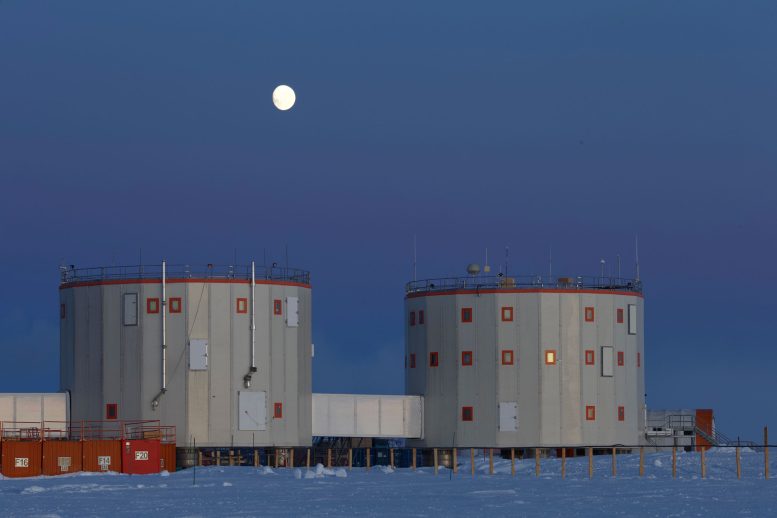
An international team led by Jan Schmutz of the University of Zurich and Andrea Cantisani of the University of Bern investigated how prolonged confinement affects group dynamics during a 10-month overwintering mission at Concordia Station in Antarctica. The remote outpost is considered one of the best real-world stand-ins for future missions to the Moon or Mars, where small crews will live and work together for months or even years.
Located on the Antarctic plateau, Concordia Station experiences winter temperatures as low as minus 80°C (minus 112°F) and remains largely cut off from the rest of the world during the winter months. These conditions provide researchers with a rare opportunity to study the psychological and social challenges of long-term isolation.
Throughout the mission, 12 crew members completed periodic surveys and wore proximity sensors that tracked their day-to-day interactions. The combination of self-reported experiences and objective behavioral data allowed scientists to follow changes in team relationships over time.
More Contact, More Conflict?
One of the study’s most surprising findings was that spending more time in close proximity to others was not always beneficial. Participants who interacted more frequently with fellow crew members were more likely to report conflict, increasing mistrust, and lower performance. The findings indicate that in highly confined environments, constant contact can become a source of stress alongside isolation.
“In small teams under extreme conditions, more contact doesn’t automatically equate to social support, but can actually increase tensions,” says Jan Schmutz. Because the study identified correlations rather than cause-and-effect relationships, the researchers cannot determine what drove these outcomes. For instance, people experiencing loneliness may have sought more social interaction, but those interactions may not have provided the support they needed.
Team Fragmentation and Social Subgroups
Data from the wearable sensors also showed that the crew gradually split into smaller social groups over time. Team members tended to spend more time with people who shared their language or nationality. While these connections can offer comfort and stability in stressful situations, they may also contribute to social divisions and reduce cohesion within multicultural teams.
The findings have important implications for future long-duration space missions, where small groups of astronauts may live and work together for months or even years with limited privacy and little contact with the outside world. The results may also be relevant to other isolated settings, including submarines, offshore oil platforms, and remote research stations. “The results show how important it is to identify social dynamics early on and provide teams with targeted support,” Schmutz says.
The study also found that wearable proximity sensors remained reliable under extreme Antarctic conditions. These devices enabled researchers to monitor changes in daily social patterns without disrupting crew activities. Future studies will investigate which types of social interactions help reduce stress and which may increase it.
Reference: “Social interactions in isolated, confined, and extreme environments: A study of Antarctic winter teams using wearable sensors” by Andrea Cantisani, Jan B. Schmutz, Pedro Marques-Quinteiro, Lorenzo Dall’Amico, Ciro Cattuto, Mirko Antino, Walter J. Eppich, Katharina Stegmayer and Sebastian Walther, 26 May 2026, Proceedings of the National Academy of Sciences.
DOI: 10.1073/pnas.2533420123
Never miss a breakthrough: Join the SciTechDaily newsletter.
Follow us on Google and Google News.
15 Comments
It is not as difficult to live alone on a sailboat as it is with even one or two other persons. There is a huge difference between solitude and being lonely.
Yes, I agree.
Why would anyone think throwing a bunch of random people together could be expected to cause them to like each other? It’s not impossible for people to find they are more compatible than expected, but there is no reason to expect that the entire group will slowly decide that an obnoxious egoistic rude person is fun to have around. Some people grow on you and others just become harder to deal with. I suspect that an authoritarian who has been given too much authority might eventually became impossible to tolerate. That’s the kind of thing the planners of long term missions need to be thinking about.
Maybe the proximity sensors caused the stress. The absolute lack of privacy would cause massive distress for some, if not all.
Are they trying to revise the 1982 script from “The Thing”?
All those involved in the research are not lonely. Some people came with their own agenda to be an observant, learn something and have fun! Hopefully, the environment was warm, sunny, with green and brown stuff for concentration. Maybe stuff figures for them to talk to in privacy would have helped them. Perhaps, if you’re stuck with anyone long enough, they are not a stranger. If you choose to make them a stranger without people support – you may become conflicted or mental.
There is nothing here that any career submariner couldn’t have told you.
Um, wasn’t there an issue with 3rd worlders acting anti-social (African normal in other terms)?
Actually, Africans on-avg are very slighly more social than most.
‘ it seems intuitive that spending more time together would strengthen social bonds ‘
To whom would that be intuitive? To people who have no intuition?
Oh! This only emphasizes the nature of humanity. Under environmental distress, the DNA of humanity socially bifurcates and migrates to more hospitable climates. This exemplifies how our Earth was populated by humans that sought better survival.
Oh! This only emphasizes the nature of humanity. Under environmental distress, the DNA of humanity socially bifurcates and migrates to more hospitable climates. This exemplifies how our Earth was populated by humans that sought better survival.
Weren’t most sea voyages like this in the age of sail? Cramped quarters, nothing outside but salt water, few books or other resources, fellowship constrained by class, duty and discipline. Loggers in camp from fall to spring, or survey parties pegging out frontier territories for months, had the same limited prospects, which frequently failed to produce harmony.
I knew this years ago, hell anyone in the military could have told you this.
Surprising? “Familiarity breeds contempt” is a cliche for a reason.