
Close Menu
    Facebook X (Twitter) Instagram
    SciTechDaily
    • Biology
    • Chemistry
    • Earth
    • Health
    • Physics
    • Science
    • Space
    • Technology
    Facebook X (Twitter) Pinterest YouTube RSS
    SciTechDaily
    Home»Physics»The Quantum Teleportation Race Goes Into Space in 2016
    Physics

    The Quantum Teleportation Race Goes Into Space in 2016

    By SciTechDailyDecember 7, 20123 Comments4 Mins Read
    Facebook Twitter Pinterest Telegram LinkedIn WhatsApp Email Reddit
    Share
    Facebook Twitter LinkedIn Pinterest Telegram Email Reddit
    quantum-teleportation-space-race
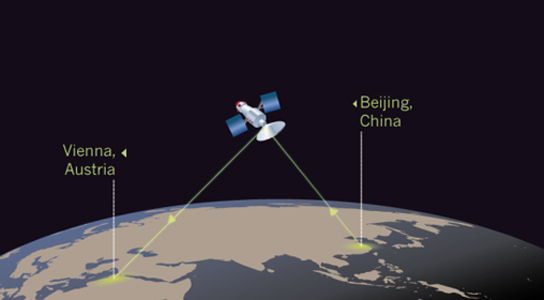
    One entangled photon is beamed from Beijing to Vienna. Credit: Nature doi:10.1038/492022a

    Three years ago, Jian-Wei Pan and his colleagues were able to quantum teleport information across 16 kilometers (10 miles). This was one of the first major steps to the research team’s ultimate goal of teleporting photons to a satellite orbiting the Earth.

    Once this is achieved, it will establish the first links of the quantum Internet, which harnesses the powers of subatomic physics in order to create a super-secure global communication network. In 2016, China plans on launching a satellite dedicated to quantum science experiments, ahead of the ESA and NASA.

    When the satellite is launched, Pan and Anton Zeilinger, a physicist at the University of Vienna, plan on creating the first intercontinental quantum-secured network, connecting Asia to Europe by satellite.
    quantum-teleportation-entangled-photon-china
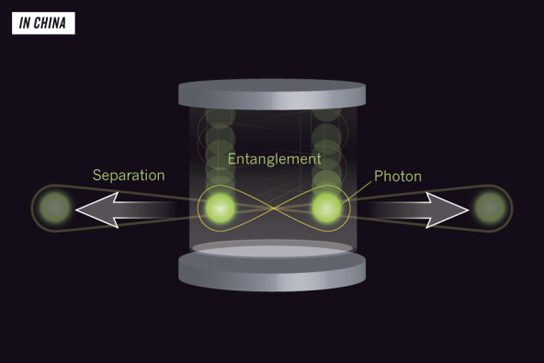
    Two photons are ‘entangled’ in the lab. Although their individual polarizations are not yet set, the entanglement ensures that any measurement will find both polarizations to be identical — no matter how widely the particles are separated. Credit: Nature doi:10.1038/492022a

    Quantum objects exist in a superposition of many states, as particles and waves. This is described in a particle’s wavefunction, which gives the probability that it is in each of those states. When the particle’s properties are measured, the wavefunction collapses, choosing a definite state in a single location. The quantum property of entanglement between particles can be correlated with measurements, even if they are separated by huge distances. Quantum superposition demands that these properties cannot be fixed until measured.

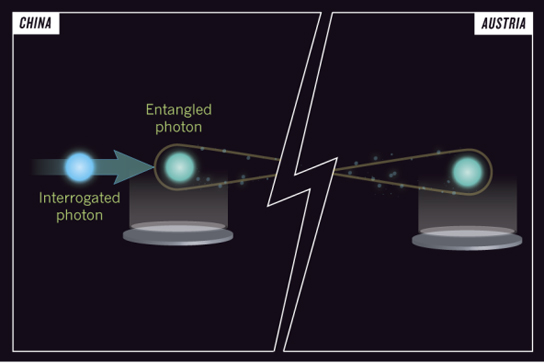
    Zeilinger was able to show that buckyballs, fullerene molecules containing 60 carbon atoms, can exhibit both wave and particle behavior. Quantum teleportation shows that all information about a quantum object can be scanned in one location and recreated in another, thanks to entanglement because operations carried out on one of the entangled particles affects the state of its partner, no matter how far away it is. The objects can be manipulated to transmit quantum information.
    quantum-teleportation-entangled-photon
    The stay-at-home photon is used to pick up information from another photon. The traveling photon is instantly affected by the comparison in China, and acquires information about the interrogated photon. Credit: Nature doi:10.1038/492022a

    The data transmission of entangled particles is usually fraught with noise, scattering interactions which could destroy the delicate quantum correlations needed for teleportation to work. In order to transmit data beyond a city, it needs to be teleported through a satellite.

    Currently, the record for quantum teleportation is 143 km (89 mi), achieved by the Austrian team. Since the scientific concerns about teleporting to a satellite have been defused, the next step involves using one to test out quantum teleportation. The China National Space Administration stepped in after the ESA hesitated.

    At these larger distances, general relativity starts to have an effect. Quantum theory and general relativity represent different conceptions of space and time, and physicists haven’t yet been able to unify them into a framework of quantum gravity.

    Einstein postulates that space-time is perfectly smooth, even at infinitesimal scales. Quantum uncertainty implies that it’s impossible to examine space at such small distances. The satellite experiments could help determine when the rules of quantum theory apply over general relativity, and when the former starts to take effect.

    It’s also an open question whether entangled particles will survive between space and Earth. If they don’t, physicists will have to look for an alternative theory to quantum mechanics. The satellite could also probe into the structure of space-time made by quantum-gravity theories. All of such theories predict that space-time becomes grainy beyond the scale of 1E-35 meters, i.e. the Planck length. Photons traveling from the satellite would be very slightly slowed and their polarizations would undergo a tiny, random rotation, which would be large enough to be detected at the ground station.

    Never miss a breakthrough: Join the SciTechDaily newsletter.
    Follow us on Google and Google News.

    General Relativity Quantum Mechanics Quantum Physics Quantum Teleportation Satellites
    Share. Facebook Twitter Pinterest LinkedIn Email Reddit

    Related Articles

    Einstein Meets Quantum Mechanics – And the Results Are Surprising

    Quantum Teleportation Breakthrough Sends 5 States at Once

    Earth’s Gravity Might Be Warping Quantum Mechanics, Say Physicists

    New Time Dilation Phenomenon Revealed: Timekeeping Theory Combines Quantum Clocks and Einstein’s Relativity

    Quantum Physics – Teleporting Toward a Quantum Internet

    Experiment Shows That Light Defies the Principles of Classical Physics

    “Schrödinger’s Hat” Conceals Matter Waves Inside an Invisible Container

    Simulating Quantum Walks in Two Dimensions

    Evidence of Elusive Majorana Fermions Raises Possibilities for Quantum Computing

    3 Comments

    1. seth scheller on December 7, 2012 12:42 pm

      what about quantum communication? it would make deep space robotics easier to use.

      Reply
    2. Peter on December 11, 2013 4:37 pm

      I didn’t know that Vienna, Austria was in the middle of Egypt in northeast Africa! I thought it was in Europe … somewhere around Germany or something. (Also, it looks as though they must have moved Bejing to Shanghai; but at least it’s still in China.)

      Reply
    3. Angel Chronicles on January 4, 2018 12:54 pm

      Old news for the feeble-minded has been in existence and used for years already.

      Reply
    Leave A Reply Cancel Reply

    • Facebook
    • Twitter
    • Pinterest
    • YouTube

    Don't Miss a Discovery

    Subscribe for the Latest in Science & Tech!

    Trending News

    Scientists May Have Found the Key to Jupiter and Saturn’s Moon Mystery

    Scientists Uncover Brain Changes That Link Pain to Depression

    Saunas May Do More Than Raise Body Temperature – They Activate Your Immune System

    Exercise in a Pill? Metformin Shows Surprising Effects in Cancer Patients

    Hidden Oceans of Magma Could Be Protecting Alien Life

    New Study Challenges Alzheimer’s Theories: It’s Not Just About Plaques

    Artificial Sweeteners May Harm Future Generations, Study Suggests

    Splashdown! NASA Artemis II Returns From Record-Breaking Moon Mission

    Follow SciTechDaily
    • Facebook
    • Twitter
    • YouTube
    • Pinterest
    • Newsletter
    • RSS
    SciTech News
    • Biology News
    • Chemistry News
    • Earth News
    • Health News
    • Physics News
    • Science News
    • Space News
    • Technology News
    Recent Posts
    • Scientists Make Breakthrough on 40-Year-Old 2D Physics Puzzle
    • As Cities Invade the Amazon, Yellow Fever Makes a Dangerous Comeback
    • “Asian Flush” May Be a Hidden Trigger for Deadly Heart Damage
    • AI Could Detect Early Signs of Alzheimer’s in Under a Minute – Far Before Traditional Tests
    • What if Dark Matter Has Two Forms? Bold New Hypothesis Could Explain a Cosmic Mystery
    Copyright © 1998 - 2026 SciTechDaily. All Rights Reserved.
    • Science News
    • About
    • Contact
    • Editorial Board
    • Privacy Policy
    • Terms of Use

    Type above and press Enter to search. Press Esc to cancel.