
Close Menu
    Facebook X (Twitter) Instagram
    SciTechDaily
    • Biology
    • Chemistry
    • Earth
    • Health
    • Physics
    • Science
    • Space
    • Technology
    Facebook X (Twitter) Pinterest YouTube RSS
    SciTechDaily
    Home»Space»The Universe Just Sent Us a Spooky Bat Signal
    Space

    The Universe Just Sent Us a Spooky Bat Signal

    By European Southern Observatory (ESO)October 31, 2025No Comments4 Mins Read
    Facebook Twitter Pinterest Telegram LinkedIn WhatsApp Email Reddit
    Share
    Facebook Twitter LinkedIn Pinterest Telegram Email Reddit
    RCW 94/95 Nebulae
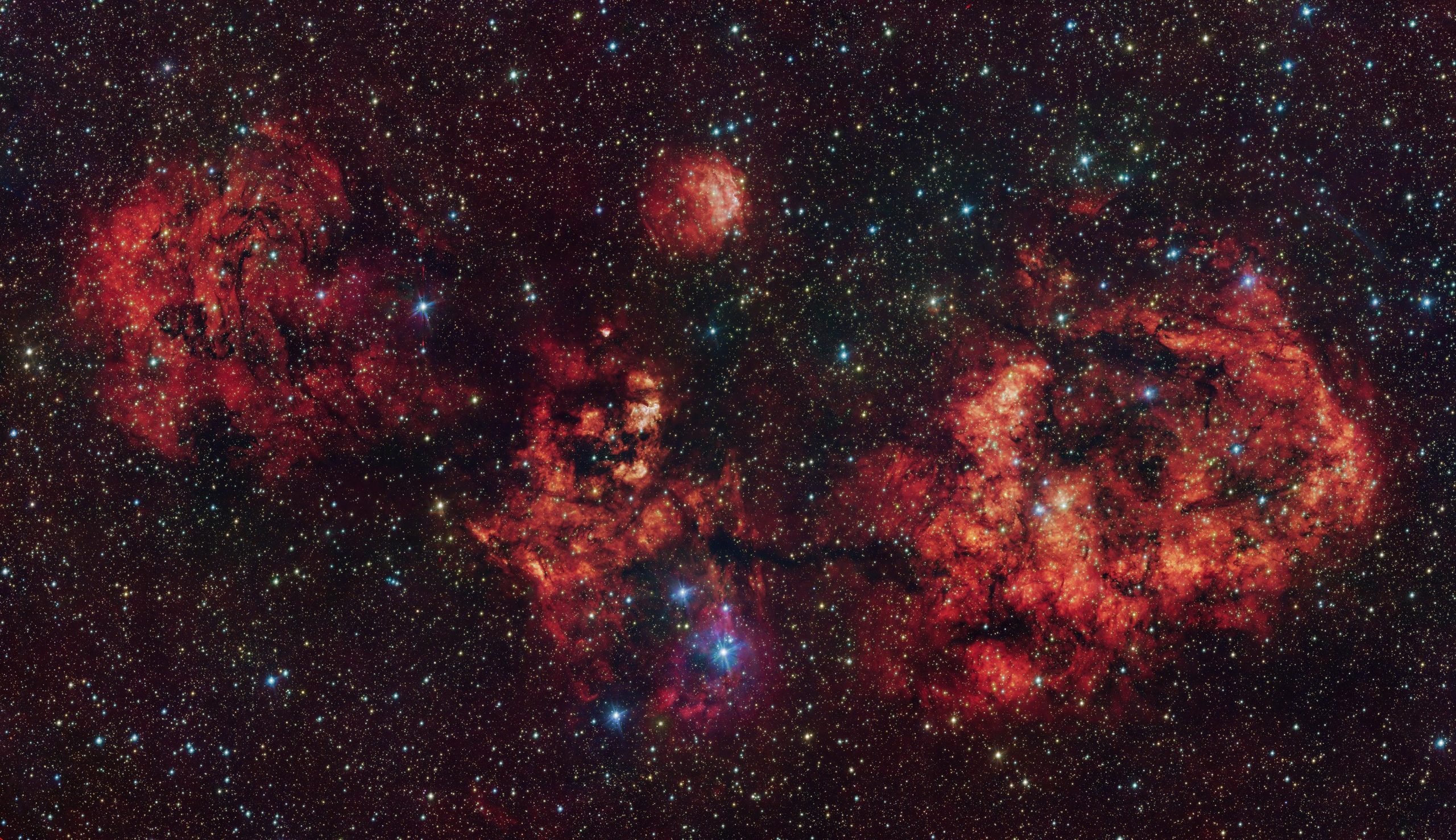
    This image shows a cloud of gas and dust, shaped like a cosmic bat. The image was obtained mostly in visible light with the VLT Survey Telescope (VST), hosted at ESO’s Paranal Observatory in Chile. The intense red glow comes from hydrogen atoms ionised by the intense radiation of young stars within the cloud. The image also includes additional infrared data captured by ESO’s Visible and Infrared Survey Telescope for Astronomy (VISTA), also at Paranal. The most prominent clouds here are RCW 94, which represents the right wing of the bat, and RCW 95, which forms the body, while the other parts of the bat have no official designation. Credit: ESO/VPHAS+ team/VVV team

    A ghostly “cosmic bat” nebula, glowing red with newborn stars, has been captured by ESO’s telescope in Chile.

    Just in time for Halloween, astronomers have captured the image of a bat-like figure soaring across the night sky over the European Southern Observatory’s (ESO’s) Paranal site in Chile. Using its exceptionally wide field of view, the VLT Survey Telescope (VST) recorded a vast cloud of interstellar gas and dust whose ghostly outline looks strikingly like the shape of a flying bat.

    Situated around 10,000 light-years from Earth, this “cosmic bat” appears to drift between the southern constellations of Circinus and Norma. The nebula stretches across a portion of the sky roughly equal to four full Moons. In the image, it seems to be swooping toward a glowing patch of light above it, giving the impression of a predator on the hunt.

    This mysterious structure is actually a stellar nursery—a vast region of gas and dust where new stars are forming. Young stars inside release enough radiation to energize the surrounding hydrogen gas, causing it to shine in deep shades of red. The darker, thread-like features resemble the bat’s skeletal wings. These filaments are cooler and denser than the surrounding material, with dust particles that obscure the starlight behind them.
    Wide Field View Around RCW 94/95 Nebulae
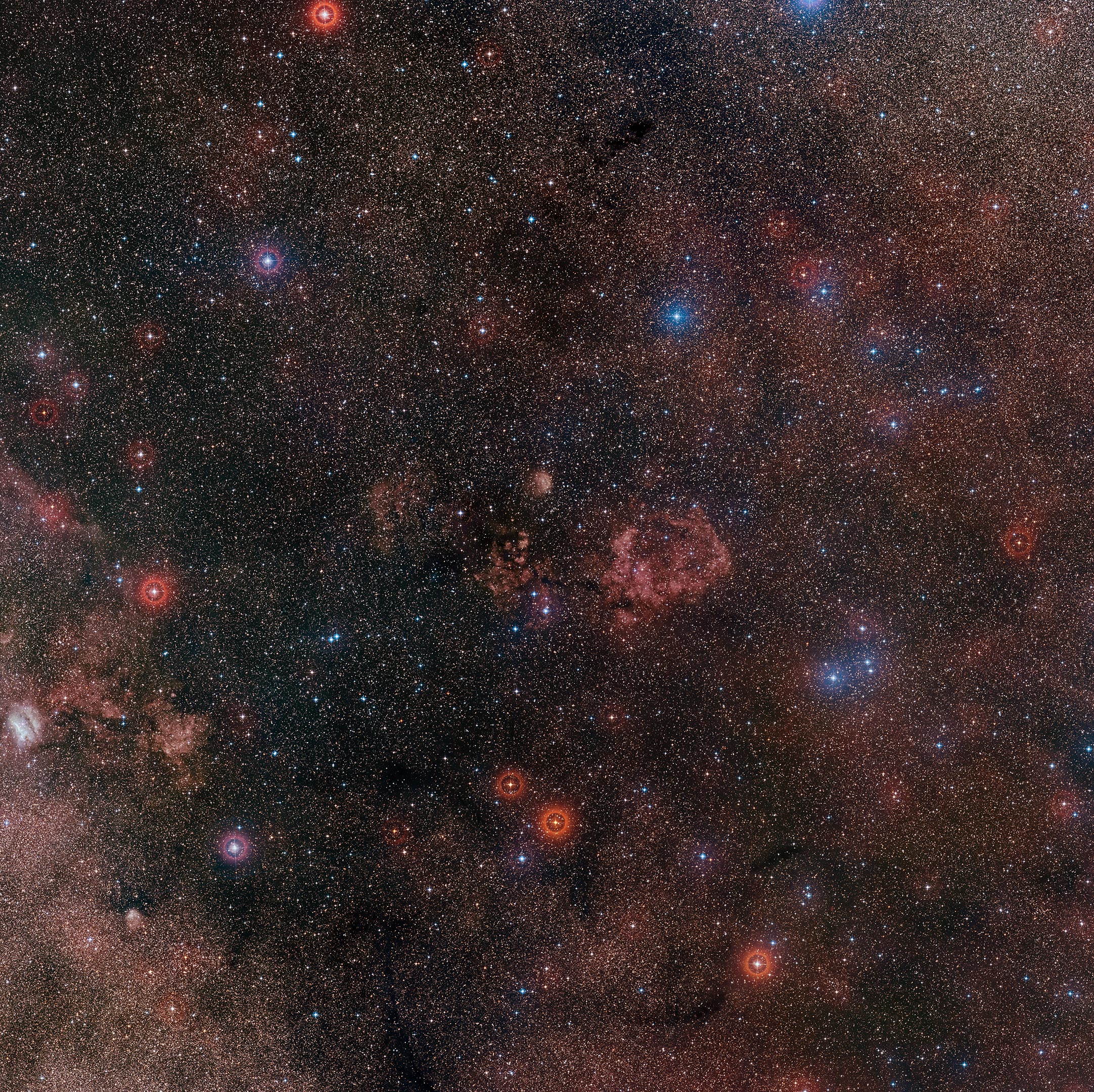
    This image from the Digitized Sky Survey (DSS) shows the region of the sky around the RCW 94 and RCW 95 nebulae, seen here at the center of the image. The nebulae are part of a larger complex of clouds resembling a bat, with RCW 94 representing the right wing and RCW 95 the body, respectively. Credit: ESO/Digitized Sky Survey 2

    The nebula’s main features correspond to well-known star-forming regions cataloged in the southern sky. RCW 94 makes up the right wing of the bat, while RCW 95 forms the central body. The remaining parts of the structure have not been given official names, adding to the nebula’s eerie, otherworldly allure.

    This extraordinary view was made possible by the VST, a telescope operated by the Italian National Institute for Astrophysics (INAF) and located at ESO’s Paranal Observatory in Chile’s Atacama Desert. The telescope is ideally suited for photographing expansive cosmic formations like this one. Mounted on it is OmegaCAM, a 268-megapixel camera that allows astronomers to capture exceptionally detailed, wide-field images of the night sky.

    To create the final image, scientists merged data collected through several filters, each designed to capture different wavelengths of light. The red glow outlining most of the bat’s shape was recorded in visible light through the VST Photometric Hα Survey of the Southern Galactic Plane and Bulge (VPHAS+). Additional infrared observations from ESO’s Visible and Infrared Survey Telescope for Astronomy (VISTA), gathered as part of the VISTA Variables in the Vía Láctea (VVV) survey, reveal hidden details in the nebula’s densest regions.
    RCW 94/95 Nebulae in Circinus and Norma Constellations
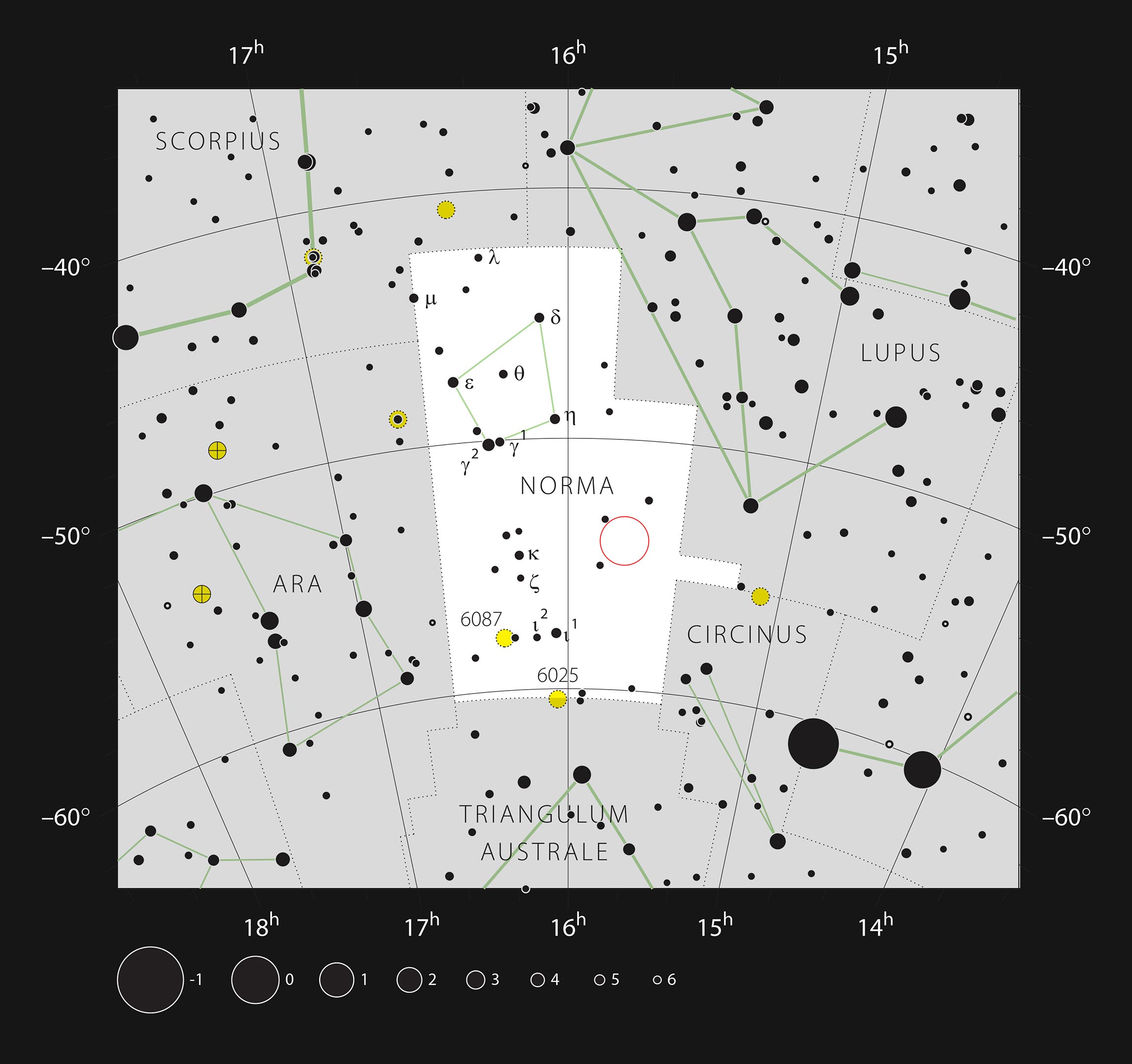
    This chart shows the location of the RCW 94 and RCW 95 nebulae between the Circinus and Norma constellations. This map shows most of the stars visible to the unaided eye under good conditions. The location of the nebulae is marked with a red circle. Credit: ESO, IAU and Sky & Telescope

    Both surveys are publicly available, inviting anyone to explore these breathtaking cosmic vistas. Look closer, if you dare, and let your curiosity wander through the haunting beauty of the universe. Happy Halloween!

    Never miss a breakthrough: Join the SciTechDaily newsletter.
    Follow us on Google and Google News.

    Astronomy European Southern Observatory
    Share. Facebook Twitter Pinterest LinkedIn Email Reddit

    Related Articles

    Supermassive Black Holes on a Collision Course: Closest Pair of Supermassive Black Holes to Earth Ever Discovered

    Black Hole Discovered Lurking in Star Cluster Outside Our Galaxy

    Discovery in a Galaxy Over 12 Billion Light-Years Away – Reveals How Element Found in Our Bones Is Forged in the Universe

    Strange 160 Mile-Long “Dog-Bone” Asteroid Kleopatra Captured in Detailed Images

    Astronomers Find Small Rocky Planet – Just Half the Mass of Venus

    First Clear Detection of a Moon-Forming Disc Around a Planet Outside Our Solar System

    Mystery Solved: Astronomers Unravel the Puzzle of Betelgeuse’s “Great Dimming”

    Stunning Galactic Fireworks: New ESO Images Reveal Spectacular Features of Nearby Galaxies

    Astronomers Were Puzzled by “Great Dimming” of Betelgeuse – Now the Mystery Is Solved

    Leave A Reply Cancel Reply

    • Facebook
    • Twitter
    • Pinterest
    • YouTube

    Don't Miss a Discovery

    Subscribe for the Latest in Science & Tech!

    Trending News

    One of the Universe’s Largest Stars May Be Getting Ready To Explode

    Scientists Discover Enzyme That Could Supercharge Ozempic-Like Weight Loss Drugs

    Popular Sweetener Linked to DNA Damage – “It’s Something You Should Not Be Eating”

    Ancient “Rock” Microbes May Reveal How Complex Life Began

    Researchers Capture Quantum Interference in One of Nature’s Rarest Atoms

    “A Plague Is Upon Us”: The Mass Death That Changed an Ancient City Forever

    Scientists Discover Game-Changing New Way To Treat High Cholesterol

    This Small Change to Your Exercise Routine Could Be the Secret to Living Longer

    Follow SciTechDaily
    • Facebook
    • Twitter
    • YouTube
    • Pinterest
    • Newsletter
    • RSS
    SciTech News
    • Biology News
    • Chemistry News
    • Earth News
    • Health News
    • Physics News
    • Science News
    • Space News
    • Technology News
    Recent Posts
    • Scientists Rethink Extreme Warming After Surprising Ocean Discovery
    • The Surprising Role of Asteroids in the Origin of Life
    • Scientists Raise Concerns Over Newly Recognized Pollutant Found Everywhere in the Air
    • New Study Challenges 40-Year Puzzle About Childhood Body Fat
    • 20-Year Study Finds Daily Multivitamins Don’t Extend Lifespan
    Copyright © 1998 - 2026 SciTechDaily. All Rights Reserved.
    • Science News
    • About
    • Contact
    • Editorial Board
    • Privacy Policy
    • Terms of Use

    Type above and press Enter to search. Press Esc to cancel.