
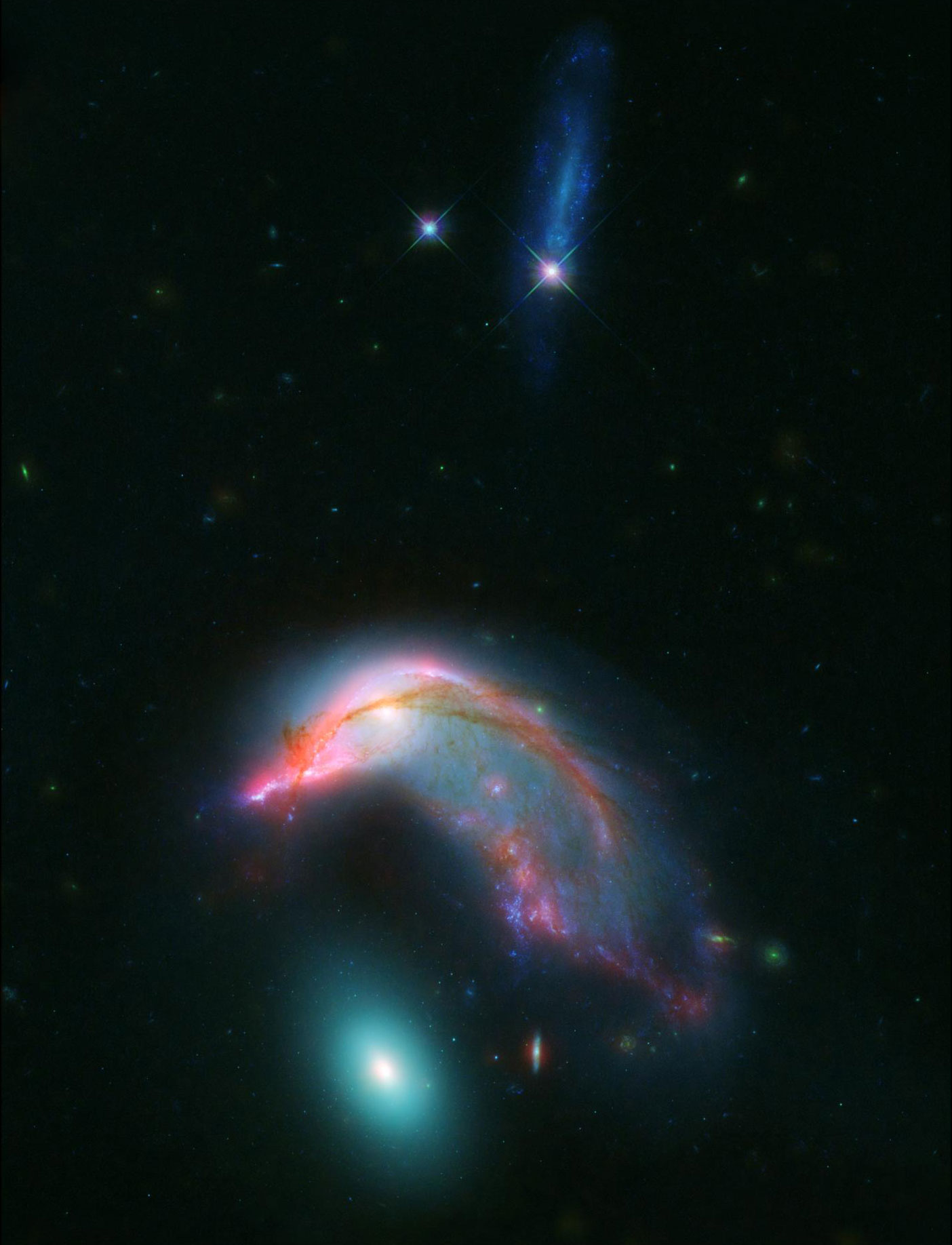
Data from NASA’s Spitzer and Hubble space telescopes have been combined to show this image of distant interacting galaxies in light that spans the visible and infrared parts of the spectrum. Known collectively as Arp 142, these interacting galaxies bear an uncanny resemblance to a penguin guarding an egg.
This dramatic pairing shows two galaxies that couldn’t look more different as their mutual gravitational attraction slowly drags them closer together.
The “penguin” part of the pair, NGC 2336, was probably once a relatively normal-looking spiral galaxy, flattened like a pancake with smoothly symmetric spiral arms. Rich with newly-formed hot stars, seen in visible light from Hubble as bluish filaments, its shape has now been twisted and distorted as it responds to the gravitational tugs of its neighbor. Strands of gas mixed with dust stand out as red filaments detected at longer wavelengths of infrared light seen by Spitzer.
The “egg” of the pair, NGC 2937, by contrast, is nearly featureless. The distinctly different greenish glow of starlight tells the story of a population of much older stars. The absence of glowing red dust features informs us that it has long since lost its reservoir of gas and dust from which new stars can form. While this galaxy is certainly reacting to the presence of its neighbor, its smooth distribution of stars obscures any obvious distortions of its shape.
Eventually, these two galaxies will merge to form a single object, with their two populations of stars, gas, and dust intermingling. This kind of merger was likely a significant step in the history of most large galaxies we see around us in the nearby universe, including our own Milky Way.
At a distance of about 23 million light-years, these two galaxies are roughly 10 times farther away than our nearest major galactic neighbor, the Andromeda galaxy. The blue streak at the top of the image is an unrelated background galaxy that is farther away than Arp 142.
Combining light from across the visible and infrared spectrums helps astronomers piece together the complex story of the life cycles of galaxies. While this image required data from both the Spitzer and Hubble telescopes to cover this range of light, NASA’s upcoming James Webb Space Telescope will be able to see all of these wavelengths of light, and with dramatically better clarity.
The Hubble Space Telescope is a project of international cooperation between NASA and ESA (European Space Agency). NASA’s Goddard Space Flight Center in Greenbelt, Maryland, manages the telescope. The Space Telescope Science Institute (STScI) in Baltimore, Maryland, conducts Hubble science operations. STScI is operated for NASA by the Association of Universities for Research in Astronomy, Inc., in Washington, D.C.
NASA’s Jet Propulsion Laboratory, Pasadena, California, manages the Spitzer Space Telescope mission for NASA’s Science Mission Directorate, Washington. Science operations are conducted at the Spitzer Science Center at Caltech in Pasadena, California. Spacecraft operations are based at Lockheed Martin Space Systems Company, Littleton, Colorado. Data are archived at the Infrared Science Archive housed at the Infrared Processing and Analysis Center at Caltech. Caltech manages JPL for NASA.
Never miss a breakthrough: Join the SciTechDaily newsletter.
Follow us on Google and Google News.
1 Comment
The main idea of the formation of celestial bodies was actually given by Sir Isaac Newton. Once upon a time, the world was filled with a homogeneous cloud of neutral hydrogen. If we look very far back in time, we will see how condensations appear in this cloud which, under the influence of gravitation, do not turn into a single huge mass, but transform into beautiful structured galaxies in which beautiful constellations appear by condensation. Unfortunately, this remarkable picture does not correspond to observations. We do not see gas clouds in which galactic structures gradually appear. There is no any gas reservoirs. The most distant observations demonstrate ready-made galaxies with all their structures and stellar populations. So, the new cosmogony only added dark matter and dark energy, which unfortunately are not observed.
https://www.academia.edu/34064032/The_Model_of_Real_Physical_Space_in_the_Light_of_Recent_Observations