

New research has revealed that the lag observed in organic electrochemical transistors (OECTs) when switched on is due to a two-step activation process, providing crucial insights for designing more effective and customizable OECTs for various technological and biological applications.
Researchers who want to bridge the divide between biology and technology spend a lot of time thinking about translating between the two different “languages” of those realms.
“Our digital technology operates through a series of electronic on-off switches that control the flow of current and voltage,” said Rajiv Giridharagopal, a research scientist at the University of Washington. “But our bodies operate on chemistry. In our brains, neurons propagate signals electrochemically, by moving ions — charged atoms or molecules — not electrons.”
Implantable devices from pacemakers to glucose monitors rely on components that can speak both languages and bridge that gap. Among those components are OECTs — or organic electrochemical transistors — which allow current to flow in devices like implantable biosensors. But scientists long knew about a quirk of OECTs that no one could explain: When an OECT is switched on, there is a lag before the current reaches the desired operational level. When switched off, there is no lag. Current drops almost immediately.
A UW-led study has solved this lagging mystery, and in the process paved the way to custom-tailored OECTs for a growing list of applications in biosensing, brain-inspired computation, and beyond.
Breakthrough in Understanding OECT Operation
“How fast you can switch a transistor is important for almost any application,” said project leader David Ginger, a UW professor of chemistry, chief scientist at the UW Clean Energy Institute and faculty member in the UW Molecular Engineering and Sciences Institute. “Scientists have recognized the unusual switching behavior of OECTs, but we never knew its cause – until now.”
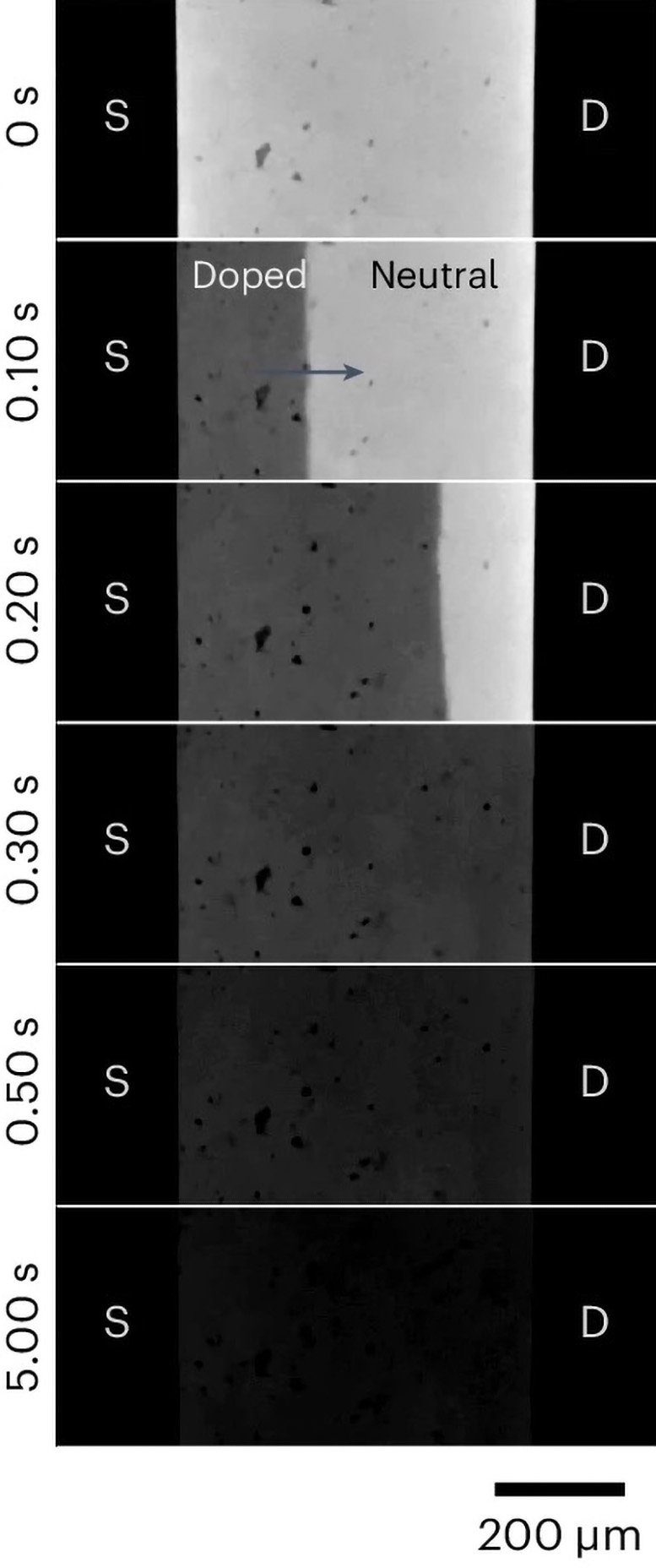
In a paper recently published in Nature Materials, Ginger’s team at the UW — along with Professor Christine Luscombe at the Okinawa Institute of Science and Technology in Japan and Professor Chang-Zhi Li at Zhejiang University in China — report that OECTs turn on via a two-step process, which causes the lag. But they appear to turn off through a simpler one-step process.
In principle, OECTs operate like transistors in electronics: When switched on, they allow the flow of electrical current. When switched off, they block it. But OECTs operate by coupling the flow of ions with the flow of electrons, which makes them interesting routes for interfacing with chemistry and biology.
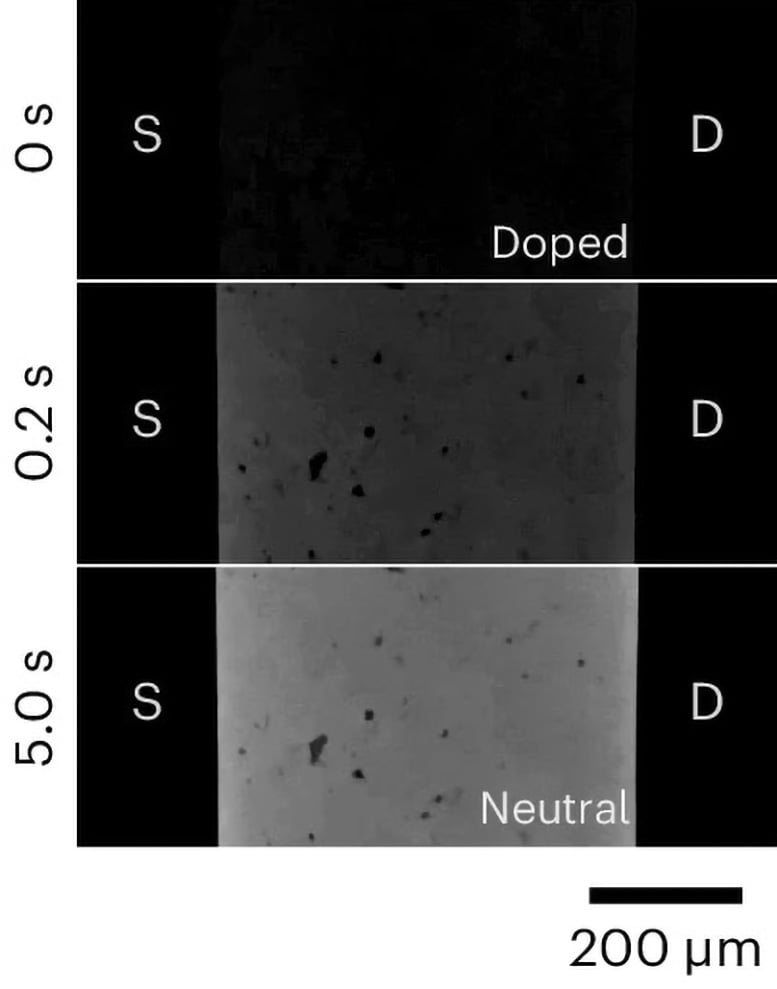
The new study illuminates the two steps OECTs go through when switched on. First, a wavefront of ions races across the transistor. Then, more charge-bearing particles invade the transistor’s flexible structure, causing it to swell slightly and bringing the current up to operational levels. In contrast, the team discovered that deactivation is a one-step process: Levels of charged chemicals simply drop uniformly across the transistor, quickly interrupting the flow of current.
Knowing the lag’s cause should help scientists design new generations of OECTs for a wider set of applications.
“There’s always been this drive in technology development to make components faster, more reliable, and more efficient,” Ginger said. “Yet, the ‘rules’ for how OECTs behave haven’t been well understood. A driving force in this work is to learn them and apply them to future research and development efforts.”
Whether they reside within devices to measure blood glucose or brain activity, OECTs are largely made up of flexible, organic semiconducting polymers — repeating units of complex, carbon-rich compounds — and operate immersed in liquids containing salts and other chemicals. For this project, the team studied OECTs that change color in response to electrical charge. The polymer materials were synthesized by Luscombe’s team at the Okinawa Institute of Science and Technology and Li’s at Zhejiang University, and then fabricated into transistors by UW doctoral students Jiajie Guo and Shinya “Emerson” Chen, who are co-lead authors on the paper.
“A challenge in the materials design for OECTs lies in creating a substance that facilitates effective ion transport and retains electronic conductivity,” said Luscombe, who is also a UW affiliate professor of chemistry and of materials science and engineering. “The ion transport requires a flexible material, whereas ensuring high electronic conductivity typically necessitates a more rigid structure, posing a dilemma in the development of such materials.”
Guo and Chen observed under a microscope — and recorded with a smartphone camera — precisely what happens when the custom-built OECTs are switched on and off. It showed clearly that a two-step chemical process lies at the heart of the OECT activation lag.
Past research, including by Ginger’s group at the UW, demonstrated that polymer structure, especially its flexibility, is important to how OECTs function. These devices operate in fluid-filled environments containing chemical salts and other biological compounds, which are more bulky compared to the electronic underpinnings of our digital devices.
Future Directions and Applications
The new study goes further by more directly linking OECT structure and performance. The team found that the degree of activation lag should vary based on what material the OECT is made of, such as whether its polymers are more ordered or more randomly arranged, according to Giridharagopal. Future research could explore how to reduce or lengthen the lag times, which for OECTs in the current study were fractions of a second.
“Depending on the type of device you’re trying to build, you could tailor composition, fluid, salts, charge carriers, and other parameters to suit your needs,” said Giridharagopal.
OECTs aren’t just used in biosensing. They are also used to study nerve impulses in muscles, as well as forms of computing to create artificial neural networks and understand how our brains store and retrieve information. These widely divergent applications necessitate building new generations of OECTs with specialized features, including ramp-up and ramp-down times, according to Ginger.
“Now that we’re learning the steps needed to realize those applications, development can really accelerate,” said Ginger.
Reference: “Understanding asymmetric switching times in accumulation mode organic electrochemical transistors” by Jiajie Guo, Shinya E. Chen, Rajiv Giridharagopal, Connor G. Bischak, Jonathan W. Onorato, Kangrong Yan, Ziqiu Shen, Chang-Zhi Li, Christine K. Luscombe and David S. Ginger, 17 April 2024, Nature Materials.
DOI: 10.1038/s41563-024-01875-3
Guo is now a postdoctoral researcher at the Lawrence Berkeley National Laboratory and Chen is now a scientist at Analog Devices. Other co-authors on the paper are Connor Bischak, a former UW postdoctoral researcher in chemistry who is now an assistant professor at the University of Utah; Jonathan Onorato, a UW doctoral alum and scientist at Exponent; and Kangrong Yan and Ziqui Shen of Zhejiang University. The research was funded by the U.S. National Science Foundation, and polymers developed at Zhejiang University were funded by the National Science Foundation of China.
Never miss a breakthrough: Join the SciTechDaily newsletter.
Follow us on Google and Google News.