
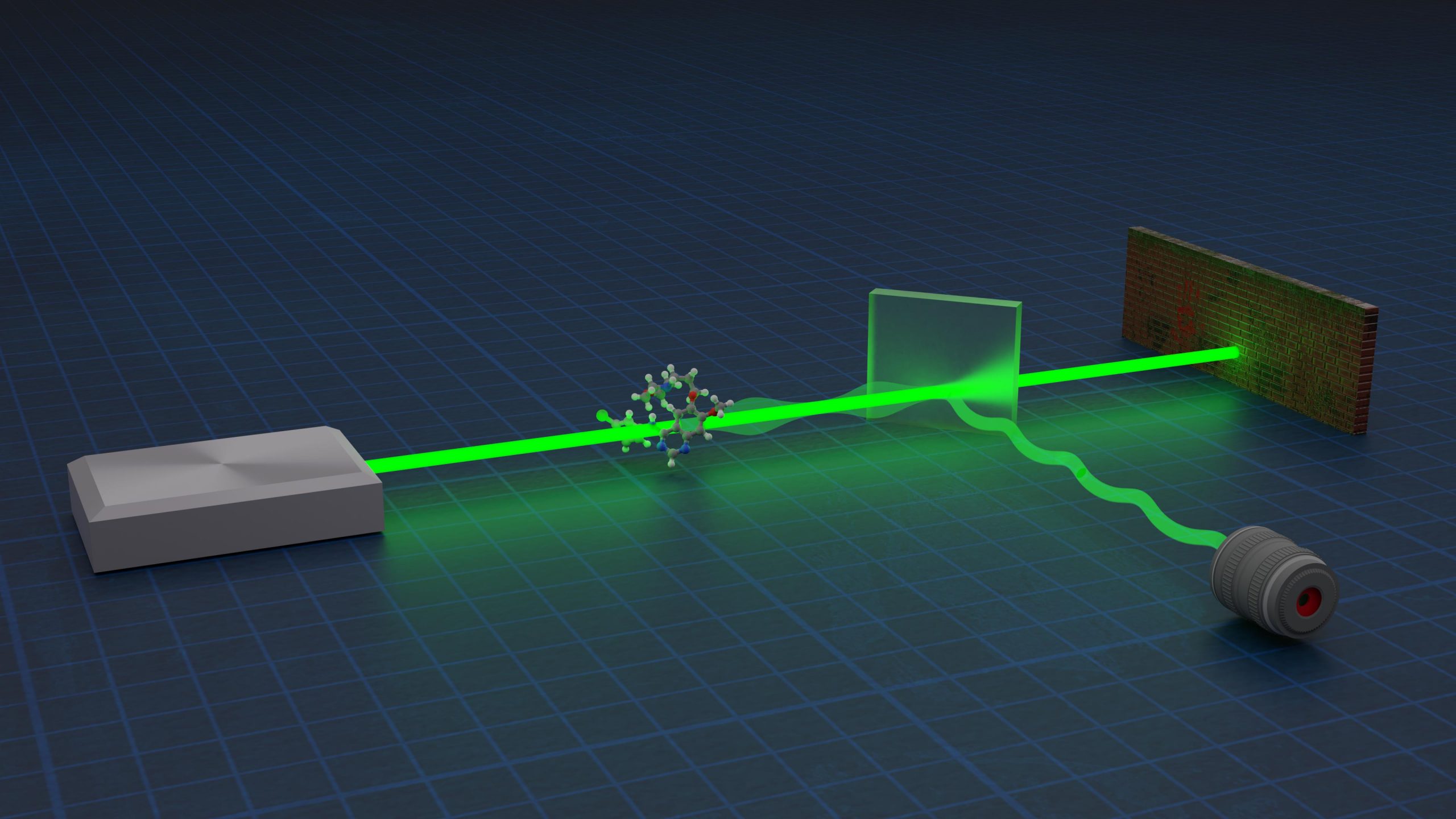
Scientists have found that a physical property called ‘quantum negativity’ can be used to take more precise measurements of everything from molecular distances to gravitational waves.
The researchers, from the University of Cambridge, Harvard, and MIT, have shown that quantum particles can carry an unlimited amount of information about things they have interacted with. The results, reported in the journal Nature Communications, could enable far more precise measurements and power new technologies, such as super-precise microscopes and quantum computers.
Metrology is the science of estimations and measurements. If you weighed yourself this morning, you’ve done metrology. In the same way as quantum computing is expected to revolutionize the way complicated calculations are done, quantum metrology, using the strange behavior of subatomic particles, may revolutionize the way we measure things.
We are used to dealing with probabilities that range from 0% (never happens) to 100% (always happens). To explain results from the quantum world, however, the concept of probability needs to be expanded to include a so-called quasi-probability, which can be negative. This quasi-probability allows quantum concepts such as Einstein’s ‘spooky action at a distance’ and wave-particle duality to be explained in an intuitive mathematical language. For example, the probability of an atom being at a certain position and traveling with a specific speed might be a negative number, such as -5%.
An experiment whose explanation requires negative probabilities is said to possess ‘quantum negativity.’ The scientists have now shown that this quantum negativity can help take more precise measurements.
All metrology needs probes, which can be simple scales or thermometers. In state-of-the-art metrology, however, the probes are quantum particles, which can be controlled at the sub-atomic level. These quantum particles are made to interact with the thing being measured. Then the particles are analyzed by a detection device.
In theory, the greater number of probing particles there are, the more information will be available to the detection device. But in practice, there is a cap on the rate at which detection devices can analyze particles. The same is true in everyday life: putting on sunglasses can filter out excess light and improve vision. But there is a limit to how much filtering can improve our vision — having sunglasses which are too dark is detrimental.
“We’ve adapted tools from standard information theory to quasi-probabilities and shown that filtering quantum particles can condense the information of a million particles into one,” said lead author Dr. David Arvidsson-Shukur from Cambridge’s Cavendish Laboratory and Sarah Woodhead Fellow at Girton College. “That means that detection devices can operate at their ideal influx rate while receiving information corresponding to much higher rates. This is forbidden according to normal probability theory, but quantum negativity makes it possible.”
An experimental group at the University of Toronto has already started building technology to use these new theoretical results. Their goal is to create a quantum device that uses single-photon laser light to provide incredibly precise measurements of optical components. Such measurements are crucial for creating advanced new technologies, such as photonic quantum computers.
“Our discovery opens up exciting new ways to use fundamental quantum phenomena in real-world applications,” said Arvidsson-Shukur.
Quantum metrology can improve measurements of things including distances, angles, temperatures, and magnetic fields. These more precise measurements can lead to better and faster technologies, but also better resources to probe fundamental physics and improve our understanding of the universe. For example, many technologies rely on the precise alignment of components or the ability to sense small changes in electric or magnetic fields. Higher precision in aligning mirrors can allow for more precise microscopes or telescopes, and better ways of measuring the Earth’s magnetic field can lead to better navigation tools.
Quantum metrology is currently used to enhance the precision of gravitational wave detection in the Nobel Prize-winning LIGO Hanford Observatory. But for the majority of applications, quantum metrology has been overly expensive and unachievable with current technology. The newly-published results offer a cheaper way of doing quantum metrology.
“Scientists often say that ‘there is no such thing as a free lunch,’ meaning that you cannot gain anything if you are unwilling to pay the computational price,” said co-author Aleksander Lasek, a Ph.D. candidate at the Cavendish Laboratory. “However, in quantum metrology, this price can be made arbitrarily low. That’s highly counterintuitive and truly amazing!”
Dr. Nicole Yunger Halpern, co-author and ITAMP Postdoctoral Fellow at Harvard University, said: “Everyday multiplication commutes: Six times seven equals seven times six. Quantum theory involves multiplication that doesn’t commute. The lack of commutation lets us improve metrology using quantum physics.
“Quantum physics enhances metrology, computation, cryptography, and more; but proving rigorously that it does is difficult. We showed that quantum physics enables us to extract more information from experiments than we could with only classical physics. The key to the proof is a quantum version of probabilities — mathematical objects that resemble probabilities but can assume negative and non-real values.”
Reference: “Quantum advantage in postselected metrology” by David R. M. Arvidsson-Shukur, Nicole Yunger Halpern, Hugo V. Lepage, Aleksander A. Lasek, Crispin H. W. Barnes and Seth Lloyd, 29 July 2020, Nature Communications.
DOI: 10.1038/s41467-020-17559-w
Never miss a breakthrough: Join the SciTechDaily newsletter.
Follow us on Google and Google News.
10 Comments
This sounds like such BS. Especially if it’s being promoted by cosmologists and incorporated into their theories of gravity waves. The cosmologists are always the first to latch on to impossible-sounding ideas, their only hope for proving dark matter / energy and big bang / genesis theories. The only advances in this area come from real physicists working with semiconductors, thin films and the like.
You sound like you know what you’re talking about; why don’t you go get a doctorate, secure a position at Harvard, and refute their findings with something other than your intuition?
“Hope”? Those cosmology entities are well tested since a couple of years – these results is just a search away [ https://en.wikipedia.org/wiki/Big_Bang ]. “Cosmologists now have fairly precise and accurate measurements of many of the parameters of the Big Bang model, and have made the unexpected discovery that the expansion of the universe appears to be accelerating.[citation needed]”
As Brett says, why don’t you get an education in these things and then do something productive with that?
Quantum computers are still pie-in-the-sky. This sounds like some of that. How can there be negative probabilities?
Consider that counter-intuitive mathematical constructs such as imaginary numbers have real-world applications in electrical calculations, real-time radar, etc. You can say “you can’t square a number and get a negative product”, and yet, it turns out to be a useful idea with practical consequences.
There isn’t, those are quasiprobabibilites of relative and nonlocal likelihoods. You can think of it as expressing a suppression in your bank account. “Oops, I added – 5 dollars!”
Math is seductive. The square root of 4 is 2. It can also be -2. This leads physicists to contemplate time travel and other speculations. I have NO grasp of quantum physics except for the experiments that show it does truly exist. Have you seen the 3 polarized filters video on Youtube? It cannot be explained by high-school physics. I am a member of Densa; the ungifted.
The last word before the creation of every black hole… “oops”
Old news… Douglas Adams developed the infinite improbability drive decades ago.
“This quasi-probability allows quantum concepts such as Einstein’s ‘spooky action at a distance’ and wave-particle duality to be explained in an intuitive mathematical language.”
““We’ve adapted tools from standard information theory to quasi-probabilities and shown that filtering quantum particles can condense the information of a million particles into one,””.
Not too surprising since amount of entanglement could potentially be infinite [ https://www.scottaaronson.com/blog/?p=4512 ].