
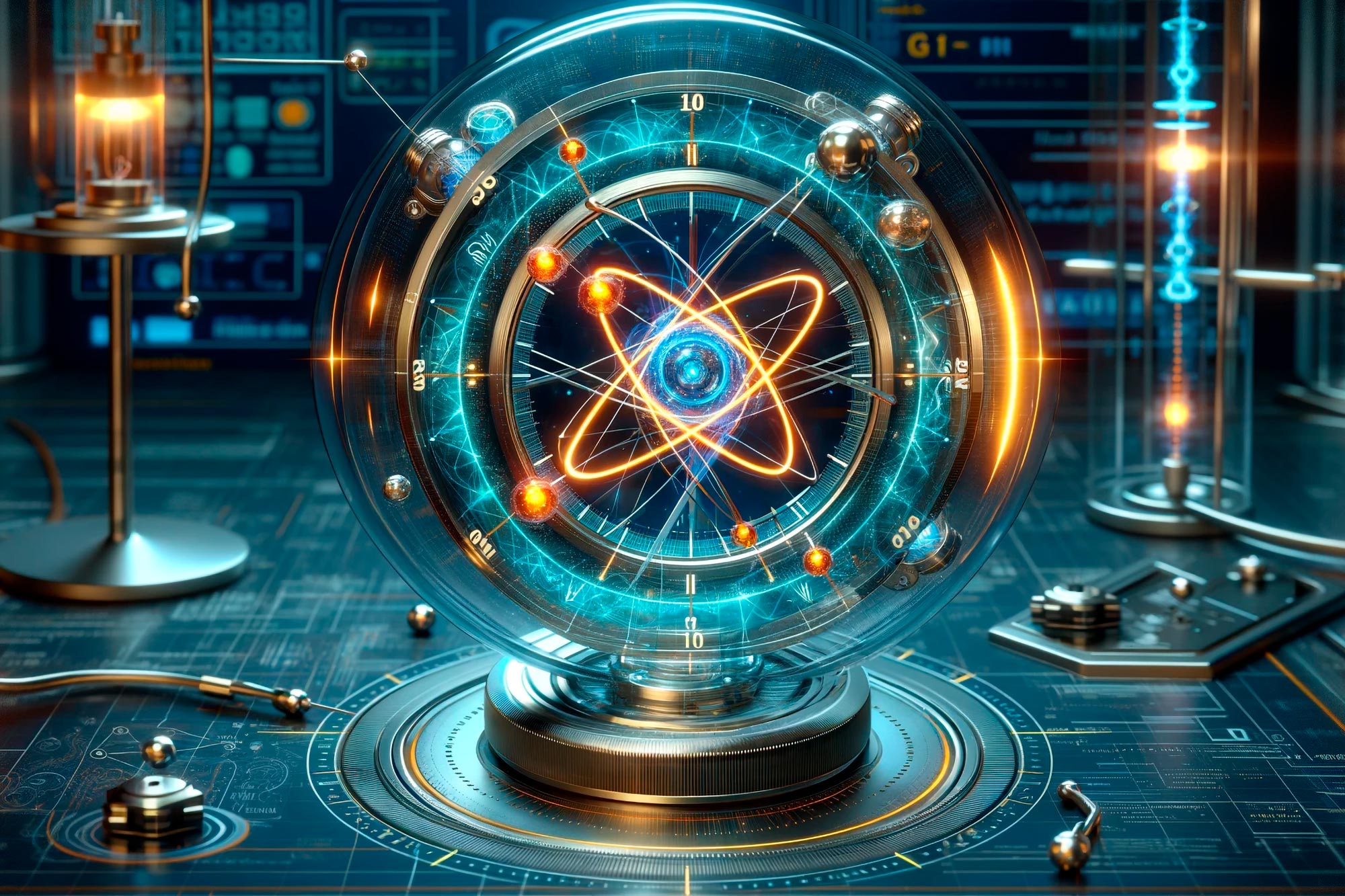
An international team at JILA is pioneering a nuclear clock that surpasses current atomic clocks in precision, potentially enabling advancements in GPS, internet synchronization, and secure communications.
Their work, leveraging thorium nuclei and ultraviolet lasers, has also established a crucial link to existing atomic timekeeping systems, offering insights into the fundamental physics and the potential for more robust, portable clocks.
Revolutionizing Timekeeping: The Advent of Nuclear Clocks
The world keeps time with the ticks of atomic clocks, but a new type of clock under development — a nuclear clock — could revolutionize how we measure time and probe fundamental physics.
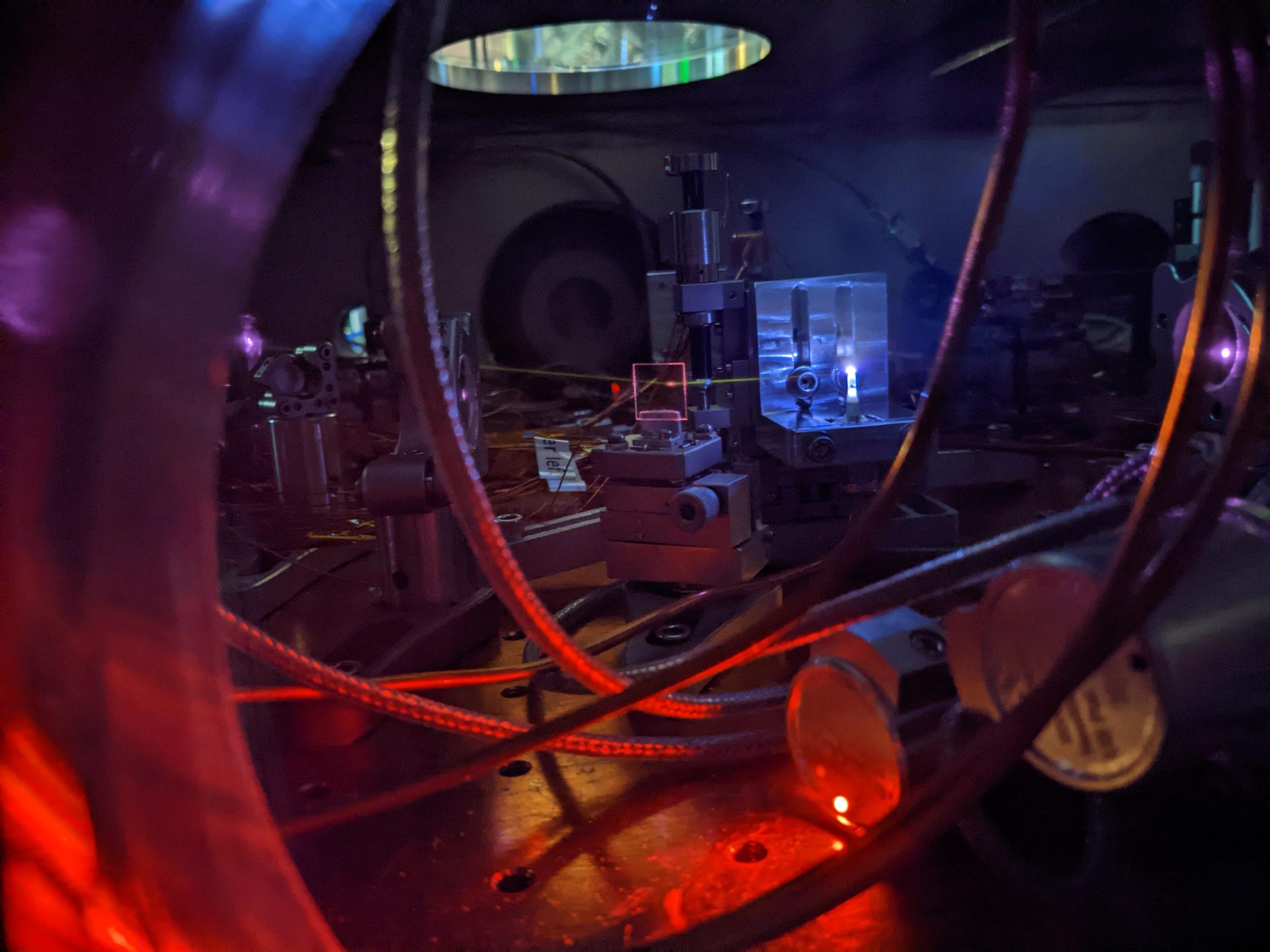
An international research team led by scientists at JILA, a joint institute of the National Institute of Standards and Technology (NIST) and the University of Colorado Boulder, has demonstrated key elements of a nuclear clock. A nuclear clock is a novel type of timekeeping device that uses signals from the core, or nucleus, of an atom. The team used a specially designed ultraviolet laser to precisely measure the frequency of an energy jump in thorium nuclei embedded in a solid crystal. They also employed an optical frequency comb, which acts like an extremely accurate light ruler, to count the number of ultraviolet wave cycles that create this energy jump. While this laboratory demonstration is not a fully developed nuclear clock, it contains all the core technology for one.
Enhanced Precision and Technology Integration
Nuclear clocks could be much more accurate than current atomic clocks, which provide official international time and play major roles in technologies such as GPS, internet synchronization, and financial transactions. For the general public, this development could ultimately mean even more precise navigation systems (with or without GPS), faster internet speeds, more reliable network connections, and more secure digital communications.
Beyond everyday technology, nuclear clocks could improve tests of fundamental theories for how the universe works, potentially leading to new discoveries in physics. They could help detect dark matter or verify if the constants of nature are truly constant, allowing for verification of theories in particle physics without the need for large-scale particle accelerator facilities.
Laser Precision in Timekeeping
Atomic clocks measure time by tuning laser light to frequencies that cause electrons to jump between energy levels. Nuclear clocks would utilize energy jumps within an atom’s tiny central region, known as the nucleus, where particles called protons and neutrons cram together. These energy jumps are much like flipping a light switch. Shining laser light with the exact amount of energy needed for this jump can flip this nuclear “switch.”
A nuclear clock would have major advantages for clock precision. Compared with the electrons in atomic clocks, the nucleus is much less affected by outside disturbances such as stray electromagnetic fields. The laser light needed to cause energy jumps in nuclei is much higher in frequency than that required for atomic clocks. This higher frequency — meaning more wave cycles per second — is directly related to a greater number of “ticks” per second and therefore leads to more precise timekeeping.
Challenges and Milestones in Development
But it is very hard to create a nuclear clock. To make energy jumps, most atomic nuclei need to be hit by coherent X-rays (a high-frequency form of light) with energies much greater than those that can be produced with current technology. So scientists have focused on thorium-229, an atom whose nucleus has a smaller energy jump than any other known atom, requiring ultraviolet light (which is lower in energy than X-rays).
In 1976, scientists discovered this thorium energy jump, known as a “nuclear transition” in physics language. In 2003, scientists proposed using this transition to create a clock, and they only directly observed it in 2016. Earlier this year, two different research teams used ultraviolet lasers they created in the lab to flip the nuclear “switch” and measure the wavelength of light needed for it.
Breakthroughs and Future Prospects
In the new work, the JILA researchers and their colleagues create all the essential parts of a clock: the thorium-229 nuclear transition to provide the clock’s “ticks,” a laser to create precise energy jumps between the individual quantum states of the nucleus, and a frequency comb for direct measurements of these “ticks.” This effort has achieved a level of precision that is one million times higher than the previous wavelength-based measurement. In addition, they compared this ultraviolet frequency directly to the optical frequency used in one of the world’s most accurate atomic clocks, which uses strontium atoms, establishing the first direct frequency link between a nuclear transition and an atomic clock. This direct frequency link and increase in precision are a crucial step in developing the nuclear clock and integrating it with existing timekeeping systems.
The research has already yielded unprecedented results, including the ability to observe details in the thorium nucleus’s shape that no one had ever observed before — it’s like seeing individual blades of grass from an airplane.
The team presented its results in the September 4 issue of the journal Nature as a cover story.
On the Horizon: Portable and Precise Timekeeping
While this isn’t yet a functioning nuclear clock, it’s a crucial step towards creating such a clock that could be both portable and highly stable. The use of thorium embedded in a solid crystal, combined with the nucleus’s reduced sensitivity to external disturbances, paves the way for potentially compact and robust timekeeping devices.
“Imagine a wristwatch that wouldn’t lose a second even if you left it running for billions of years,” said NIST and JILA physicist Jun Ye. “While we’re not quite there yet, this research brings us closer to that level of precision.”
For more on this breakthrough, see Precision Meets Power in the World’s First Thorium Nuclear Clock.
Reference: “Frequency ratio of the 229mTh nuclear isomeric transition and the 87Sr atomic clock” by Chuankun Zhang, Tian Ooi, Jacob S. Higgins, Jack F. Doyle, Lars von der Wense, Kjeld Beeks, Adrian Leitner, Georgy A. Kazakov, Peng Li, Peter G. Thirolf, Thorsten Schumm and Jun Ye, 4 September 2024, Nature.
DOI: 10.1038/s41586-024-07839-6
The research team included researchers from JILA, a joint institute of NIST and the University of Colorado Boulder; the Vienna Center for Quantum Science and Technology; and IMRA America, Inc.
Never miss a breakthrough: Join the SciTechDaily newsletter.
Follow us on Google and Google News.
5 Comments
Does this nuclear clock really lose one billionth of a second? How do they calculate this!!!😱
While this isn’t yet a functioning nuclear clock, it’s a crucial step towards creating such a clock that could be both portable and highly stable.
Very good!
In topological spacetime, the nature of timing is to use the spin period of one vortex to measure the spin period of another vortex, or self timing to use the spin period of one vortex. In theory, topological vortex clocks are more accurate and persistent than nuclear clocks.
Scientific research guided by correct theories can help humanity avoid detours, failures, and pomposity. Please witness the exemplary collaboration between theoretical physicists and experimentalists (https://scitechdaily.com/microscope-spacecrafts-most-precise-test-of-key-component-of-the-theory-of-general-relativity/#comment-854286).
“Atomic clocks measure time by tuning laser light to frequencies that cause electrons to jump between energy levels. Nuclear clocks would utilize energy jumps within an atom’s tiny central region, known as the nucleus, where particles called protons and neutrons cram together.”
In other words, it’s a new kind of laser-based “light clock” where the laser phase is apparently arbitrary in the sense of being ultimately independent of the collective rate of individual energy jumps, so it would not matter how many atoms are undergoing a jump or whether all the atoms are synchronized/entangled. Presumably this new light clock as a distant source is just as prone to the distortion of behaving as if natural time rates depend on gravity, most revealingly in the opposite sense that falling rates depend on gravity.
A “light clock” frequency shift is good for measuring gravity difference after velocity difference is subtracted. After extracting gravity and velocity information from a light clock frequency shift there is no obvious information left over for anything else but noise/errors. The situation resembles applying a Lorentz-type factor to energetic (fast) mass, just like collider physicists do, leaving time dilation irrelevant/redundant after momentum/energy shift is considered. “Outreach” people cleverly tend to distract from that by referring to relativistic mass as the “embarrassment” in SR.
It’s at least a time-shift-agnostic physics where there is no relevant realism beyond the energy of a collision, it’s not as if one must set a clock by the sound of an ambulance approaching or departing. I mean that it seems the underlying processes of the ideal clock apparently must remain unclear if they are not already apparent. People sign releases to not talk about everything, I suppose. It’s all profit-based at some point and I’m not privy-to, or cleared-for, or bound-by, any of that. Relativity appears to be relegated to military-inspired quantum-phobic magical thinking.
Adding dimension to such a massless particle as gravity it is like giving detailed surface/depth character and overall shaping features to a Planck-scale compact dipole field, and that seems a lot like string junk and not my focus at this time.
Quantum gravity is basically a decades-old hobby for me that leads me to compare flat quarks and flat galaxies and suppose gravity is a mass-dipole-based field. Buried in that idea is a fundamental basis for entanglements and a very Hebbian concept, namely a “cold focus” for concentrated quantum gravity flows in cooled matter. Also, I’d rather compare round nucleon fields with isolated galaxies being characteristically surrounded by a primary stationary wave providing an extended intrinsic quantum gravity carrier rotation-rate effect, a core-based stationary positionally-exposed gravitational ripple that may keep a small galaxy stably surrounded by a hydrogen halo with an outer edge concentrated close to ~100K light-years radius. That’s where nature shows basic holography, from quark to cluster scale, and encourages life, in quantum gravity flows.
Just my secular opinion.