
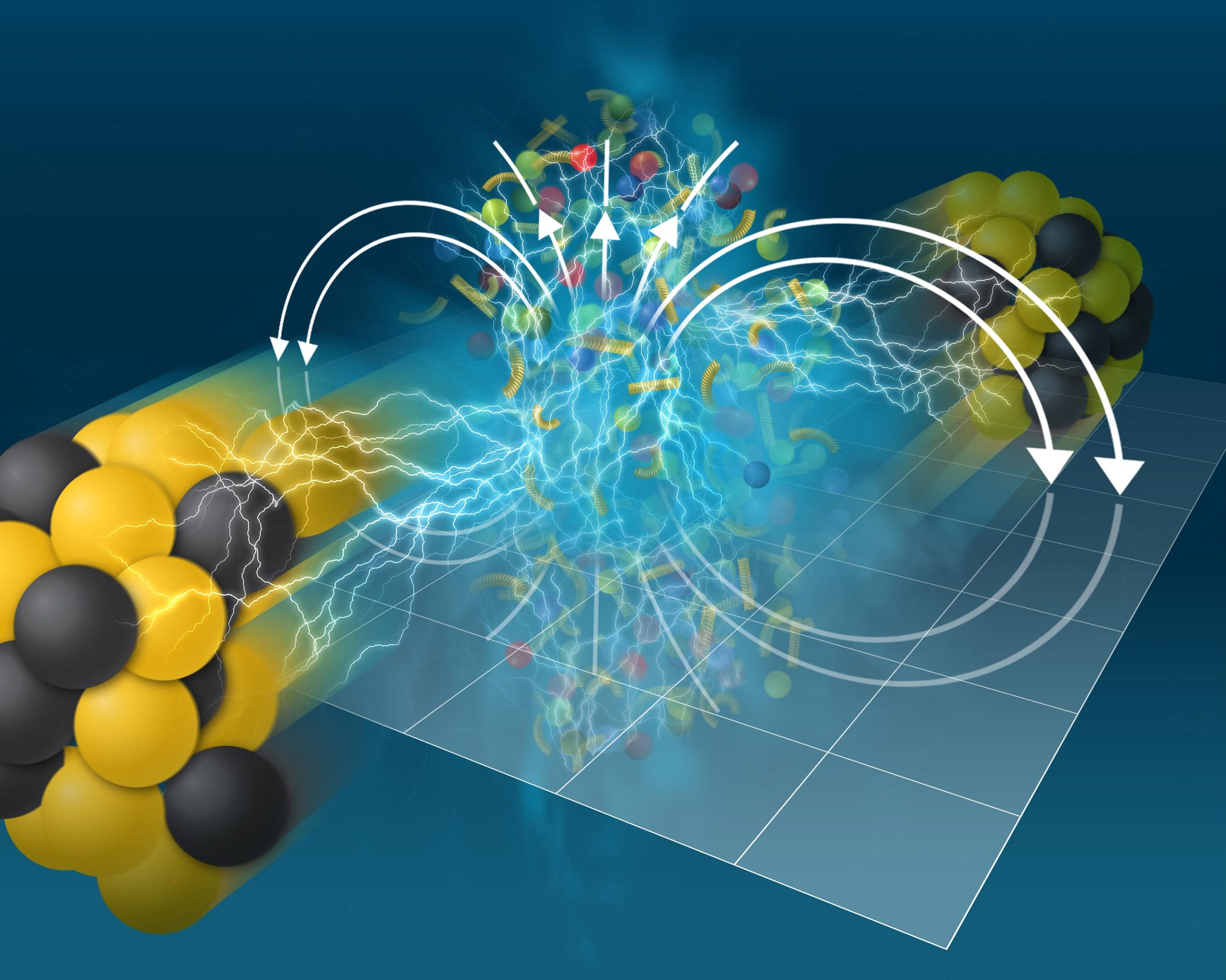
Data from heavy ion collisions give new insight into electromagnetic properties of quark-gluon plasma.
A new analysis by the STAR collaboration at the Relativistic Heavy Ion Collider (RHIC), a particle collider at the U.S. Department of Energy’s (DOE) Brookhaven National Laboratory, provides the first direct evidence of the imprint left by what may be the universe’s most powerful magnetic fields on “deconfined” nuclear matter. The evidence comes from measuring the way differently charged particles separate when emerging from collisions of atomic nuclei at this DOE Office of Science user facility.
As described in the journal Physical Review X, the data indicate that powerful magnetic fields generated in off-center collisions induce an electric current in the quarks and gluons set free, or deconfined, from protons and neutrons by the particle smashups. The findings give scientists a new way to study the electrical conductivity of this “quark-gluon plasma” (QGP) to learn more about these fundamental building blocks of atomic nuclei.
“This is the first measurement of how the magnetic field interacts with the quark-gluon plasma (QGP),” said Diyu Shen, a STAR physicist from Fudan University in China and a leader of the new analysis. In fact, measuring the impact of that interaction provides direct evidence that these powerful magnetic fields exist.
More powerful than a neutron star
Scientists have long believed that off-center collisions of heavy atomic nuclei such as gold, also known as heavy ions, would generate powerful magnetic fields. That’s because some of the non-colliding positively charged protons—and neutral neutrons—that make up the nuclei would be set aswirl as the ions sideswipe one another at close to the speed of light.
“Those fast-moving positive charges should generate a very strong magnetic field, predicted to be 1018 gauss,” said Gang Wang, a STAR physicist from the University of California, Los Angeles. For comparison, he noted that neutron stars, the densest objects in the universe, have fields of about 1014 gauss, while refrigerator magnets produce a field of about 100 gauss and our home planet’s protective magnetic field measures a mere 0.5 gauss. “This is probably the strongest magnetic field in our universe.”
But because things happen very quickly in heavy ion collisions, the field doesn’t last long. It dissipates in less than 10-23 seconds—ten millionths of a billionth of a billionth of a second—making it difficult to observe.
So instead of trying to measure the field directly, the STAR scientists looked for evidence of its impact on the particles streaming out of the collisions.
“Specifically, we were looking at the collective motion of charged particles,” Wang said.
Detecting deflection
It is well known that magnetic fields can affect the movement of charged particles and even induce electromagnetic fields in conductive forms of matter such as metals. That’s the same thing that’s happening here, but on a much smaller scale.
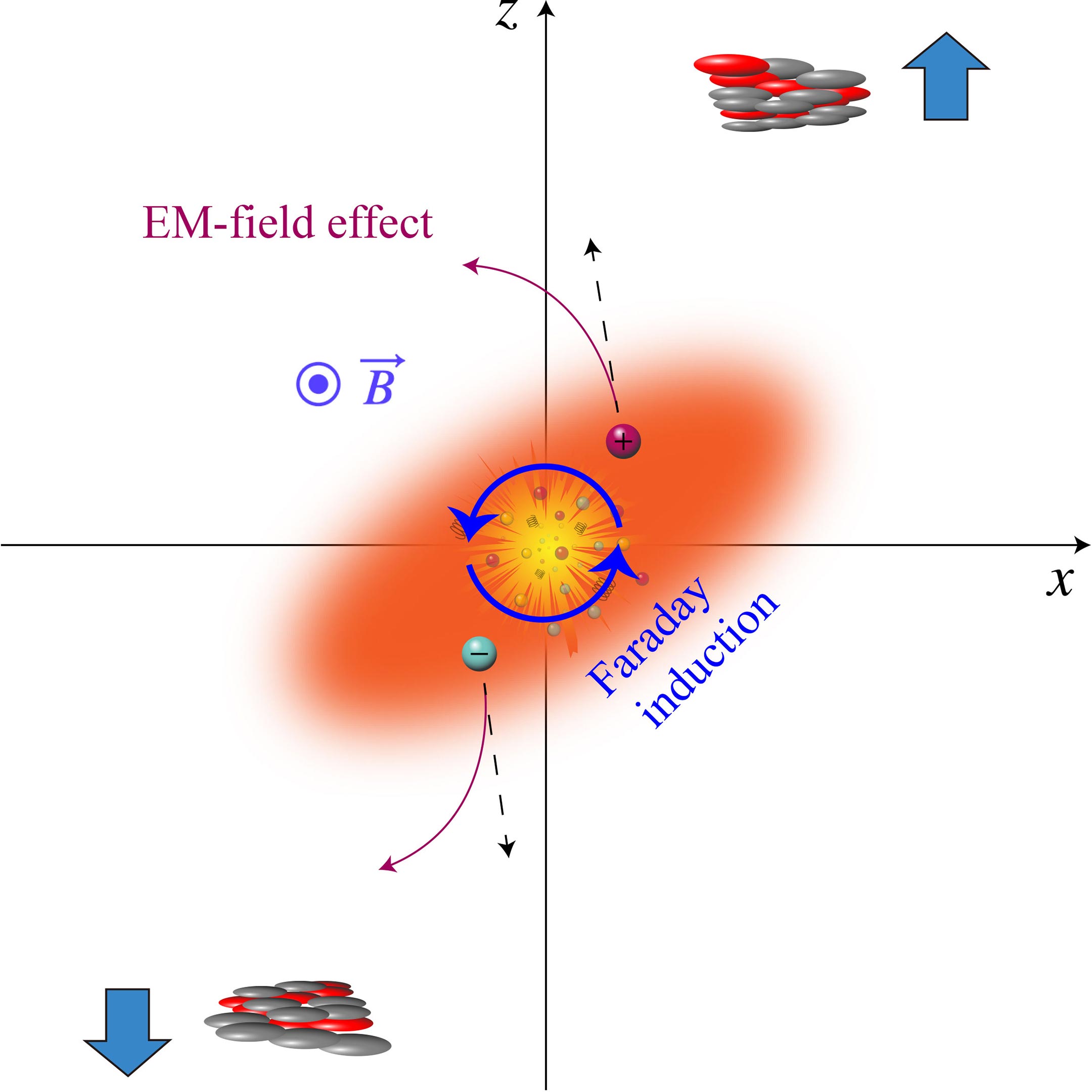
“We wanted to see if the charged particles generated in off-center heavy ion collisions were being deflected in a way that could only be explained by the existence of an electromagnetic field in the tiny specks of QGP created in these collisions,” said Aihong Tang, a Brookhaven Lab physicist and member of the STAR collaboration.
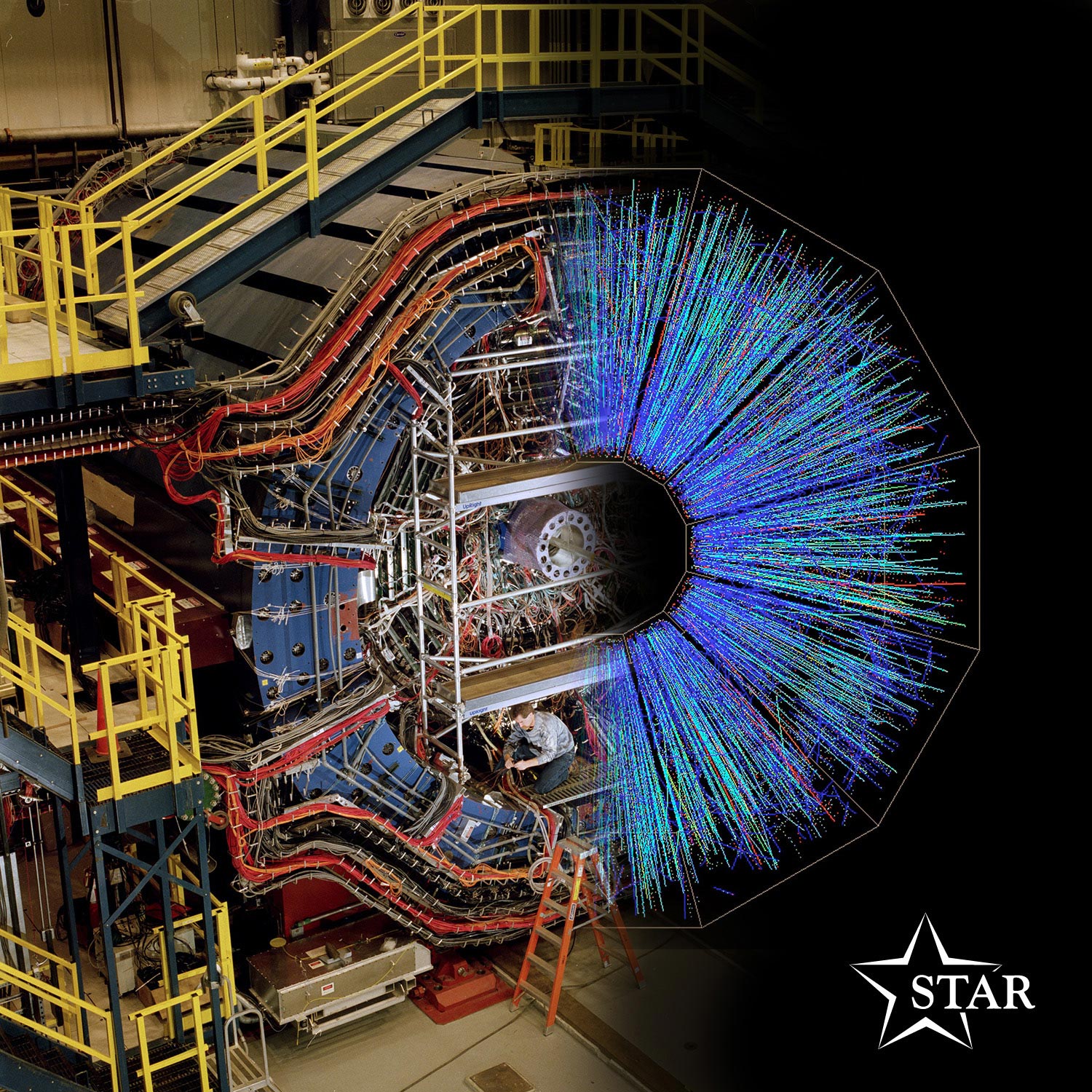
The team used STAR’s sophisticated detector systems to track the collective motion of different pairs of charged particles while ruling out the influence of competing non-electromagnetic effects. They were most interested in ruling out deflections caused by charged quarks transported along as part of the colliding nuclei. Fortunately, those “transported quarks” produce a pattern of deflection opposite to that triggered by the magnetic-field-induced electric current, known as Faraday induction.
A clear signal
“In the end, we see a pattern of charge-dependent deflection that can only be triggered by an electromagnetic field in the QGP—a clear sign of Faraday induction,” said Tang.
The scientists saw this strong signal not only in off-center collisions of two gold nuclei at high energy—gold-gold at 200 billion electron volts, or GeV—but also in off-center collisions of smaller nuclei—ruthenium-ruthenium and zirconium-zirconium, both at 200 GeV.
“This effect is universal. It happens not just in a big system but also in a smaller system,” said Shen.
The scientists saw an even stronger signal when they analyzed data from gold-gold collisions at a relatively low energy—27 GeV. This finding provides more supporting evidence that the particle-deflecting electromagnetic field was induced by the powerful magnetic fields generated by off-center collisions.
That’s because Faraday induction occurs as the magnetic field dissipates. In lower-energy collisions, that happens more slowly.
“This effect is stronger at lower energy because the lifetime of a magnetic field is longer at lower energy; the speed of the nuclear fragments is lower, so the magnetic field and its effects last longer,” said Wang.
Implications
Now that the scientists have evidence that magnetic fields induce an electromagnetic field in the QGP, they can use the induction to probe the QGP’s conductivity.
“This is a fundamental and important property,” said Shen. “We can infer the value of the conductivity from our measurement of the collective motion. The extent to which the particles are deflected relates directly to the strength of the electromagnetic field and the conductivity in the QGP—and no one has measured the conductivity of QGP before.”
Understanding the fundamental electromagnetic properties of the QGP could offer insights into important questions in physics. For one thing, the magnetic fields that induce the electromagnetic effects may contribute to an interesting separation of particles according to their “handedness,” or chirality.
“This study gives strong evidence of the magnetic field, which is one of the preconditions for this ‘chiral magnetic effect,’” Shen said.
The magnetic field and electromagnetic properties of the QGP also play a role in determining the conditions under which free, deconfined quarks and gluons coalesce to form composite particles called hadrons—such as the protons and neutrons that make up ordinary nuclei.
“We want to map out the nuclear ‘phase diagram,’ which shows at which temperature the quarks and gluons can be considered free and at which temperature they will ‘freeze out’ to become hadrons. Those properties and the fundamental interactions of quarks and gluons, which are mediated by the strong force, will be modified under an extreme electromagnetic field,” said Wang. With this new probe of the QGP’s electromagnetic properties, he added, “we can investigate these fundamental properties in another dimension to provide more information about the strong interaction.”
For now, the scientists pointed out, theorists will be looking at these results to help refine the interpretations.
Reference: “Observation of the Electromagnetic Field Effect via Charge-Dependent Directed Flow in Heavy-Ion Collisions at the Relativistic Heavy Ion Collider” by 23 February 2024, Physical Review X.
DOI: 10.1103/PhysRevX.14.011028
This research was funded by the DOE Office of Science, the U.S. National Science Foundation, and a range of international organizations and agencies listed in the scientific paper. The STAR team used computing resources at the Scientific Data and Computing Center at Brookhaven Lab, the National Energy Research Scientific Computing Center (NERSC) at DOE’s Lawrence Berkeley National Laboratory, and the Open Science Grid consortium.
Never miss a breakthrough: Join the SciTechDaily newsletter.
Follow us on Google and Google News.
1 Comment
OFF CENTER COLLISION key words that fade in the article and head line.