
New evidence shows that the key assumption made in the discovery of dark energy is in error.
High precision age dating of supernova host galaxies reveals that the luminosity evolution of supernovae is significant enough to question the very existence of dark energy.
The most direct and strongest evidence for the accelerating universe with dark energy is provided by the distance measurements using type Ia supernovae (SN Ia) for the galaxies at high redshift. This result is based on the assumption that the corrected luminosity of SN Ia through the empirical standardization would not evolve with redshift.
New observations and analysis made by a team of astronomers at Yonsei University (Seoul, South Korea), together with their collaborators at Lyon University and KASI, show, however, that this key assumption is most likely in error. The team has performed very high-quality (signal-to-noise ratio ~175) spectroscopic observations to cover most of the reported nearby early-type host galaxies of SN Ia, from which they obtained the most direct and reliable measurements of population ages for these host galaxies. They find a significant correlation between SN luminosity and stellar population age at a 99.5% confidence level.
As such, this is the most direct and stringent test ever made for the luminosity evolution of SN Ia. Since SN progenitors in host galaxies are getting younger with redshift (look-back time), this result inevitably indicates a serious systematic bias with redshift in SN cosmology. Taken at face value, the luminosity evolution of SN is significant enough to question the very existence of dark energy. When the luminosity evolution of SN is properly taken into account, the team found that the evidence for the existence of dark energy simply goes away (see Figure 1).
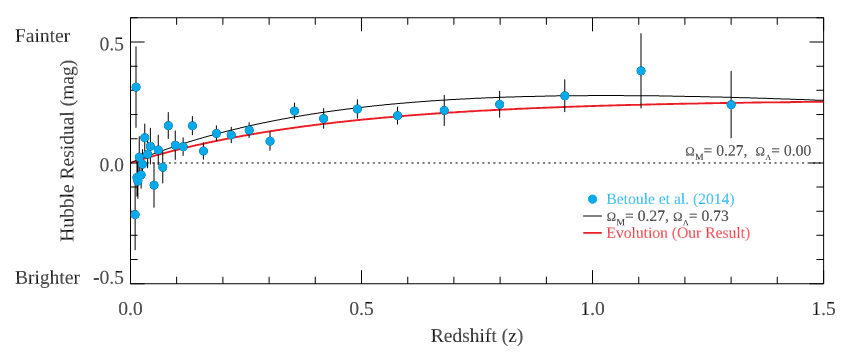
The Hubble residual is the difference in SN luminosity with respect to the cosmological model without dark energy (the black dotted line). The cyan circles are the binned SN data from Betoule et al. (2014). The red line is the evolution curve based on our age dating of early-type host galaxies. The comparison of our evolution curve with SN data shows that the luminosity evolution can mimic Hubble residuals used in the discovery and inference of the dark energy (the black solid line). Credit: Yonsei University
Commenting on the result, Prof. Young-Wook Lee (Yonsei Univ., Seoul) who was leading the project said; “Quoting Carl Sagan, extraordinary claims require extraordinary evidence, but I am not sure we have such extraordinary evidence for dark energy. Our result illustrates that dark energy from SN cosmology, which led to the 2011 Nobel Prize in Physics, might be an artifact of a fragile and false assumption.”
Other cosmological probes, such as CMB (Cosmic Microwave Background) and BAO (Baryonic Acoustic Oscillations), are also known to provide some indirect and “circumstantial” evidence for dark energy, but it was recently suggested that CMB from Planck mission no longer supports the concordance cosmological model which may require new physics (Di Valentino, Melchiorri, & Silk 2019). Some investigators have also shown that BAO and other low-redshift cosmological probes can be consistent with a non-accelerating universe without dark energy (see, for example, Tutusaus et al. 2017). In this respect, the present result showing the luminosity evolution mimicking dark energy in SN cosmology is crucial and is very timely.
This result is reminiscent of the famous Tinsley-Sandage debate in the 1970s on luminosity evolution in observational cosmology, which led to the termination of the Sandage project originally designed to determine the fate of the universe.
This work based on the team’s 9-year effort at Las Campanas Observatory 2.5-m telescope and at MMT 6.5-m telescope was presented at the 235th meeting of the American Astronomical Society held in Honolulu on January 5th (2:50 PM in cosmology session, presentation No. 153.05). Their paper was also accepted for publication in The Astrophysical Journal and was published in January 2020 issue.
Reference: “Early-Type Host Galaxies of Type Ia Supernovae. II. Evidence for Luminosity Evolution in Supernova Cosmology” by Yijung Kang, Young-Wook Lee (Yonsei Univ., South Korea), Young-Lo Kim (Lyon Univ., France), Chul Chung (Yonsei Univ.) and Chang Hee Ree (KASI, South Korea), 20 January 2020, The Astrophysical Journal.
DOI: 10.3847/1538-4357/ab5afc
arXiv: 1912.04903
Never miss a breakthrough: Join the SciTechDaily newsletter.
Follow us on Google and Google News.
5 Comments
“Doth not this aethereal medium in passing out of water, glass, crystal, and other compact and dense bodies in empty spaces, grow denser and denser by degrees, and by that means refract the rays of light not in a point, but by bending them gradually in curve lines? …Is not this medium much rarer within the dense bodies of the Sun, stars, planets and comets, than in the empty celestial space between them? And in passing from them to great distances, doth it not grow denser and denser perpetually, and thereby cause the gravity of those great bodies towards one another, and of their parts towards the bodies; every body endeavouring to go from the denser parts of the medium towards the rarer?” Isaac Newton,Third Book of Opticks.
If this is true then a lot of 2000s physics documentaries just lost their tv contracts haha.
Since work done (and the corresponding to it potential energy) is misdefined neither missing mass nor dark energy is necessary – see:
Czajko J. Equalized mass can explain the dark energy or missing mass problem as higher density of matter in stars amplifies their attraction. World Scientific News WSN 80 (2017) 207-238 http://www.worldscientificnews.com/wp-content/uploads/2017/07/WSN-80-2017-207-238.pdf
Now wait just a minute here!! How can we upset settled science that 97% of scientists have agreed is true, simply because of a few observations paid for by oil companies? These so-called “scientists” ought to be stripped of their positions and ostracized. Now I see the wisdom of prosecuting science deniers.
Once the truth has been declared, doubt is dangerous. Humanity could go extinct, or something.
This is the usual recycling of using little data, taking a spurious result and claiming it invalidates all the other consistent evidence in cosmology – here with the help of cherry picking similar spurious results.
More precisely. SN1as are local Hubble rate indicators, but there are many similar such as the red giant branch tip that converge on the same Hubble rate.
The Di Valentino, Melchiorri, & Silk 2019 type of work was recently rejected by most others:
“When researchers reanalyzed the gold-standard data set of the early universe, they concluded that the cosmos must be “closed,” or curled up like a ball. Most others remain unconvinced. … “it is just a statistical fluke.””
[ https://www.quantamagazine.org/what-shape-is-the-universe-closed-or-flat-20191104/ ]
Now we can turn to Sarkar et al, who in turn referenced Di Valentino but made a different claim:
“No Dark Energy? No Chance, Cosmologists Contend. … It’s standard to correct for this motion and to transform supernova data into a stationary reference frame. But Sarkar and company did not.”
[ https://www.quantamagazine.org/no-dark-energy-no-chance-cosmologists-contend-20191217/ ]
From the last link we can note on the recycling of bad data analysis from non-DE papers:
“Those who find the back-and-forth about data analysis hard to follow should note that the data from supernovas matches other evidence of cosmic acceleration. Over the years, dark energy has been inferred from the ancient light called the cosmic microwave background, fluctuations in the density of the universe called baryon acoustic oscillations, the gravitationally distorted shapes of galaxies, and the clustering of matter in the universe.”
So, here is the nut:
Tutusaus et al suggest to relax the SN1a redshift like the work here, and not surprisingly can find a better curve fit with a more complex model; they use 5 SN1a. But besides that unwarranted assumption they run into problems with the Hubble rate value instead [ https://arxiv.org/pdf/1803.06197.pdf ].
The current work picks a handful of SN1as and make an extraordinary claim at 2.8 sigma. The dark energy data set contains thousands [!] of SN1as [ https://iopscienc…5a9/meta ] and is tested to ~ 5 sigma.
(Technically they do a chi-square test, so I’m eye balling it from their comparison with non-DE power laws – Riess et al are 2 order of magnitude better. But that is also the tension in the local vs global Hubble rate, so we should also not expect any better confidence IMO. Also, I think these opportunistic non-DE papers somewhat rely on that tension, at least indirectly.)