

The newfound planet represents Webb’s first direct image discovery of a planet.
Nearly 6,000 worlds beyond our solar system have been found so far, and NASA’s James Webb Space Telescope may have just added another. The telescope picked up a faint glow from TWA 7 b, a planet about the mass of Saturn orbiting the young star TWA 7.
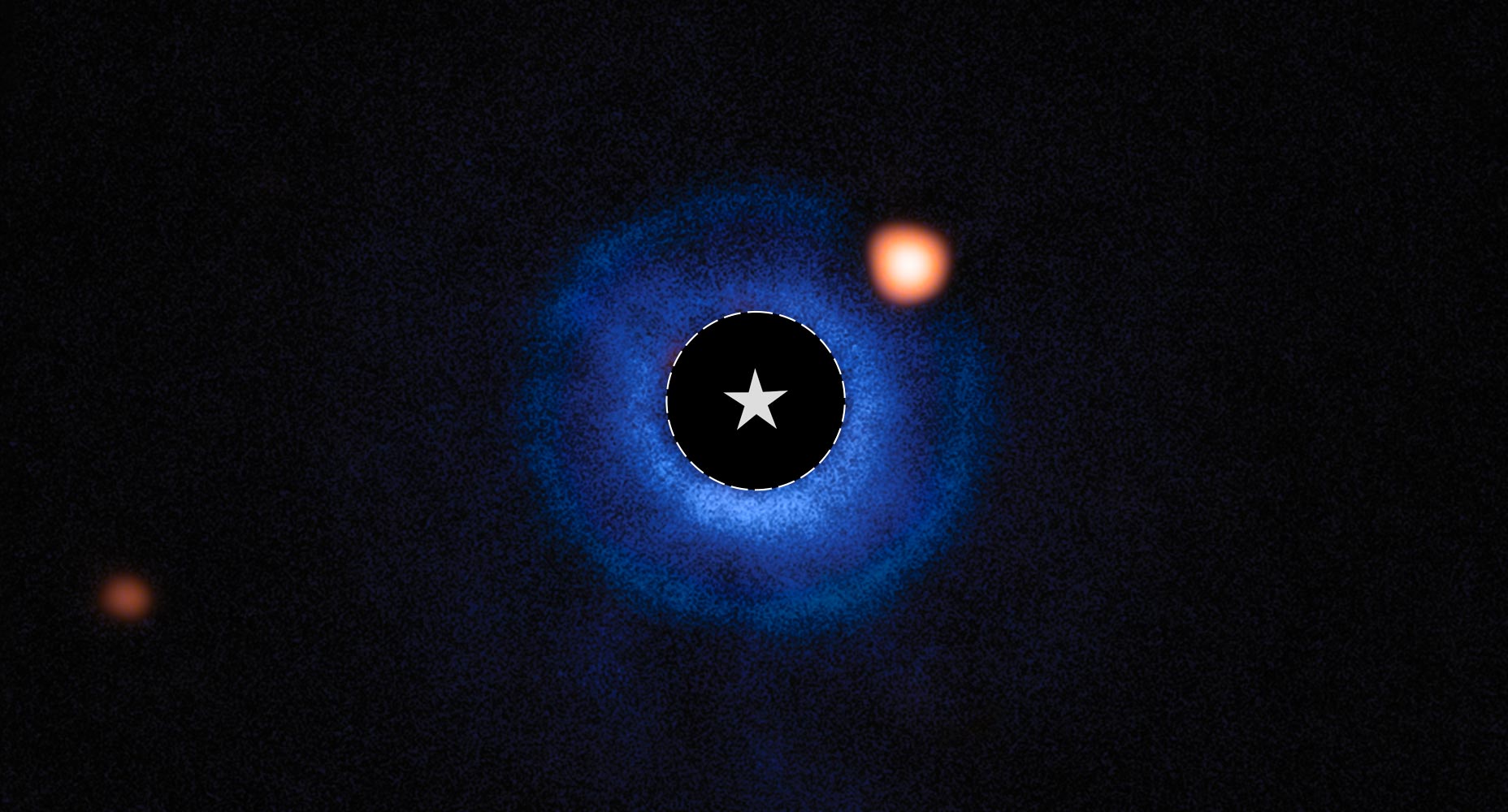
To see it, astronomers used Webb’s coronagraph to block the star’s glare and expose what was hiding nearby. TWA 7 b sits neatly inside a gap in one of three dusty rings circling its star, exactly where models predict a ring-carving planet should live. Its brightness, color, and distance all line up with what scientists expect from a young planet sculpting the surrounding debris, making this discovery one of Webb’s most exciting finds yet.
Likely Saturn-Mass Planet Imaged by NASA Webb Is Lightest Ever Seen
Astronomers using NASA’s James Webb Space Telescope have spotted a faint object that appears to be a Saturn-mass planet circling the young star TWA 7. If confirmed, this would be Webb’s first planet found through direct imaging and the lightest world ever captured with this technique beyond our solar system.
The signal comes from Webb’s Mid-Infrared Instrument, which detected a soft glow embedded in the star’s dusty debris disk. Sitting about fifty times farther from its star than Earth is from the Sun, the glow lies exactly where models predict a ring-carving planet should be. Details of the discovery were published on June 25 in Nature.
To reveal the hidden world, scientists used MIRI’s coronagraph to block the star’s glare, then applied advanced image processing to sweep away lingering light. The final image showed a pinprick of infrared brightness that almost certainly belongs to a new planet. Tests ruled out a wandering object from our own solar system, and although a distant galaxy cannot be completely excluded, the evidence points strongly to an undiscovered planet shaping the dust around TWA 7.

Saturn-Mass World Emerges in Dust Gap
The source is located in a gap in one of three dust rings that were discovered around TWA 7 by previous ground-based observations. The object’s brightness, color, distance from the star, and position within the ring are consistent with theoretical predictions for a young, cold, Saturn-mass planet that is expected to be sculpting the surrounding debris disk.
“Our observations reveal a strong candidate for a planet shaping the structure of the TWA 7 debris disk, and its position is exactly where we expected to find a planet of this mass,” said Anne-Marie Lagrange, CNRS researcher at the Observatoire de Paris-PSL and Université Grenoble Alpes in France, lead author of the paper.
“This observatory enables us to capture images of planets with masses similar to those in the solar system, which represents an exciting step forward in our understanding of planetary systems, including our own,” added co-author Mathilde Malin of Johns Hopkins University and the Space Telescope Science Institute in Baltimore.
TWA 7 b: Young Sculptor of Rings
Initial analysis suggests that the object — referred to as TWA 7 b — could be a young, cold planet with a mass around 0.3 times that of Jupiter (about 100 Earth masses, or one Saturn mass) and a temperature near 120 degrees Fahrenheit (47 degrees Celsius). Its location aligns with a gap in the disk, hinting at a dynamic interaction between the planet and its surroundings.
Debris disks filled with dust and rocky material are found around both young and older stars, although they are more easily detected around younger stars as they are brighter. They often feature visible rings or gaps, thought to be created by planets that have formed around the star, but such a planet has yet to be directly detected within a debris disk. If verified, this discovery would mark the first time a planet has been directly associated with sculpting a debris disk, and could offer the first observational hint of a “trojan disk” — a collection of dust trapped in the planet’s orbit.
TWA 7, also known as CE Antilae, is a young (about 6.4 million years old) red dwarf star located about 34 light-years away in the TW Hydrae association. Its nearly face-on disk made it an ideal target for Webb’s high-sensitivity mid-infrared observations.
Webb Expands Exoplanet Frontiers
The findings highlight Webb’s ability to explore previously unseen, low-mass planets around nearby stars. Ongoing and future observations will aim to better constrain the properties of the candidate, verify its planetary status, and deepen our understanding of planet formation and disk evolution in young systems.
Reference: “Evidence for a sub-Jovian planet in the young TWA 7 disk” by A.-M. Lagrange, C. Wilkinson, M. Mâlin, A. Boccaletti, C. Perrot, L. Matrà, F. Combes, H. Beust, D. Rouan, A. Chomez, J. Milli, B. Charnay, S. Mazevet, O. Flasseur, J. Olofsson, A. Bayo, Q. Kral, A. Carter, K. A. Crotts, P. Delorme, G. Chauvin, P. Thebault, P. Rubini, F. Kiefer, A. Radcliffe, J. Mazoyer, T. Bodrito, S. Stasevic and M. Langlois, 25 June 2025, Nature.
DOI: 10.1038/s41586-025-09150-4
These observations were taken as part of the Webb observing program 3662.
The James Webb Space Telescope is the world’s premier space science observatory. Webb is solving mysteries in our solar system, looking beyond to distant worlds around other stars, and probing the mysterious structures and origins of our universe and our place in it. Webb is an international program led by NASA with its partners, ESA (European Space Agency) and CSA (Canadian Space Agency).
Never miss a breakthrough: Join the SciTechDaily newsletter.
Follow us on Google and Google News.
1 Comment
Outstanding!!!!!