
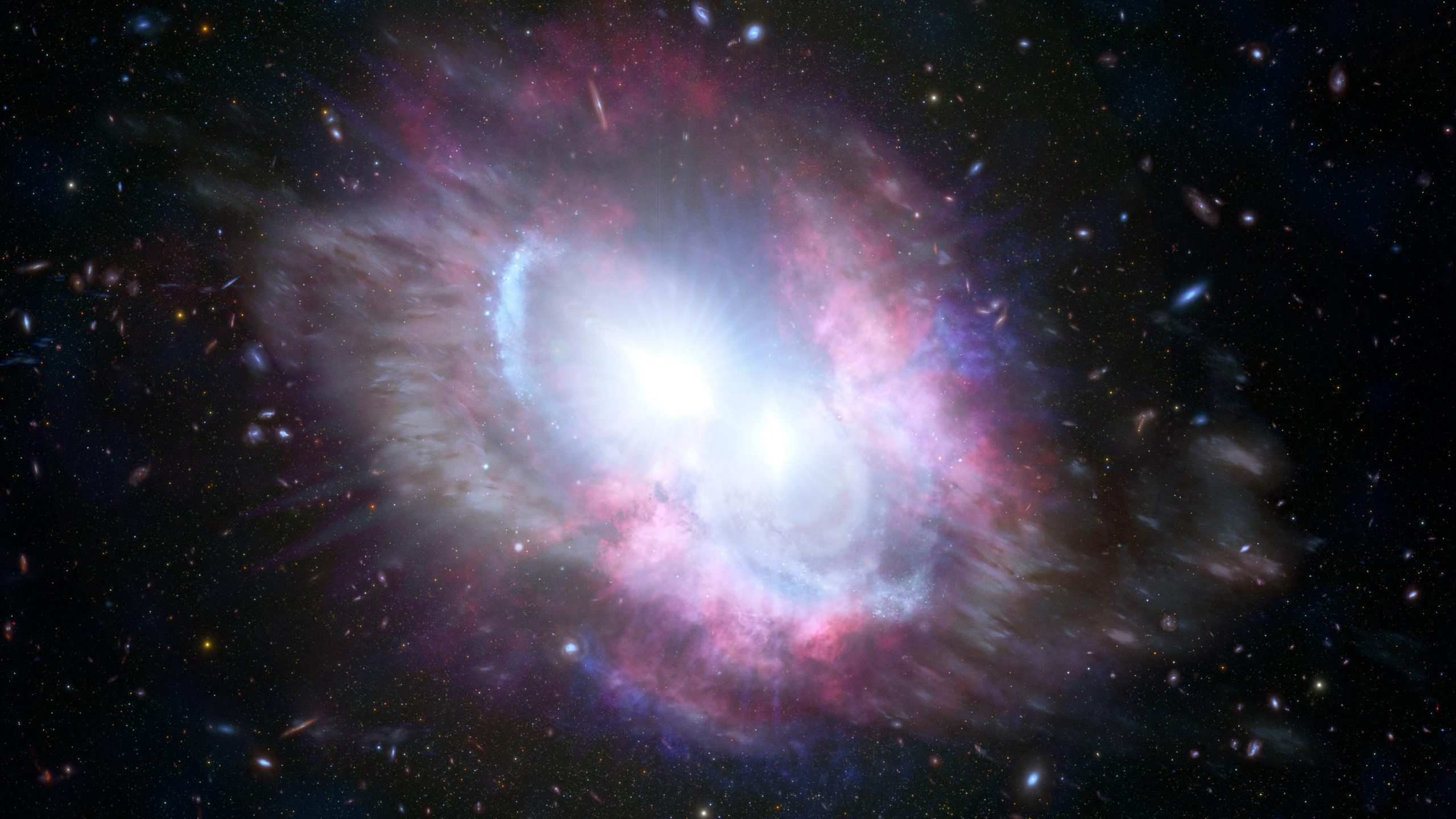
Gemini North Telescope helps confirm nature of cosmic system on the verge of becoming a giant elliptical galaxy.
Astronomers using an array of ground- and space-based telescopes, including Gemini North on Hawai‘i, have uncovered a closely bound duo of energetic quasars — the hallmark of a pair of merging galaxies — seen when the Universe was only three billion years old. This discovery sheds light on the evolution of galaxies at “cosmic noon,” a period in the history of the Universe when galaxies underwent bursts of furious star formation. This merger also represents a system on the verge of becoming a giant elliptical galaxy.
Galaxies grow and evolve by merging with other galaxies, blending their billions of stars, triggering bursts of vigorous star formation, and often fueling their central supermassive black holes to produce luminous quasars that outshine the entire galaxy. Some of these mergers eventually go on to become massive elliptical galaxies that contain black holes that are many billions of times the mass of our Sun. Although astronomers have observed a veritable menagerie of merging galaxies with more than one quasar in our own cosmic neighborhood, more distant examples, seen when the Universe was only a quarter of its current age, are quite rare and extremely challenging to find.
By harnessing a bevy of ground- and space-based observatories — including Gemini North, one half of the International Gemini Observatory, operated by NSF’s NOIRLab — a team of astronomers has discovered a closely bound pair of actively feeding supermassive black holes — quasars. This discovery is the first confirmed detection of a pair of supermassive black holes in the same galactic real estate at ‘cosmic noon’ — a period of frenetic star formation at a time when the Universe was only three billion years old.
Previous observations have identified similar systems in the early stages of merging, when the two galaxies could still be considered clearly separate entities. But these new results show a pair of quasars blazing away in such close proximity, a mere 10,000 light-years apart, that their original host galaxies are likely well on their way to becoming a single giant elliptical galaxy.
Challenges in Detecting Supermassive Black Hole Pairs
Searching for pairs of supermassive black holes so close to each other during this early epoch is like trying to find the proverbial needle in a haystack. The challenge is that most black-hole pairs are too close to distinguish individually. To definitively detect such a system, the two supermassive black holes need to be actively accreting and shining as quasars simultaneously, conditions that are extremely rare. Statistically, for every 100 supermassive black holes only one should be actively accreting at a given time.
Astronomers know, however, that the distant Universe should be brimming with pairs of supermassive black holes embedded within merging galaxies. The first hints of such a system were found in data from the NASA/ESA Hubble Space Telescope, which revealed two closely aligned pinpoints of light in the distant Universe.
To verify the true nature of this system, the team searched through ESA’s Gaia observatory’s vast database and found that this system had an apparent “jiggle,” which could be the result of sporadic changes in a black hole’s feeding activity.
The team then used the Gemini Multi-Object Spectrograph (GMOS) and GNIRS on Gemini North, which provided the team with independent measurements of the distance to the quasars and confirmed that the two objects were both quasars rather than a chance alignment of a single quasar with a foreground star. Further studies with the W.M. Keck Observatory, NSF’s Karl G. Jansky Very Large Array, and NASA’s Chandra X-ray Observatory also helped to confirm these observations.
“The confirmation process wasn’t easy and we needed an array of telescopes covering the spectrum from X-rays to the radio to finally confirm that this system is indeed a pair of quasars, instead of, say, two images of a gravitationally lensed quasar,” said co-author Yue Shen, an astronomer at the University of Illinois.
“We don’t see a lot of double quasars at this early time. And that’s why this discovery is so exciting. Knowing about the progenitor population of black holes will eventually tell us about the emergence of supermassive black holes in the early Universe, and how frequent those mergers could be,” said graduate student Yu-Ching Chen of the University of Illinois at Urbana-Champaign, lead author of this study, which is published in the journal Nature.
For more on this discovery:
- Pair of Merging Galaxies Ignite Black Holes on a Collision Course
- Astronomers Discover Rare Quasar Pair Ready to Rumble
Reference: “A close quasar pair in a disk–disk galaxy merger at z = 2.17” by Yu-Ching Chen, Xin Liu, Adi Foord, Yue Shen, Masamune Oguri, Nianyi Chen, Tiziana Di Matteo, Miguel Holgado, Hsiang-Chih Hwang and Nadia Zakamska, 5 April 2023, Nature.
DOI: 10.1038/s41586-023-05766-6
Never miss a breakthrough: Join the SciTechDaily newsletter.
Follow us on Google and Google News.