
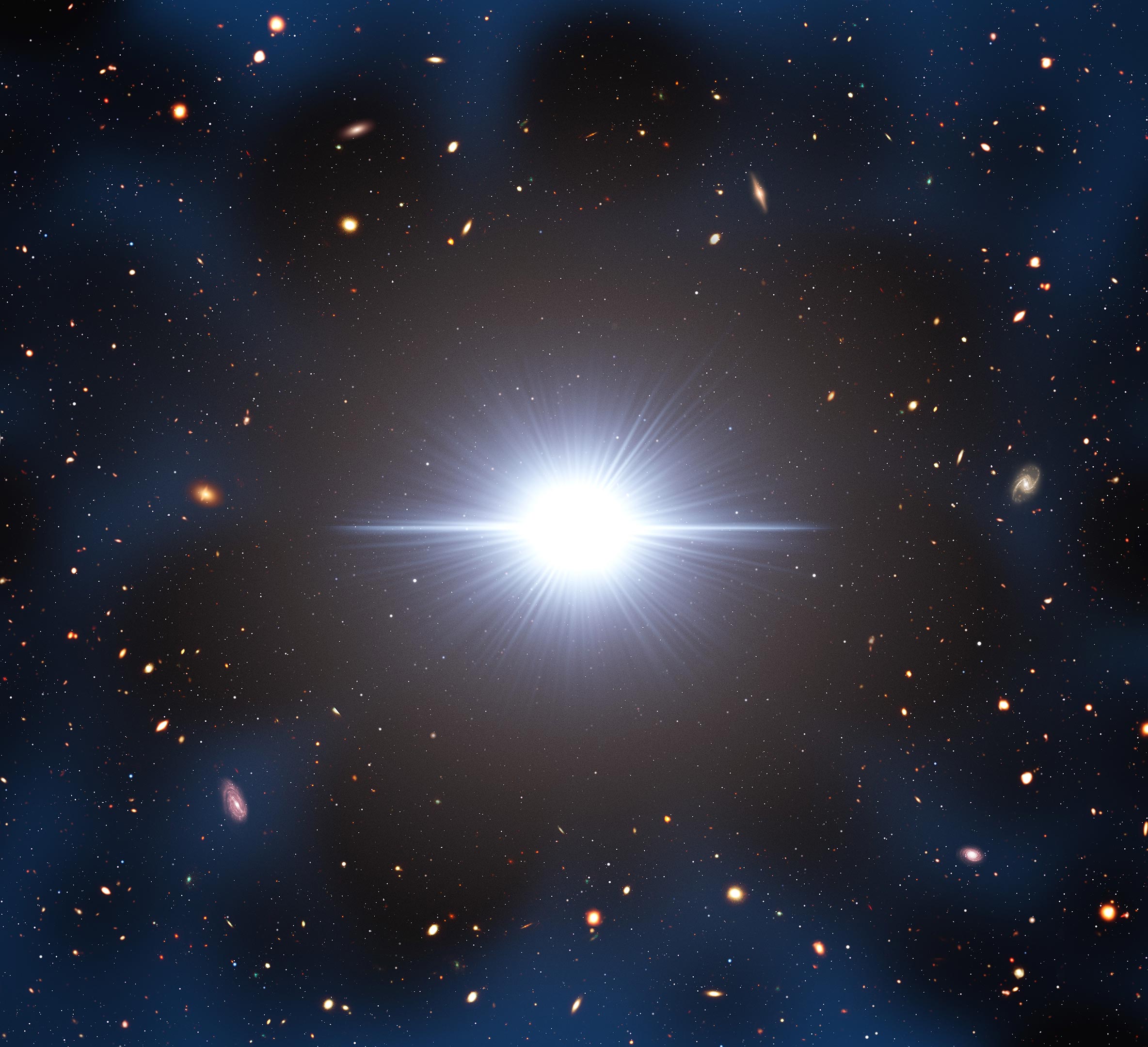
A new finding with the expansive Dark Energy Camera offers a clear explanation for the quasar ‘urban density’-conundrum.
Using the DECam, researchers discovered 38 galaxies around quasar VIK J2348-3054 but found an unexpected void of galaxies close to the quasar. This suggests that the intense radiation from quasars could suppress star formation in nearby galaxies, offering a new perspective on the dynamics of early universe galaxy clusters.
Quasars, the most luminous objects in the Universe, are powered by material accreting onto supermassive black holes at the centers of galaxies. Studies have shown that early-Universe quasars have black holes so massive that they must have been swallowing gas at very high rates, leading most astronomers to believe that these quasars formed in some of the densest environments in the Universe where gas was most available.
However, observational measurements seeking to confirm this conclusion have thus far yielded conflicting results. Now, a new study using the Dark Energy Camera (DECam) points the way to both an explanation for these disparate observations and also a logical framework to connect observation with theory.

Unveiling the Universe with DECam
DECam was fabricated by the Department of Energy (DOE) and is mounted on the U.S. National Science Foundation Víctor M. Blanco 4-meter Telescope at Cerro Tololo Inter-American Observatory in Chile, a Program of NSF NOIRLab.
The study was led by Trystan Lambert, who completed this work as a PhD student at Diego Portales University’s Institute of Astrophysical Studies in Chile[1] and is now a postdoc at the University of Western Australia node at the International Centre for Radio Astronomy Research (ICRAR). Utilizing DECam’s massive field of view, the team conducted the largest on-sky area search ever around an early-Universe quasar in an effort to measure the density of its environment by counting the number of surrounding companion galaxies.
For their investigation, the team needed a quasar with a well-defined distance. Luckily, quasar VIK 2348–3054 has a known distance, determined by previous observations with the Atacama Large Millimeter/submillimeter Array (ALMA), and DECam’s three-square-degree field of view provided an expansive look at its cosmic neighborhood. Serendipitously, DECam is also equipped with a narrowband filter perfectly matched for detecting its companion galaxies. “This quasar study really was the perfect storm,” says Lambert. “We had a quasar with a well-known distance, and DECam on the Blanco telescope offered the massive field of view and exact filter that we needed.”
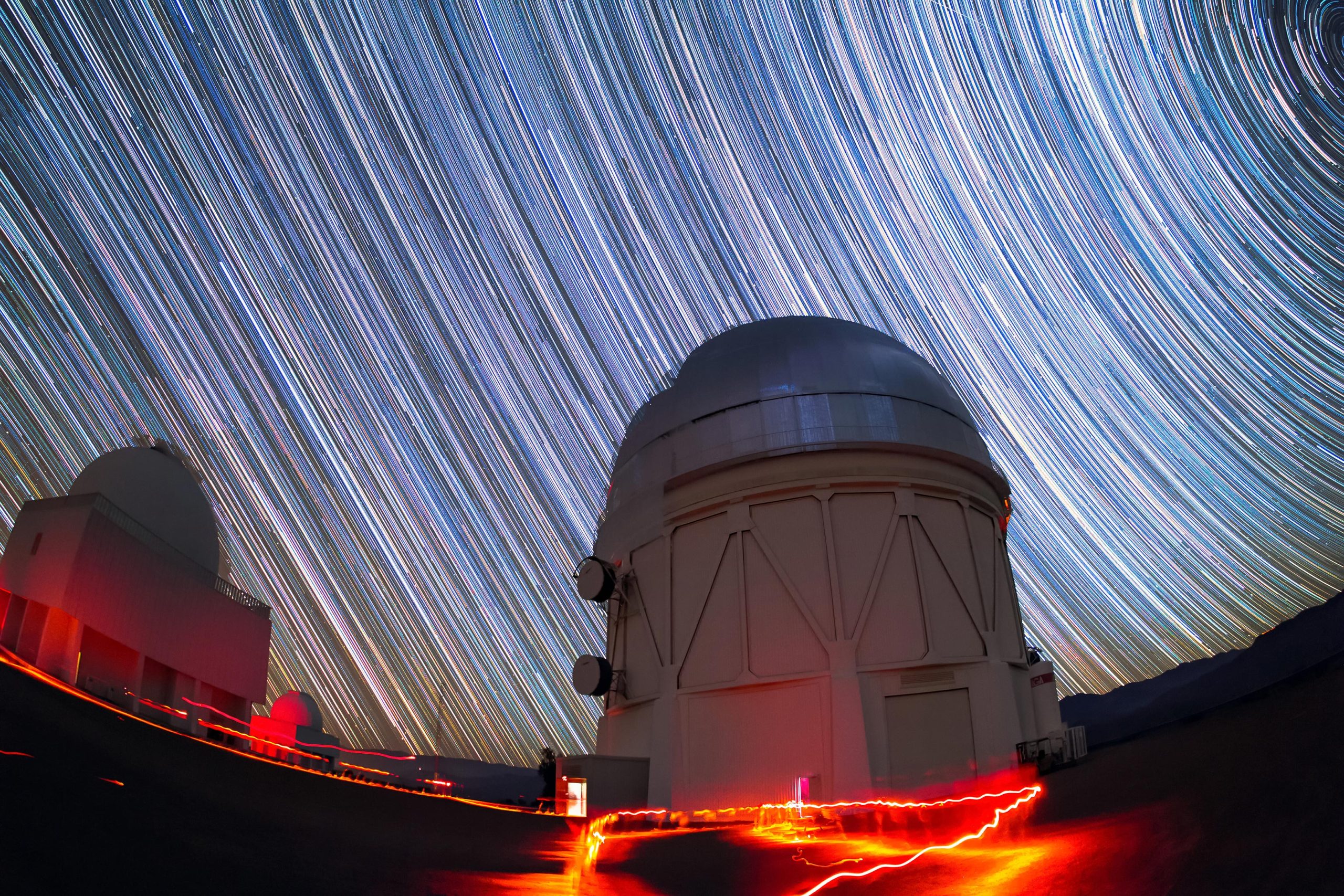
DECam’s Technological Edge
DECam’s specialized filter allowed the team to count the number of companion galaxies around the quasar by detecting a very specific type of light they emit, known as Lyman-alpha radiation. Lyman alpha radiation is a specific energy signature of hydrogen, produced when it is ionized and then recombined during the process of star formation. Lyman-alpha emitters are typically younger, smaller galaxies, and their Lyman-alpha emission can be used as a way to reliably measure their distances. Distance measurements for multiple Lyman-alpha emitters can then be used to construct a 3D map of a quasar’s neighborhood.
Surprising Findings in Quasar Research
After systematically mapping the region of space around quasar VIK J2348-3054, Lambert and his team found 38 companion galaxies in the wider environment around the quasar — out to a distance of 60 million light-years — which is consistent with what is expected for quasars residing in dense regions. However, they were surprised to find that within 15 million light-years of the quasar, there were no companions at all.
This finding illuminates the reality of past studies aimed at classifying early-Universe quasar environments and proposes a possible explanation for why they have turned out conflicting results. No other survey of this kind has used a search area as large as the one provided by DECam, so to smaller-area searches a quasar’s environment can appear deceptively empty.
“DECam’s extremely wide view is necessary for studying quasar neighborhoods thoroughly. You really have to open up to a larger area,” says Lambert. “This suggests a reasonable explanation as to why previous observations are in conflict with one another.”
Theories on Radiation Impact and Future Research
The team also suggests an explanation for the lack of companion galaxies in the immediate vicinity of the quasar. They postulate that the intensity of the radiation from the quasar may be large enough to affect, or potentially stop, the formation of stars in these galaxies, making them invisible to our observations.
“Some quasars are not quiet neighbors,” says Lambert. “Stars in galaxies form from gas that is cold enough to collapse under its own gravity. Luminous quasars can potentially be so bright as to illuminate this gas in nearby galaxies and heat it up, preventing this collapse.”
Lambert’s team is currently following up with additional observations to obtain spectra and confirm star formation suppression. They also plan to observe other quasars to build a more robust sample size.
“These findings show the value of the National Science Foundation’s productive partnership with the Department of Energy,” says Chris Davis, NSF program director for NSF NOIRLab. “We expect that productivity will be amplified enormously with the upcoming NSF–DOE Vera C. Rubin Observatory, a next-generation facility that will reveal even more about the early Universe and these remarkable objects.”
Notes
- This study was made possible through a collaboration between researchers at Diego Portales University and the Max Planck Institute of Astronomy. A portion of this work was funded through a grant by Chile’s National Research and Development Agency (ANID) for collaborations with the Max Planck Institutes.
Reference: “A lack of Lyman alpha emitters within 5Mpc of a luminous quasar in an overdensity at z=6.9: Potential evidence of negative quasar feedback at protocluster scales” by Trystan S. Lambert, R.J. Assef, C. Mazzucchelli, E. Bañados , M. Aravena, F. Barrientos, J. González-López, W. Hu, L. Infante, S. Malhotra, C. Moya-Sierralta, J. Rhoads, F. Valdes, J. Wang, I.G.B. Wold and Z. Zheng, 24 July 2024, Astronomy & Astrophysics.
DOI: 10.1051/0004-6361/202449566
The team is composed of Trystan S. Lambert (Universidad Diego Portales, Chile/University of Western Australia, Australia), R.J. Assef (Universidad Diego Portales, Chile), C. Mazzucchelli (Universidad Diego Portales, Chile), E. Bañados (Max Planck Institute of Astronomy, Germany), M. Aravena (Universidad Diego Portales, Chile), F. Barrientos (Pontificia Universidad Católica de Chile, Chile), J. González-López (Las Campanas Observatory, Chile/Universidad Diego Portales, Chile), W. Hu (George P. and Cynthia Woods Mitchell Institute for Fundamental Physics and Astronomy, Texas A&M University, USA), L. Infante (Pontificia Universidad Católica de Chile, Chile), S. Malhotra (NASA Goddard Space Flight Center, USA), C. Moya-Sierralta (Pontificia Universidad Católica de Chile, Chile), J. Rhoads (NASA Goddard Space Flight Center, USA), F. Valdes (NSF NOIRLab), J. Wang (University of Science and Technology of China, People’s Republic of China), I.G.B. Wold (Center for Research and Exploration in Space Science and Technology, NASA Goddard Space Flight Center, USA/Catholic University of America, USA), and Z. Zheng (Shanghai Astronomical Observatory, People’s Republic of China).
Never miss a breakthrough: Join the SciTechDaily newsletter.
Follow us on Google and Google News.