
Close Menu
    Facebook X (Twitter) Instagram
    SciTechDaily
    • Biology
    • Chemistry
    • Earth
    • Health
    • Physics
    • Science
    • Space
    • Technology
    Facebook X (Twitter) Pinterest YouTube RSS
    SciTechDaily
    Home»Space»Distant Quasar Ejects 2 Million Light-Year Long Jet of Cosmic Material
    Space

    Distant Quasar Ejects 2 Million Light-Year Long Jet of Cosmic Material

    By SciTechDailyOctober 23, 2012No Comments3 Mins Read
    Facebook Twitter Pinterest Telegram LinkedIn WhatsApp Email Reddit
    Share
    Facebook Twitter LinkedIn Pinterest Telegram Email Reddit
    PKS 0637-752 Jet
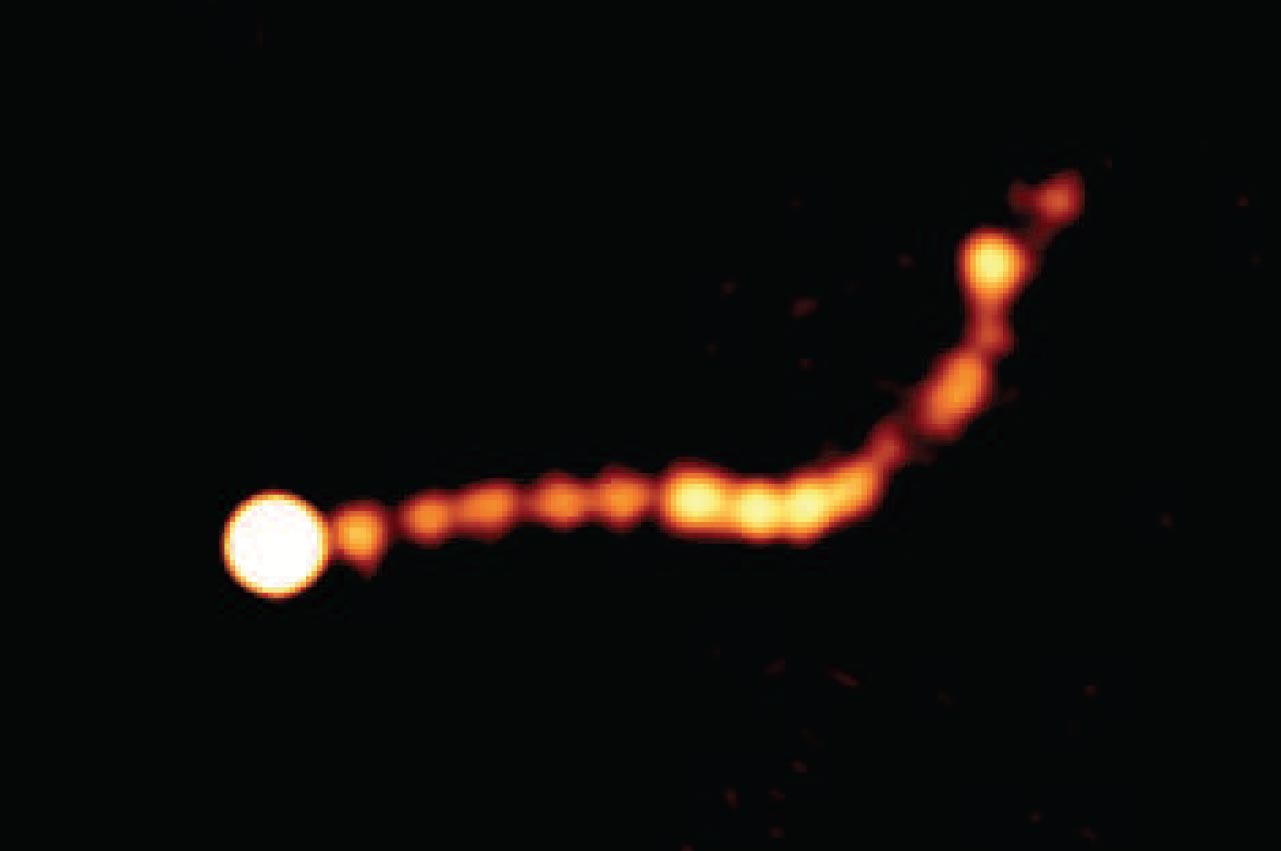
    The jet known as ‘PKS 0637-752’ as seen by the Australia Telescope Compact Array (ATCA) in New South Wales, Australia clearly shows the shock diamond-like shapes in the two million light-year long structure. Credit: Dr. Leith Godfrey, ICRAR and Dr. Jim Lovell, University of Tasmania

    This extended jet of cosmic materials, traveling near light speed, emerged from a distant galaxy. The flow is almost 2 million light-years long, at least 20 times larger than the Milky Way. Astronomers published their findings in the Astrophysical Journal Letters.

    The outflow is coming from a distant quasar that was formed 6 billion years ago and is shining with the power of 10 trillion suns. It’s called PKS 0637-752 and is thought to be an early galaxy with a supermassive black hole in its center. When dust and gas fall into the black hole, they are spun around and this spiraling motion accelerates the charged particles like a particle accelerator.

    Luminous Quasar PKS 0637-752
    PKS 0637-752 in the constellation Mensa. PKS 0637-72 is so distant that we see it as it was 6 billion years ago. It is a luminous quasar that radiates with the power of 10 trillion suns. The source of this prodigious energy is believed to be a supermassive black hole. Chandra’s X-ray image reveals a powerful X-ray jet extending away from the quasar that stretches across several hundred thousand light years. The jet, also observed by radio telescopes, is probably due to a beam of extremely high-energy particles. Credit: NASA/CXC/SAO

    The image was taken by the CSIRO Australia Telescope Compact Array radio telescope in New South Wales, and shows off the radio wavelengths of the galactic jet. There are dot-like structures seen within the jet, which are intriguing to astronomers. These formations are known as knots and they aren’t very well understood. However, they seem to represent sections of the jet separated by 160,000 to 360,000 light-years each.

    This odd pattern suggests that the jet is periodically turning off and on, or that some kind of shockwave within the jet is causing the knots. Astronomers are examining the data to better understand this object and its features.

    Reference: “Periodic Structure in the Megaparsec-Scale Jet of PKS 0637−752” by L. E. H. Godfrey, J. E. J. Lovell, S. Burke-Spolaor, R. Ekers, G. V. Bicknell, M. Birkinshaw, D. M. Worrall, D. L. Jauncey, D. A. Schwartz, H. L. Marshall, J. Gelbord, E. S. Perlman and M. Georganopoulos, 27 September 2012, Astrophysical Journal Letters.
    DOI: 10.1088/2041-8205/758/2/L27

    Never miss a breakthrough: Join the SciTechDaily newsletter.
    Follow us on Google and Google News.

    Astronomy Astrophysics Chandra X-ray Observatory Quasars
    Share. Facebook Twitter Pinterest LinkedIn Email Reddit

    Related Articles

    Supermassive Black Holes Defy Physics to Become Cosmic Titans

    Defying Expectations: The Quasar That’s Rewriting Galactic Rules

    Defying Expectations: NASA’s Chandra Uncovers a Quasar’s Surprising Galactic Impact

    Quasar Conundrum: Brilliant Supermassive Black Hole Defies Expectations

    Record-Breaking Jet of Particles Spied From a Supermassive Black Hole in the Early Universe

    Massive X-ray Jet – Extending for 160,000 Light-Years – Spied From Supermassive Black Hole in Early Universe

    Chandra X-ray Observatory Studies Extraordinary Magnetar [Video]

    Astronomers Discover Earliest Supermassive Black Hole and Quasar in the Universe – 1000x More Luminous Than the Milky Way

    Most Distant Quasar Discovered Sheds Light on How Supermassive Black Holes Grow

    Leave A Reply Cancel Reply

    • Facebook
    • Twitter
    • Pinterest
    • YouTube

    Don't Miss a Discovery

    Subscribe for the Latest in Science & Tech!

    Trending News

    Collapsing Plasma May Hold the Key to Cosmic Magnetism

    This Breakthrough Solar Panel Generates Power From Both Sunlight and Raindrops

    Scientists Uncover New Metabolic Effects Beyond Weight Loss of Mounjaro

    Scientists Discover Cancer Tumors Are “Addicted” to This Common Antioxidant

    1,800 Miles Down: Scientists Uncover Mysterious Movements at the Edge of Earth’s Core

    Scientists Discover Hidden “Good Fats” in Green Rice That Could Transform Nutrition

    Your Child’s Clothes Could Contain Toxic Lead, Study Finds

    Researchers Break a 150-Year-Old Math Law With a Surprising Donut Discovery

    Follow SciTechDaily
    • Facebook
    • Twitter
    • YouTube
    • Pinterest
    • Newsletter
    • RSS
    SciTech News
    • Biology News
    • Chemistry News
    • Earth News
    • Health News
    • Physics News
    • Science News
    • Space News
    • Technology News
    Recent Posts
    • Natural Oils vs. Antibiotics: The Swine Study That Could Change Farming
    • The Biggest Volcanic Event in Earth’s History Transformed an Entire Oceanic Plate
    • Scientists Warn: Humanity Has Pushed the Planet Past Its Limits
    • Stronger Flu Shot Linked to Nearly 55% Lower Alzheimer’s Risk, Study Finds
    • Researchers Say That Eating Mango With Avocado Offers Surprising Heart Benefits
    Copyright © 1998 - 2026 SciTechDaily. All Rights Reserved.
    • Science News
    • About
    • Contact
    • Editorial Board
    • Privacy Policy
    • Terms of Use

    Type above and press Enter to search. Press Esc to cancel.