
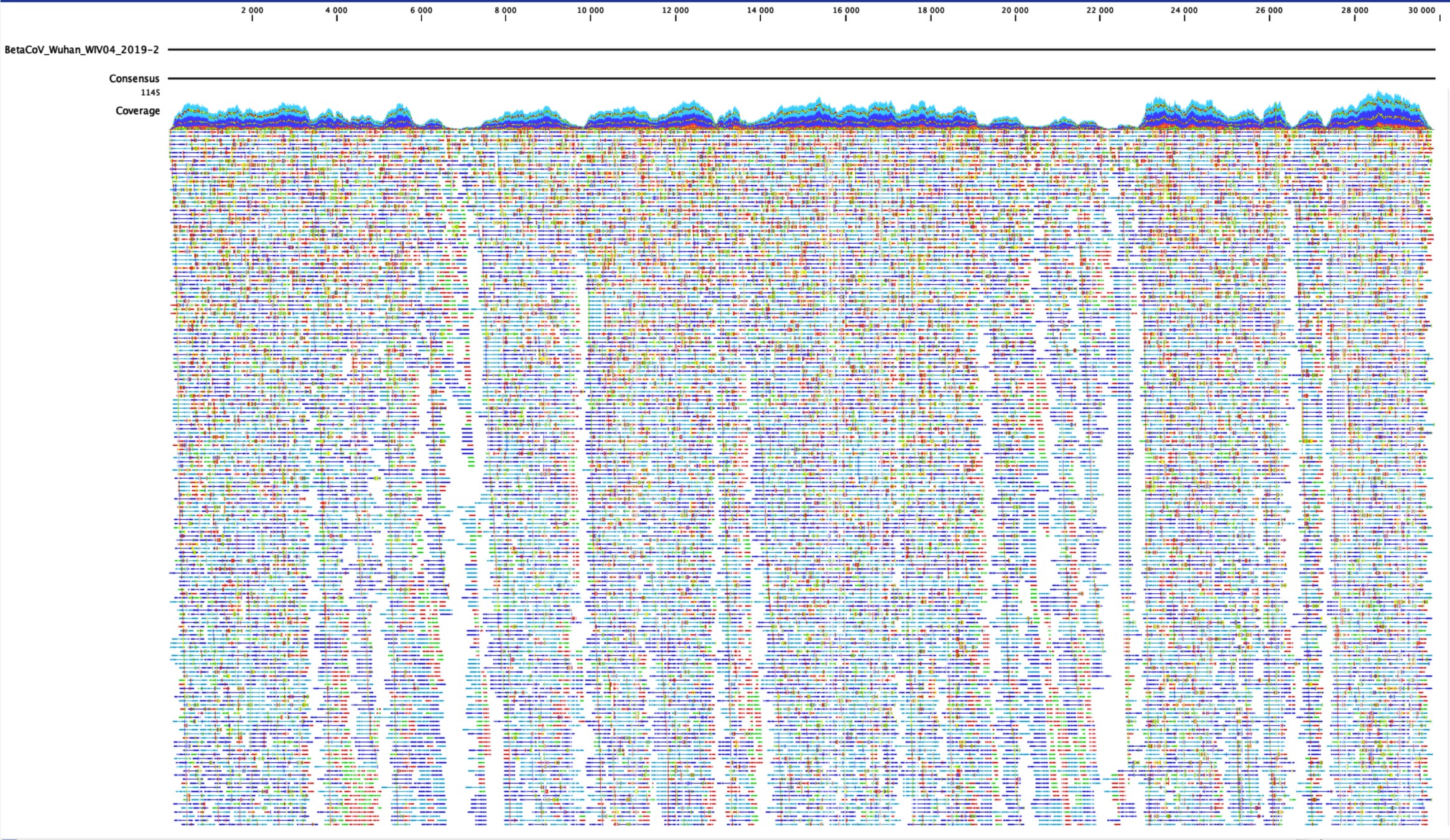
On January 24, 2020, the French Ministry of Health confirmed the first three cases of patients affected by the Wuhan coronavirus. On January 29, 2020, the Institut Pasteur, which is responsible for monitoring respiratory viruses in France, sequenced the whole genome of the coronavirus known as “2019-nCoV”, becoming the first institution in Europe to sequence the virus since the start of the outbreak. The virus was sequenced at the Institut Pasteur’s Mutualized Platform for Microbiology (P2M), which performs genome sequencing on bacterial, viral, fungal and parasite strains received by National Reference Centers and World Health Organization Collaborating Centers for the purpose of infectious disease surveillance.
In December 2019, an outbreak of apparently viral pneumonia of unknown etiology emerged in the city of Wuhan, in the Chinese province of Hubei.
On January 9, 2020, the Chinese health authorities and the World Health Organization (WHO) announced the discovery of a novel coronavirus, known as 2019-nCoV, which was confirmed as the agent responsible for the pneumonia cases.
Over the weekend of January 11-12, the Chinese authorities shared the full sequence of the coronavirus genome, as detected in samples taken from the first patients. “Sequencing the genome of pathogens is crucial for the development of specific diagnostic tests and the identification of potential treatment options,” explains Sylvie van der Werf, Director of the National Reference Center (CNR) for Respiratory Viruses at the Institut Pasteur.
Friday, January 24, 2020. Detection of the virus confirmed in France
On Friday, January 24, late in the morning, the Institut Pasteur received samples of three suspected cases (two patients in Paris and one in Bordeaux). “Using the samples taken from these patients, we detected the novel coronavirus,” says Sylvie Behillil, Deputy Director of the CNR at the Institut Pasteur.
From Friday January 24, 2020. Viral genome sequenced at the Institut Pasteur
That same Friday evening, scientists launched the process of sequencing the viral genome based on the samples. The CNR prepared the material for sequencing, ready for P2M to begin work immediately the following Monday. The sequencing run was completed by early evening on Tuesday, and the scientists used data analysis to obtain the sequence of the whole genome in two of the first three confirmed cases in France. “This proves the efficacy of the CNR’s process of analysis based on viral sequencing,” continues Vincent Enouf.
Thursday, January 30, 2020. The Institut Pasteur obtains and shares the whole sequence of the virus
The P2M platform (see inset below) currently performs at an extremely high level; the average time taken to produce sequences ranges from three days (for emergencies) to a maximum of ten days. In this case, it took just three days for the whole sequence to be determined: “We performed data analysis during the night from Tuesday to Wednesday, then corroborated the results on Wednesday with counter analysis,” explains Vincent Enouf. “The whole sequence was confirmed in just three days.”
What can we learn from it? “The sequences were identical in all our samples. One member of the couple must have contaminated the other, as the virus is the same.” The two full sequences of the virus isolated in two of the first French cases were submitted to the Global Initiative on Sharing All Influenza Data (GISAID) platform,1 which was initially developed to share sequences and monitor the genetic evolution of influenza viruses, a process that is vital to determine the composition of the influenza vaccine. A special “coronavirus” tab has been created so that the scientific community can work together and advance at a quicker pace.
“Around twenty other sequences of the novel coronavirus genome have been obtained worldwide, and if we compare them with ours, we can see that they are all very close; there is not much diversity in the viruses analyzed, which suggests that coronavirus 2019-nCoV did not need to mutate in order to adapt and spread,” continues Vincent Enouf.
The National Reference Center (CNR) for Respiratory Viruses at the Institut Pasteur in Paris is one of WHO’s reference laboratories for coronavirus 2019-nCoV.
A total of eight people from the CNR and two from the P2M sequencing platform have been working on the virus this week and will continue to monitor the outbreak in France.
P2M, a state-of-the-art mutualized platform for microbiology also open to external CNRs
P2M is also available to external CNRs for sequencing. In 2019 it worked with four CNRs based outside the Institut Pasteur. The platform sequences bacteria, viruses, parasites and fungi. Thanks to experience gained over the past five years (since 2015), P2M today offers a highly efficient service, as shown by a first-pass success rate (i.e. a high-quality sequence providing comprehensive information on the entire genome) of more than 95% in 2019. Sequence production takes between three days (for emergencies) and ten days at most.
In 2019, P2M sequenced around 25,000 pathogens. Genome sequencing increases the sensitivity threshold for outbreak detection. Early identification of outbreaks by the Institut Pasteur’s scientists (clustered cases in a short space of time caused by the same pathogen) enables epidemiologists to get to work immediately to determine the origins of the outbreak, and the authorities to coordinate the public health response.
Never miss a breakthrough: Join the SciTechDaily newsletter.
Follow us on Google and Google News.
2 Comments
sir i had some work on embryology and genes … ican sent to you… to go through once..
This scientific study is describing the information of genome of Wuhan Coronavirus that’s why this article is very important for me. One needs to check info about how to get dissertation help online. students who are studying Wuhan Coronavirus should read this article.