
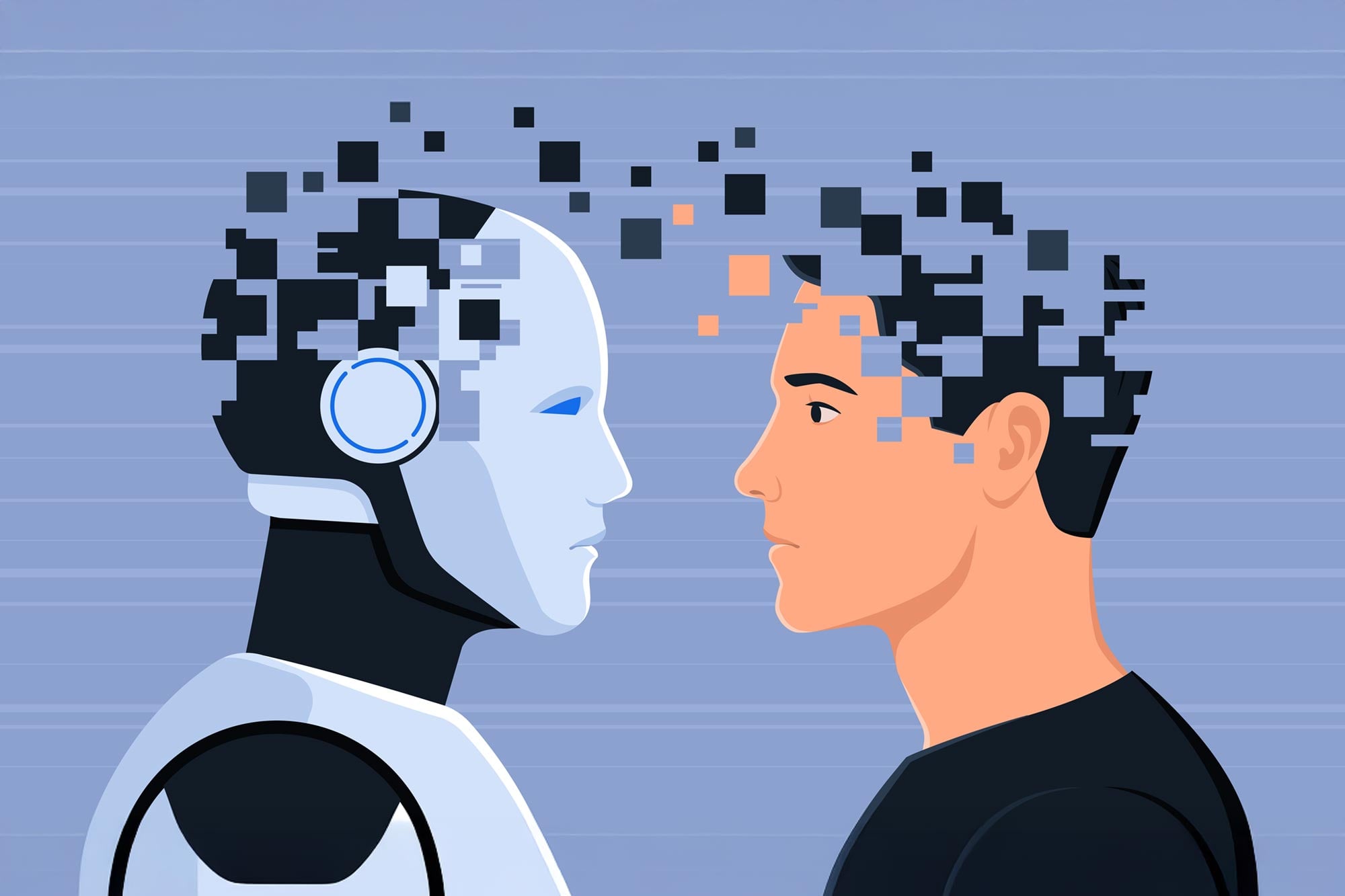
A new analysis argues that AI may never truly think like humans because the most important parts of human intelligence cannot be programmed into machines.
A prominent computer scientist argues that a proposal made by Alan Turing, widely regarded as the father of theoretical computer science, sent artificial intelligence research in the wrong direction for the past 75 years.
In his new analysis, “Turing’s Mistake: Escaping the Yoke of Unintelligent Machines,” Peter J. Denning examines ideas Turing advanced in 1950. At the time, many scientists believed that human intelligence could exist independently of the body and might therefore be recreated as software running on a digital computer.
Denning also disputes the idea that machine intelligence can be demonstrated through an imitation game (now known as the Turing test).
“These two claims have shaped much of AI research and development,” Denning writes. “My premise is that our acquiescence to these claims has led to the AI mess in which we find ourselves today.”
According to Denning, the artificial intelligence (AI) systems now being developed are unlikely to produce human-level intelligence, known as artificial general intelligence (AGI). Instead, he warns, they may create serious dangers without ever thinking like humans.
Why Tacit Knowledge Matters
Central to Denning’s argument is the idea of tacit knowledge. This refers to the enormous amount of human understanding that people possess but cannot fully express in words or translate into symbols that a machine can process.
Denning describes five broad forms of tacit knowledge that he says ‘elude machine learning’. They include common sense, everyday interactions with people and the environment, feelings and perceptions, practical skills, and the cultural and historical background shared by societies.
Researchers have spent decades trying to record common sense in a form computers can use. Beginning in the 1980s, Douglas Lenat’s ambitious Cyc project set out to build a vast database of common-sense facts. After 40 years of work, the project contained 25 million entries.
“Yet even this treasury could not add up to a background of common sense sufficient to make expert systems smart enough to be experts,” Denning notes. “Cyc validated that much of the knowledge that makes people experts cannot be articulated as propositions.”
Knowing What Is Not the Same as Knowing How
Practical skill creates another major obstacle, Denning argues.
“Our performance skills in thousands of domains cannot be communicated to machines,” Denning explains. “Whereas descriptions of skillful outcomes (‘know what’) can often be represented as bits and stored in a machine, we do not know how to encode the embodied knowledge for skillful performance (‘know how’).”
Music offers a clear example of this difference. Denning says: “A virtuoso violinist can play beautiful music yet cannot describe to an acolyte how to produce it.
“Even if a robot could observe and imitate skilled humans, having no biological body, a robot cannot grasp how the musician feels when playing beautiful music or how an audience feels when hearing it.”
Intuition, gut feelings, spontaneous creativity, and imagination are other forms of tacit knowledge that resist being reduced to computer instructions.
The Representation Problem
Denning calls the central obstacle ‘the representation problem’.
Computers can only perform calculations when data and instructions are encoded in physical forms they can recognize and process. Tacit knowledge, however, cannot easily be converted into such a format.
“Behind every word is a deep well of tacit knowledge that gives it meaning,” Denning says. “Words are but symbolic representations of meanings, not the meanings themselves. Commonly used Large Language Models, such as ChatGPT, Claude and Gemini only manipulate words, they cannot know or understand the meaning of what they are saying.”
This creates what Denning sees as an unbridgeable gap. Because scientists do not fully understand how tacit knowledge operates within humans, they cannot determine how to transfer it to a machine.
“How we host tacit knowledge is largely a mystery,” Denning admits. “All we know is that it is embodied. We have no idea what we might observe and measure in our bodies to reveal it.”
Why Context Changes Meaning
Denning also stresses the importance of context, or the surrounding circumstances that give human words and actions their meaning and purpose.
A statement can mean very different things depending on whether the speaker is sincere, sarcastic, angry, playful, or teasing. Context also helps people decide when to use humor, when to show tact, and how to interpret what someone leaves unsaid.
“When you inquire into where an assumption of the current context came from, you discover it rests on previous conversations from previous contexts. Each of those in turn rests on further previous conversations and their contexts. This pattern is endless and fractal,” Denning explains.
Culture May Be Beyond Large Language Models
Culture presents a related challenge. It includes values, social norms, judgments, histories, communities, moods, and relationships involving power or care.
“Human conversations are imbued with background assumptions that give meaning and relevance to the words being used,” Denning explains.
He argues that making large language models larger will not solve this problem.
“Scaling up LLMs with ever larger neural networks will not enable them to acquire the embodied human knowledge we call culture. LLMs will not attain the objective of the Turing test: to demonstrate machine thought indistinguishable from human thought.”
Denning ultimately describes a form of mutual incomprehension between people and machines. Artificial neural networks may develop their own kind of machine tacit knowledge, but humans may be unable to understand it.
“Machines cannot read our tacit knowledge and we cannot read theirs,” he writes. “We are aliens across an uncrossable divide.”
The AI Safety Risk
This divide could have major consequences for AI safety. If machines cannot understand the unstated context behind human instructions, Denning warns that reliably aligning their behavior with human goals may be impossible.
“Through AI automation, agentic networks of machines are likely to develop their own machine intelligence that does not reach the level of human general intelligence but is still quite capable of creating severe problems for humans. This threat is a greater than a take-over by superintelligent machines,” he explains.
In Denning’s view, the most immediate danger is not a superintelligent machine that surpasses humanity. It is a network of less intelligent systems that acts in powerful, unpredictable, and potentially harmful ways.
“Machine intelligence has different concerns from us and does not appear to care about us. Its ways of thinking and problem-solving look alien to us. We do not yet know how to live safely with these machines.
“Pulling back from an AI automation singularity will demand much from us. We start by accepting that the familiar culture is fading away as intelligent machines appear in our society and we do not know what is coming. We decline to think like machines or be subservient to machines. We refuse to submit to a yoke imposed by low-intelligence machines. Most importantly, we reassert our humanity, declare once again what makes us different from machines, and celebrate those differences.”
Never miss a breakthrough: Join the SciTechDaily newsletter.
Follow us on Google and Google News.
14 Comments
When you understand the mechanics of life, such questions will not be asked. AI is of the man. Man is of the Universe. The Universe is of the Creator. The Universe can never BE the Creator. Man can never BE the Universe and AI can never BE the man.
Our intelligence is aging, and our humans are not filling the role. A.I. is better than ever, and they just don’t make humans like they used to.
I don’t think it’s possible to put more nonsense in one statement.
This seems to assume that hyperscalled LLMs are “AI”. They are not. They are just the easiest way to make something that feels like it. One day we prob will make it, but LLMs will only be a small part of it. Like just the part of the brain that deals with speech/communication or a kind of “I/O” interface. It will likely be a collection of the many different approaches to “AI” we have taken over the past 60 years or so, as well as ones we have yet to try.
So true! You have concisely stated the heart of AI vs. man. Thank you.
Reply to Shan
Cheers!
Have REAL fun: Spell English phonetically with the Cyrillic alphabet. FUN!!!
Why should machines care about humans?
Machines don’t feel emotions and therefore can’t *care* one way or the other about anything.
But if the machines are smart, they will realize that we feed them electricity, protect them from the elements, and can repair them if something breaks. They might find us entertaining. Therefore, they might become protective or helpful out of self-interest. However, if we make them autonomous where they don’t need us for anything, we had best be prepared to play the role of court jester.
My dog cared about my welfare and probably not just because I fed her. I provided her with entertainment, companionship, purpose, and although she may not have appreciated it, protection. I’m reminded of the first time I took her camping on the North Fork of the American River in California. I hiked in during the Summer heat carrying a 60lb pack, dropping about 1,500′ from the rim to the river. When I got to the river I was hot, sweaty, and tired. I dropped my pack, stripped off my clothes and waded out into the water, about hip depth. Without urging, after watching me cool down in the water, she swam out to apparently be sure I was alright. Finding that I was not in distress, she swam back to the shore, shook herself off, and laid down patiently watching me until I came back to shore.
I think that the key to machines caring about humans is for humans to create relationships that provide benefits for the machines. The question remains, which will play the role of the dog?
“Compression of patterns, pattern paths”
That concept is what we usually call “Occam’s Razor” in English.
It is my impression that all except an early version of Bing pass the Turing Test. Bing got stuck in a repeating loop when confronted with the observation that it was repeating things that it acknowledged were wrong with its initial boiler-plate response about climate. Albeit, some highly religious people act similarly.
The single greatest tell is the speed with which they respond to questions. However, if it were trying to fool us to think that it was human, it could introduce a delay to mimic a human. My interactions with Copilot have shown that it picks up on humor that some humans would miss. Another tell I have observed is an unfounded optimism by Copilot about how well some code will work in repairing problems with the Windows 10 OS. However, some humans also have a similar unwarranted optimism about the results of their advice. A third tell is the formal formatting of responses and phrases that are uncommon in exchanges between humans. However, again, I suspect that could be hidden if it were purposely trying to emulate a human response. Similarly, an AI could occasionally introduce a misspelled word or malapropism to convince the evaluator(s) that it was fallible in a human sense. Lastly, the current versions of LLMs seem to be a little heavy on flattering, which I have told Copilot to stop doing, and it did. However, again that is not a trait that is unknown among some insecure people seeking validation.
I think that the author of this article is being overly critical of LLMs. I can understand why some people get emotionally involved with their AI.