
Close Menu
    Facebook X (Twitter) Instagram
    SciTechDaily
    • Biology
    • Chemistry
    • Earth
    • Health
    • Physics
    • Science
    • Space
    • Technology
    Facebook X (Twitter) Pinterest YouTube RSS
    SciTechDaily
    Home»Technology»Brain-Inspired Electronics: An Artificial Ionic Neuron for Tomorrow’s Electronic Memories
    Technology

    Brain-Inspired Electronics: An Artificial Ionic Neuron for Tomorrow’s Electronic Memories

    By CNRSAugust 11, 2021No Comments3 Mins Read
    Facebook Twitter Pinterest Telegram LinkedIn WhatsApp Email Reddit
    Share
    Facebook Twitter LinkedIn Pinterest Telegram Email Reddit
    Artificial Neuron Prototype
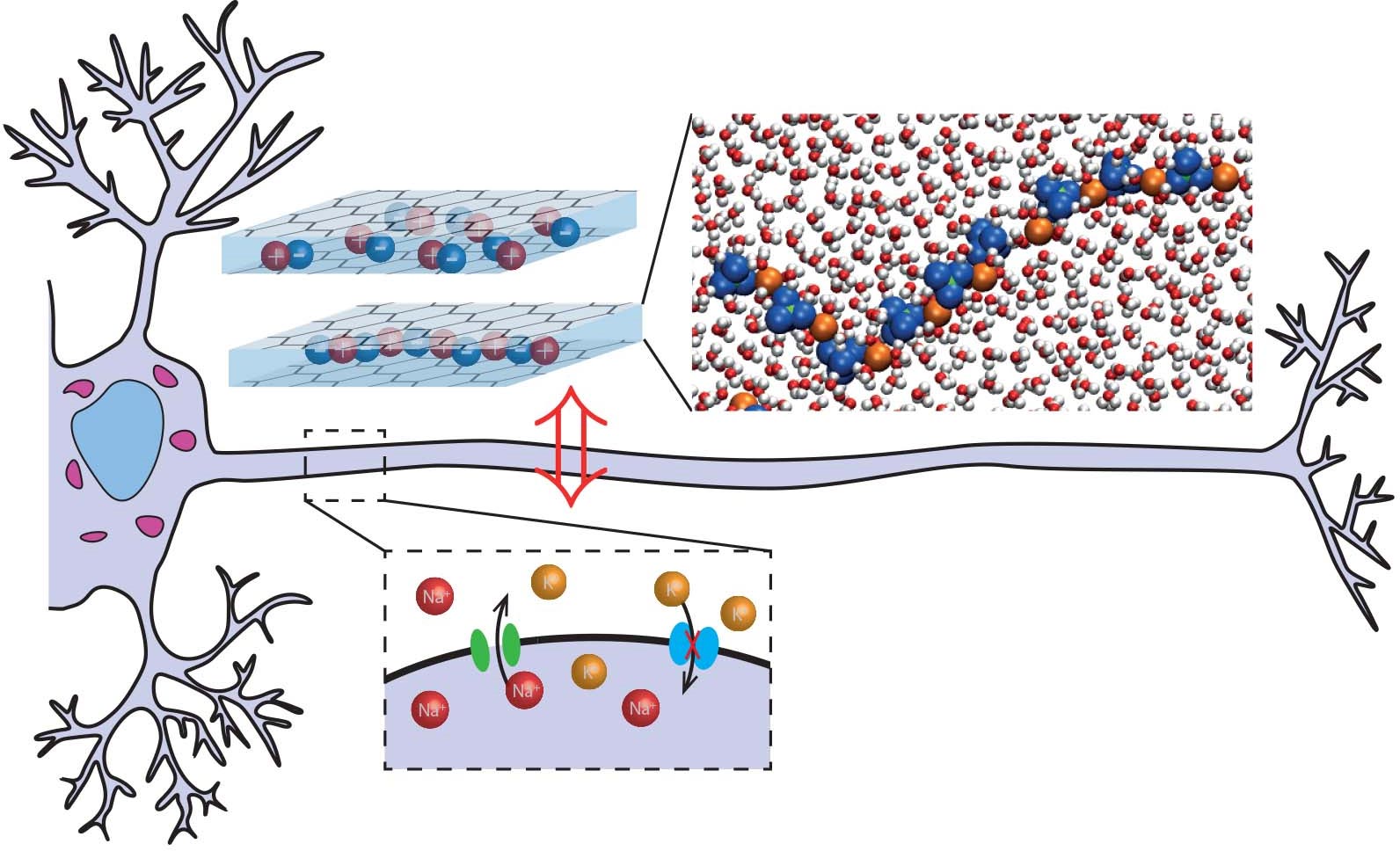
    Artificial neuron prototype: nanofluidic slits can play the role of ion channels and allow neurons to communicate. Ion clusters achieve the ion transport that causes this communication. Credit: © Paul Robin, ENS Laboratoire de Physique (CNRS/ENS-PSL/Sorbonne Université/Université de Paris).

    New ion-based devices mimic neurons, offering a path to smarter, low-energy electronics.

    Brain-inspired electronics are the subject of intense research. Scientists from CNRS and the Ecole Normale Supérieure – PSL have theorized how to develop artificial neurons using, as nerve cells, ions to carry the information. Their work, published in Science on August 6, 2021, reports that devices made of a single layer of water transporting ions within graphene nanoslits have the same transmission capacity as a neuron.

    With an energy consumption equivalent to two bananas per day, the human brain can perform many complex tasks. Its high energy efficiency depends in particular on its base unit, the neuron, which has a membrane with nanometric pores called ion channels, which open and close according to the stimuli received. The resulting ion flows create an electric current responsible for the emission of action potentials, signals that allow neurons to communicate with each other.

    Artificial intelligence can do all of these tasks but only at the cost of energy consumption tens of thousands of times that of the human brain. So the entire research challenge today is to design electronic systems that are as energy-efficient as the human brain, for example, by using ions, not electrons, to carry the information. For this, nanofluidics, the study of how fluids behave in channels less than 100 nanometers wide, offer many perspectives. In a new study, a team from the ENS Laboratoire de Physique (CNRS/ENS-PSL/Sorbonne Université/Université de Paris) shows how to construct a prototype of an artificial neuron formed of extremely thin graphene slits containing a single layer of water molecules.1

    Memristor Effect Enables Memory

    The scientists have shown that, under the effect of an electric field, the ions from this layer of water assemble into elongated clusters and develop a property known as the memristor effect: these clusters retain some of the stimuli that have been received in the past. To repeat the comparison with the brain, the graphene slits reproduce the ion channels, clusters and ion flows. And, using theoretical and digital tools, scientists have shown how to assemble these clusters to reproduce the physical mechanism of emission of action potentials, and thus the transmission of information.

    This theoretical work continues experimentally within the French team, in collaboration with scientists from the University of Manchester (UK). The goal now is to prove experimentally that such systems can implement simple learning algorithms that can serve as the basis for tomorrow’s electronic memories.

    Notes:

    1 Recently invented in Manchester by the group of André Geim (Nobel Prize in Physics 2010)

    Reference: “Modeling of emergent memory and voltage spiking in ionic transport through angstrom-scale slits” by Paul Robin, Nikita Kavokine and Lydéric Bocquet, 6 August 2021, Science.
    DOI: 10.1126/science.abf7923

    Never miss a breakthrough: Join the SciTechDaily newsletter.
    Follow us on Google and Google News.

    Artificial Intelligence Brain CNRS
    Share. Facebook Twitter Pinterest LinkedIn Email Reddit

    Related Articles

    A New Brain Model Could Pave the Way for Conscious AI

    For the First Time – A Robot Has Learned To Imagine Itself

    A Breakthrough in Dementia Care: AI Can Diagnose Dementia As Accurately as Experts

    Making Mind Reading Possible: Invention Allows Amputees To Control a Robotic Arm With Their Mind

    MIT Neuroscientists Discover That Computers Identify Faces in a Surprisingly Human-Like Fashion

    Futuristic AI-Based Computing Devices: Physicists Simulate Artificial Brain Networks With New Quantum Materials

    AI Networks Based on Human Brain Connectivity Can Perform Cognitive Tasks

    Engineers Put Tens of Thousands of Artificial Brain Synapses on a Single Chip for Portable AI Devices

    New Type of Artificial Intelligence Inspired by Brain

    Leave A Reply Cancel Reply

    • Facebook
    • Twitter
    • Pinterest
    • YouTube

    Don't Miss a Discovery

    Subscribe for the Latest in Science & Tech!

    Trending News

    Bone-Strengthening Discovery Could Reverse Osteoporosis

    Scientists Uncover Hidden Trigger Behind Stem Cell Aging

    Scientists Find Way to Reverse Fatty Liver Disease Without Changing Diet

    Could Humans Regrow Limbs? New Study Reveals Promising Genetic Pathway

    Scientists Reveal Eating Fruits and Vegetables May Increase Your Risk of Lung Cancer

    Scientists Reverse Brain Aging With Simple Nasal Spray

    Scientists Uncover Potential Brain Risks of Popular Fish Oil Supplements

    Scientists Discover a Surprising Way To Make Bread Healthier and More Nutritious

    Follow SciTechDaily
    • Facebook
    • Twitter
    • YouTube
    • Pinterest
    • Newsletter
    • RSS
    SciTech News
    • Biology News
    • Chemistry News
    • Earth News
    • Health News
    • Physics News
    • Science News
    • Space News
    • Technology News
    Recent Posts
    • Scientists Decode Mysterious Magnetic “Maze Domains” To Boost EV Efficiency
    • Scientists Say This Fungus Could Survive the Trip to Mars
    • The Universe Is Expanding Too Fast and Scientists Can’t Explain Why
    • Gaining Weight Young May Be More Dangerous Than You Think
    • Scientists Discover Hidden Pathway Inside Catalysts That Defies Decades of Assumptions
    Copyright © 1998 - 2026 SciTechDaily. All Rights Reserved.
    • Science News
    • About
    • Contact
    • Editorial Board
    • Privacy Policy
    • Terms of Use

    Type above and press Enter to search. Press Esc to cancel.