

Close Menu
    Facebook X (Twitter) Instagram
    SciTechDaily
    • Biology
    • Chemistry
    • Earth
    • Health
    • Physics
    • Science
    • Space
    • Technology
    Facebook X (Twitter) Pinterest YouTube RSS
    SciTechDaily
    Home»Science»Your Brain Pays Attention to Unfamiliar Voices During Sleep
    Science

    Your Brain Pays Attention to Unfamiliar Voices During Sleep

    By Society for NeuroscienceJanuary 17, 2022No Comments2 Mins Read
    Facebook Twitter Pinterest Telegram LinkedIn WhatsApp Email Reddit
    Share
    Facebook Twitter LinkedIn Pinterest Telegram Email Reddit
    Talking Sleeping
    During sleep, the brain continues to monitor the environment, balancing the need for rest with the need to wake up.

    New research indicates that the brain continues to process and respond selectively to stimuli during sleep, particularly favoring unfamiliar voices through distinct brain wave activities known as K-complexes, which facilitate a state of alertness while maintaining sleep.

    A good night’s sleep is not as simple as it appears. While you snooze, your brain continues to monitor the environment, balancing the need to protect sleep with the need to wake up. One example of how the brain accomplishes this is by selectively responding to unfamiliar voices over familiar ones, according to new research published in JNeurosci.

    Researchers at the University of Salzburg measured the brain activity of sleeping adults in response to familiar and unfamiliar voices. Unfamiliar voices elicited more K-complexes, a type of brain wave linked to sensory perturbances during sleep, compared to familiar voices. While familiar voices can also trigger K-complexes, only those triggered by unfamiliar voices are accompanied by large-scale changes in brain activity linked to sensory processing.
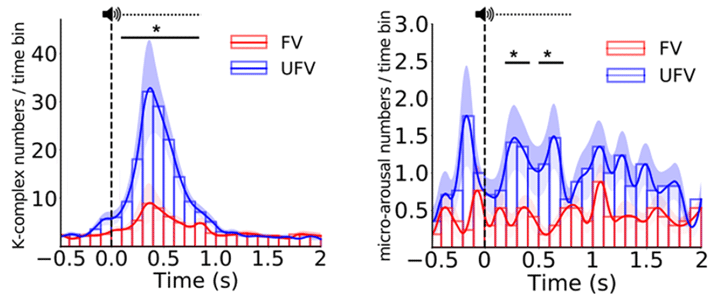
    Brain Pays Attention to Unfamiliar Voices During Sleep
    Temporal aspects of the difference in the triggered K-complexes and micro-arousals. LEFT: The difference between UFV and FV in the number of triggered K-complexes was significant from 100ms to 800ms. RIGHT: The difference in the number of micro-arousals between FVs and UFVs was significant in the periods from 200 to 400ms, and from 500 to 700ms. Credit: Ameen et al., JNeurosci 2022

    Brain responses to the unfamiliar voice occurred less often as the night went on and the voice became more familiar, indicating the brain may still be able to learn during sleep. These results suggest K-complexes allow the brain to enter a “sentinel processing mode,” where the brain stays asleep but retains the ability to respond to relevant stimuli.

    Reference: “The brain selectively tunes to unfamiliar voices during sleep” by Mohamed S. Ameen, Dominik PJ Heib, Christine Blume and Manuel Schabus, 17 January 2022, JNeurosci.
    DOI: 10.1523/JNEUROSCI.2524-20.2021

    Never miss a breakthrough: Join the SciTechDaily newsletter.
    Follow us on Google and Google News.

    Learning Neuroscience Perception Sleep Science Society for Neuroscience
    Share. Facebook Twitter Pinterest LinkedIn Email Reddit

    Related Articles

    New Research Reveals That Good Sleep Boosts Language Learning

    Nostalgia Can Relieve Pain: Viewing Images From Childhood Reduces Pain Perception

    Practice Makes Perfect, but Sleep Helps, Too: Reactivating Memories During Sleep Improves Motor Skills

    Our Brains Encode Musical Predictions Even When Music Doesn’t Play

    White Matter Reorganization: How Learning Braille Changes Brain Structure Over Time

    Special “Time Neurons” in the Human Brain Encode Specific Moments in Time

    Imaging the Twilight Zone: The Brain Network Driving Changes in Consciousness

    Why Time Sometimes Flies or Drags: How the Brain Creates the Experience of Time

    Scientists Can See the Bias in Your Brain – Even Before You Make Your Decision

    Leave A Reply Cancel Reply

    • Facebook
    • Twitter
    • Pinterest
    • YouTube

    Don't Miss a Discovery

    Subscribe for the Latest in Science & Tech!

    Trending News

    Scientists Discover 132-Million-Year-Old Dinosaur Tracks on South Africa’s Coast

    Scientists Uncover the Secret Ingredient Behind the Spark That May Have Started Life on Earth

    Physicists Observe Matter in Two Places at Once in Mind-Bending Quantum Experiment

    Stanford Scientists Discover Hidden Brain Circuit That Fuels Chronic Pain

    New Study Reveals Why Ozempic Works Better for Some People Than Others

    Climate Change Is Altering a Key Greenhouse Gas in a Way Scientists Didn’t Expect

    New Study Suggests Gravitational Waves May Have Created Dark Matter

    Scientists Discover Why the Brain Gets Stuck in Schizophrenia

    Follow SciTechDaily
    • Facebook
    • Twitter
    • YouTube
    • Pinterest
    • Newsletter
    • RSS
    SciTech News
    • Biology News
    • Chemistry News
    • Earth News
    • Health News
    • Physics News
    • Science News
    • Space News
    • Technology News
    Recent Posts
    • 320 Light-Years Away, a Planet Confirms a Fundamental Cosmic Assumption
    • Astronomers Solve Decades-Long Mystery About Saturn’s Spin – “Something Strange Was Happening”
    • Scientists Uncover Strange New State of Matter Inside Uranus and Neptune
    • The Crown Jewel of Dentistry? Breakthrough Tech Could Transform Tooth Repair
    • The Surprising Non-Medical Factor That Determines Cancer Survival
    Copyright © 1998 - 2026 SciTechDaily. All Rights Reserved.
    • Science News
    • About
    • Contact
    • Editorial Board
    • Privacy Policy
    • Terms of Use

    Type above and press Enter to search. Press Esc to cancel.