
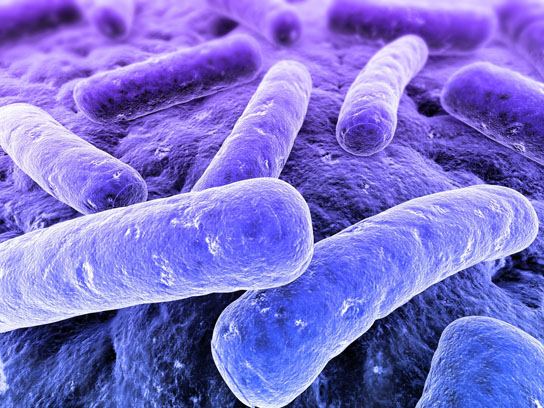
Bacteria are everywhere and in much larger amounts than you may realize. A new study looks at how much a lone human presence affects the level of indoor biological aerosols and the results may be shocking to some.
A person’s mere presence in a room can add 37 million bacteria to the air every hour — material largely left behind by previous occupants and stirred up from the floor — according to new research by Yale University engineers.
“We live in this microbial soup, and a big ingredient is our own microorganisms,” said Jordan Peccia, associate professor of environmental engineering at Yale and the principal investigator of a study recently published online in the journal Indoor Air. “Mostly people are re-suspending what’s been deposited before. The floor dust turns out to be the major source of the bacteria that we breathe.”
Many previous studies have surveyed the variety of germs present in everyday spaces. But this is the first study that quantifies how much a lone human presence affects the level of indoor biological aerosols.
Peccia and his research team measured and analyzed biological particles in a single, ground-floor university classroom over a period of eight days — four days when the room was periodically occupied, and four days when the room was continuously vacant. At all times the windows and doors were kept closed. The HVAC system was operated at normal levels. Researchers sorted the particles by size.
Overall, they found that “human occupancy was associated with substantially increased airborne concentrations” of bacteria and fungi of various sizes. Occupancy resulted in especially large spikes for larger-sized fungal particles and medium-sized bacterial particles. The size of bacteria- and fungi-bearing particles is important, because size affects the degree to which they are likely to be filtered from the air or linger and recirculate, the researchers note.
“Size is the master variable,” Peccia said.
Researchers found that about 18 percent of all bacterial emissions in the room — including both fresh and previously deposited bacteria — came from humans, as opposed to plants and other sources. Of the 15 most abundant varieties of bacteria identified in the room studied, four are directly associated with humans, including the most abundant, Propionibacterineae, common on human skin.
Peccia said carpeted rooms appear to retain especially high amounts of microorganisms, but noted that this does not necessarily mean rugs and carpets should be removed. Extremely few of the microorganisms commonly found indoors — less than 0.1 percent — are infectious, he said.
Still, understanding the content and dynamics of indoor biological aerosols is helpful for devising new ways of improving air quality when necessary, he said.
“All those infectious diseases we get, we get indoors,” he said, adding that Americans spend more than 90 percent of their time inside.
The researchers have begun a series of similar studies outside the United States.
Reference: “Size-resolved emission rates of airborne bacteria and fungi in an occupied classroom” by J. Qian, D. Hospodsky, N. Yamamoto, W. W. Nazaroff and J. Peccia, 18 January 2012, Indoor Air.
DOI: 10.1111/j.1600-0668.2012.00769.x
The paper’s lead author is J. Qian of Yale. Other contributors are D. Hospodsky and N. Yamamoto, both of Yale, and W.W. Nazaroff of the University of California–Berkeley.
The research was supported by the Alfred P. Sloan Foundation.
Never miss a breakthrough: Join the SciTechDaily newsletter.
Follow us on Google and Google News.