
A closer look at how mangoes respond to temperature reveals a delicate balance between preservation and damage.
Researchers have uncovered why a simple temperature adjustment can dramatically change how long a mango stays fresh. By studying everything from cell structure to gene activity, they found that storing ‘Tainong No.1’ mangoes at moderately cool temperatures helps the fruit stay firm, ripen more slowly, and better defend itself against internal stress. The work sheds light on the biology behind fruit preservation and points to smarter ways of transporting tropical produce.
Mango (Mangifera indica) is a global favorite, but it is also highly perishable. Once picked, it continues to breathe and ripen, quickly becoming softer and more fragile. In many tropical supply chains, mangoes travel at temperatures around 26–30°C (79–86°F). While convenient, these conditions speed up aging and leave little room for error during transport. Cooling can slow this process, but too much cold can damage the fruit, creating a narrow window for optimal storage.
Experimental Approach and Key Measurements
A study published in the journal Tropical Plants by Yuanzhi Shao & Wen Li’s team at Hainan University identifies 12 °C (54°F) as a key threshold. At this temperature, mangoes maintain quality without triggering chilling injury. More importantly, the researchers explain why.
Rather than simply slowing metabolism, 12 °C (54°F) appears to stabilize the fruit’s internal balance. It keeps reactive oxygen species, often linked to aging and cellular damage, under control. At the same time, it supports the fruit’s natural antioxidant systems, allowing it to better manage stress during storage.
Inside the Mango: What Changes Over Time
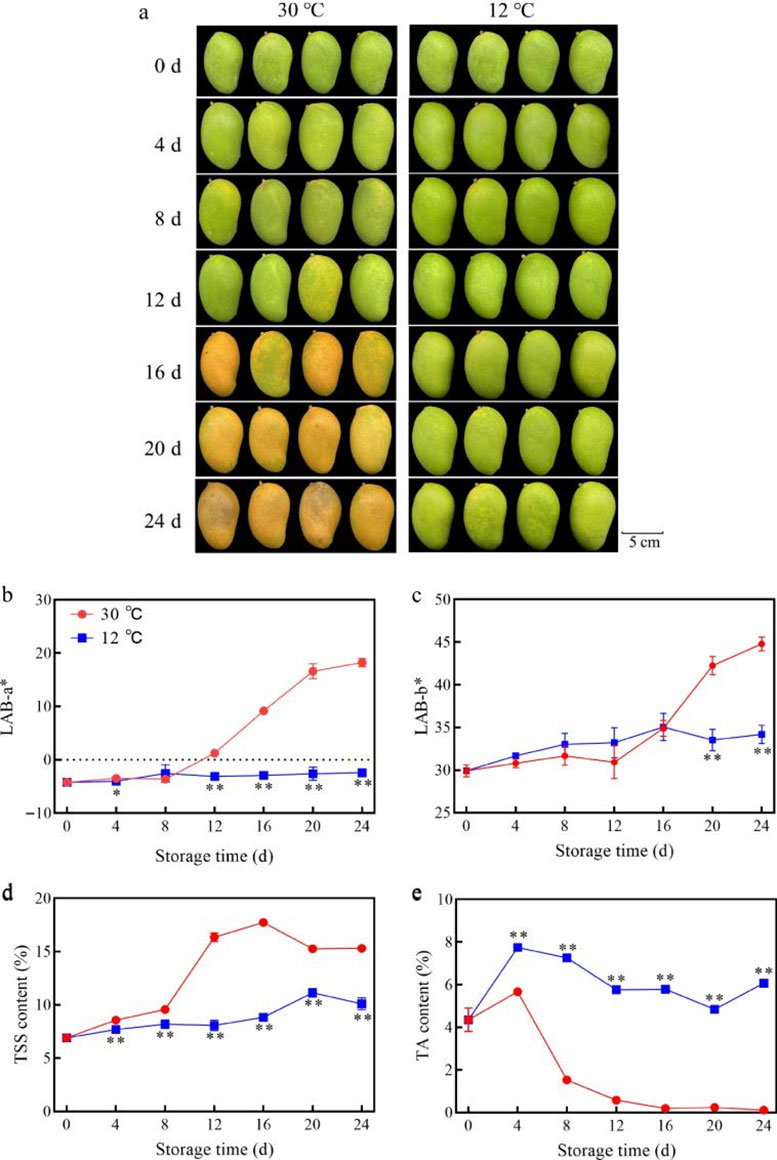
To understand these effects, the team tracked mangoes stored at 12 °C (54°F) and 30 °C (86°F) over 24 days. They examined physical traits, chemical composition, and gene activity, building a detailed picture of how the fruit evolves after harvest.
At higher temperatures, ripening accelerated quickly. Within a little over two weeks, mangoes turned yellow, sugars spiked and then dropped, and acidity declined. These are classic signs of fruit moving rapidly toward overripeness.
Under cooler conditions, the same processes unfolded much more gradually. Color changes slowed, sugar accumulation became more stable, and acidity was retained longer. This slower progression is critical for maintaining flavor and texture during transport.
Microscopic imaging revealed that mangoes stored at 12 °C (54°F) preserved the integrity of their cell walls and retained starch reserves. In contrast, fruit kept at 30 °C (86°F) showed early structural breakdown, with weakened cell walls and depleted energy stores. This collapse at the cellular level is what ultimately leads to the mushy texture consumers associate with overripe fruit.
The Role of Antioxidants and Genes
The study also highlights the importance of oxidative stress. As mangoes age, reactive oxygen species accumulate, damaging cells and accelerating spoilage. At 12 °C (54°F), this buildup was significantly reduced.
Key antioxidant enzymes remained more active, and genes linked to stress response, including MiAPX1, MiAPX2, MiSOD1, and MiSOD2, showed higher expression. Compounds such as vitamin C, phenolics, and flavonoids also stayed at elevated levels.
These insights have practical implications far beyond the lab. Holding mangoes near 12°C (54°F) could reshape how they move through global supply chains. Growers may be able to harvest earlier, ship fruit over longer distances, and still deliver consistent quality.
For retailers and consumers, this could mean mangoes that arrive in better condition and ripen more predictably at their destination. Reducing spoilage during transit also lowers economic losses and cuts down on food waste, an increasingly important goal in modern agriculture.
Reference: “Low temperature mitigates mango quality deterioration by improving antioxidant ability and gene expression levels” by Jinhe Li, Yuanhui Gao, Xin Wang, Shaobin Zeng, Dexin Ma, Yan Gong, Yuanzhi Shao, Wen Li, Jinhe Li, Yuanhui Gao, Xin Wang, Shaobin Zeng, Dexin Ma, Yan Gong, Yuanzhi Shao and Wen Li, 16 December 2025, Tropical Plants.
DOI: 10.48130/tp-0025-0034
This research was funded by the Hainan Province Agricultural Reclamation Team Joint Innovation Project (Grant No. HKKJ202432), the National Key Research and Development Program Project (Grant No. 2023YFD2300803–7), and Hainan University Mango Industry Technology System Construction Project.
Never miss a breakthrough: Join the SciTechDaily newsletter.
Follow us on Google and Google News.
2 Comments
thanks
Buy a tin it’s easier.