
Close Menu
    Facebook X (Twitter) Instagram
    SciTechDaily
    • Biology
    • Chemistry
    • Earth
    • Health
    • Physics
    • Science
    • Space
    • Technology
    Facebook X (Twitter) Pinterest YouTube RSS
    SciTechDaily
    Home»Space»Mars Reconnaissance Orbiter Reveals Clues about Volcanoes Under Ice on Ancient Mars
    Space

    Mars Reconnaissance Orbiter Reveals Clues about Volcanoes Under Ice on Ancient Mars

    By Guy Webster, Jet Propulsion LaboratoryMay 3, 20161 Comment3 Mins Read
    Facebook Twitter Pinterest Telegram LinkedIn WhatsApp Email Reddit
    Share
    Facebook Twitter LinkedIn Pinterest Telegram Email Reddit
    Clues about Volcanoes Under Ice on Ancient Mars Discovered
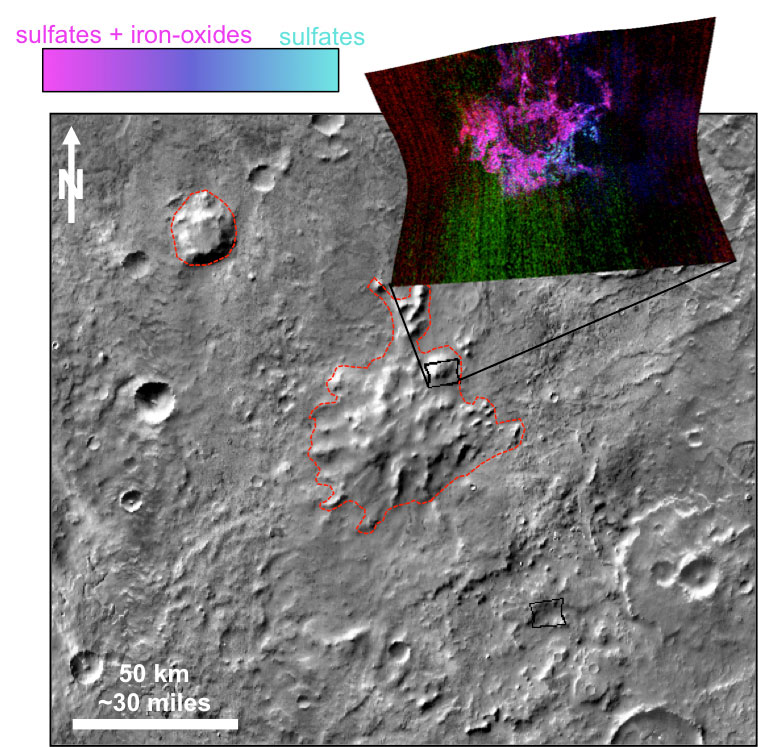
    This graphic illustrates where Mars mineral mapping from orbit has detected minerals that can indicate where a volcano erupted beneath an ice sheet. The site is far from any ice sheet on modern Mars, in an area where unusual shapes have been interpreted as a possible result of volcanism under ice.

    New evidence from NASA’s Mars Reconnaissance Orbiter suggests that volcanoes erupted beneath an ice sheet on Mars billions of years ago.

    The research about these volcanoes helps show there was extensive ice on ancient Mars. It also adds information about an environment combining heat and moisture, which could have provided favorable conditions for microbial life.

    Sheridan Ackiss of Purdue University, West Lafayette, Indiana, and collaborators used the orbiter’s mineral-mapping spectrometer to investigate surface composition in an oddly textured region of southern Mars called “Sisyphi Montes.” The region is studded with flat-topped mountains. Other researchers previously noted these domes’ similarity in shape to volcanoes on Earth that erupted underneath the ice.

    “Rocks tell stories. Studying the rocks can show how the volcano formed or how it was changed over time,” Ackiss said. “I wanted to learn what story the rocks on these volcanoes were telling.”

    When a volcano begins erupting beneath a sheet of ice on Earth, the rapidly generated steam typically leads to explosions that punch through the ice and propel ash high into the sky. For example, the 2010 eruption of ice-covered Eyjafjallajökull in Iceland lofted ash that disrupted air travel across Europe for about a week.

    Characteristic minerals resulting from such subglacial volcanism on Earth include zeolites, sulfates, and clays. Those are just what the new research has detected at some flat-topped mountains in the Sisyphi Montes region examined with the spacecraft’s Compact Reconnaissance Imaging Spectrometer for Mars (CRISM), providing resolution of about 60 feet (18 meters) per pixel.

    “We wouldn’t have been able to do this without the high resolution of CRISM,” Ackiss said.

    The Sisyphi Montes region extends from about 55 degrees to 75 degrees south latitude. Some of the sites that have shapes and compositions consistent with volcanic eruptions beneath an ice sheet are about 1,000 miles (about 1,600 kilometers) from the current south polar ice cap of Mars. The cap now has a diameter of about 220 miles (about 350 kilometers).

    NASA has three active orbiters and two rovers at Mars that are advancing knowledge about the Red Planet that is useful in planning future missions that will take humans there.

    Never miss a breakthrough: Join the SciTechDaily newsletter.
    Follow us on Google and Google News.

    Astronomy Mars Mars Reconnaissance Orbiter NASA Planetary Science Volcano
    Share. Facebook Twitter Pinterest LinkedIn Email Reddit

    Related Articles

    Ten Years and Counting, Mars Orbiter Still Going Strong

    New NASA Image of the Northern Plains of Mars

    Mars Orbiter Preparing for Mars InSight Lander’s 2016 Arrival

    NASA’s Mars Reconnaissance Orbiter Completes 40,000 Mars Orbits

    Orbiter Examines Clues to Possible Water Flows on Mars

    Mars Reconnaissance Orbiter Examines a New Impact Crater

    Scientists Find Evidence for Granite on Mars

    Data Indicates Temperatures Rise and Fall Twice a Day on Mars

    Mars Orbiter Shows McLaughlin Crater May Have Once Held a Groundwater-Fed Lake

    1 Comment

    1. Madanagopsl.V.C. on May 4, 2016 9:53 am

      Volcanoes are general activity on all planets.Thank You.

      Reply
    Leave A Reply Cancel Reply

    • Facebook
    • Twitter
    • Pinterest
    • YouTube

    Don't Miss a Discovery

    Subscribe for the Latest in Science & Tech!

    Trending News

    Massive Study Warns Marijuana Use in Teens Is Linked to Serious Mental Illness

    Scientists Discover a Completely Unexpected Way T Cells Kill Cancer

    Scientists Just Found the Solar System’s Original “Planet Factory”

    Study Warns Widely Used Food Preservatives Linked to High Blood Pressure and Heart Disease

    New Treatment Could Reverse Osteoarthritis Within Weeks

    Physicists Have Measured “Negative Time” in Bizarre Quantum Experiment

    The Deadly Tapeworm Spreading Across America Has Reached the Pacific Northwest

    Could Low Vitamin D Be Making Your Pain Worse?

    Follow SciTechDaily
    • Facebook
    • Twitter
    • YouTube
    • Pinterest
    • Newsletter
    • RSS
    SciTech News
    • Biology News
    • Chemistry News
    • Earth News
    • Health News
    • Physics News
    • Science News
    • Space News
    • Technology News
    Recent Posts
    • Scientists Discover Mysterious Creature Living in the Great Salt Lake – and It Exists Nowhere Else on Earth
    • It’s Alive? Surprising Discovery Changes What We Know About Fog
    • Simple Family Routines May Be the Secret to a Smoother Start at School
    • Brain Study Overturns Long-Held Beliefs About How Humans Learn Speech
    • Ancient Goose Fossil Challenges Long-Held Theories About New Zealand Birds
    Copyright © 1998 - 2026 SciTechDaily. All Rights Reserved.
    • Science News
    • About
    • Contact
    • Editorial Board
    • Privacy Policy
    • Terms of Use

    Type above and press Enter to search. Press Esc to cancel.