
New research from the Max Planck Institute shows that mice can sense oxygen levels in the environment using specialized neurons in their noses that are present in the olfactory mucosa.
The genome of mice harbors more than 1000 odorant receptor genes, which enable them to smell myriad odors in their surroundings. Researchers at the Max Planck Research Unit for Neurogenetics in Frankfurt, the University of Saarland in Homburg, the University of Cambridge, and the Karolinska Institute in Stockholm have discovered that mice can also sense the oxygen level of the inhaled air using neurons in their nose. For this newly discovered sensory property, mice rely on two genes termed Gucy1b2 and Trpc2, but apparently not on odorant receptor genes.
The research team discovered that a specific type of chemosensory neuron in the mouse olfactory mucosa responds to oxygen decreases in the environment. Chemosensory cells typically detect an increase in the concentration of a substance. In mammals, a lack of oxygen was thought to be detected primarily by the carotid body, a sensory organ situated at the carotid arteries in the neck. Activation of the carotid body results in activation of the respiratory center in the brain. As mice live in burrows, it appears that during evolution an additional mechanism has developed in order to protect the individuals and their offspring from a shortage of oxygen.
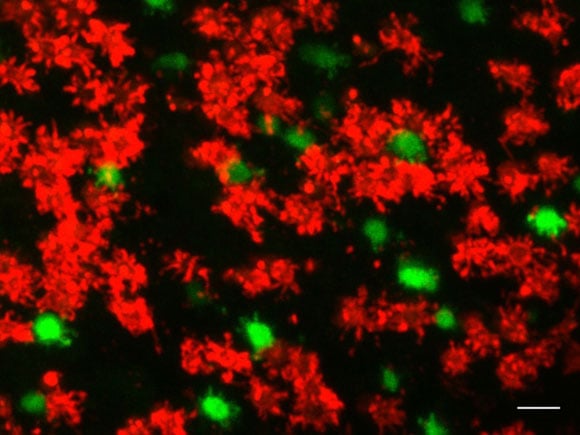
The function of these so-called type B cells was enigmatic until this paper. “We activated these cells with low-oxygen air, and discovered a possibly vital function of these cells”, says Peter Mombaerts, director of the Max Planck Research Unit for Neurogenetics. The research team investigated how type B cells behave when exposed to various oxygen levels. Using a calcium-sensitive dye, they observed that type B cells in the olfactory mucosa are activated following a modest decrease in the oxygen level in the external environment.
The scientists found that the Gucyb12 and Trpc2 genes are essential for signal transduction in type B cells upon exposure to low oxygen. They used genetically altered mice in which either gene is inactivated genetically. These genes encode, respectively, an enzyme that produces the second messenger cGMP, and an ion channel through which calcium enters the cells. (Calcium is also another important intracellular messenger.) Without functional Gucy1b2 and Trpc2 genes, calcium-dependent signaling pathways are not activated in type B cells, and mice cannot distinguish or respond properly to decreased oxygen levels. Thus far the molecular sensor that detects the low oxygen level remains unknown. The researchers are investigating further the signaling mechanisms that result in activation of these neurons.
Moreover, the scientists found that mice can learn very quickly where locations with low oxygen levels are, and then avoid these areas. By contrast, mice with inactivated Gucy1b2 or Trpc2 genes cannot distinguish between normal and modestly decreased oxygen levels in the external environment, and do not show avoidance behavior of these areas with a low oxygen level. These genes thus enable mice early on to select locations with an optimal oxygen level.
The researchers speculate that type B cells have also a social influence in mice. For instance, mice build their nests preferably in locations with a higher oxygen level in order to protect their offspring. “The offspring needs sufficient oxygen, otherwise they would be underserved”, says Frank Zufall, director at the Center for Integrative Physiology and Molecular Medicine in Homburg.
Mice may be more sensitive to a lack of oxygen than humans. The human Gucy1b2 and Trpc2 genes are pseudogenes, which means that these genes may not encode proteins. It remains to be determined if type B cells occur in humans at all and if so, whether they detect low oxygen levels.
Reference: “A Sensor for Low Environmental Oxygen in the Mouse Main Olfactory Epithelium” by Katherin Bleymehl, Anabel Pérez-Gómez, Masayo Omura, Ana Moreno-Pérez, David Macías, Zhaodai Bai, Randall S. Johnson, Trese Leinders-Zufall, Frank Zufall and Peter Mombaerts, 1 December 2016, Neuron,
DOI: 10.1016/j.neuron.2016.11.001
Never miss a breakthrough: Join the SciTechDaily newsletter.
Follow us on Google and Google News.