
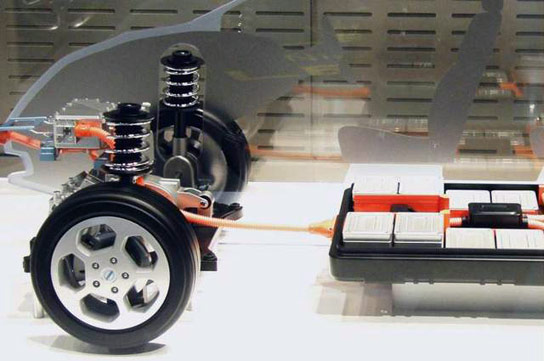
A new report from UCLA and UC Berkeley shows that used electric car batteries could help California achieve its renewable energy, greenhouse gas reduction, and energy storage goals more efficiently — and could lower the cost of owning an electric car.
As California searches for cheap energy storage options, a new report by the Climate Change and Business Research Initiative at the UCLA and UC Berkeley law schools suggests that used electric vehicle batteries may be an ideal solution.
“Most batteries will retain much of their capacity and value after the use of the car,” said report author Ethan Elkind, associate director of the Climate Change and Business Program at UCLA and UC Berkeley law schools, which leads the initiative. “As a result, repurposing them can absorb excess renewable energy and dispatch it when the sun isn’t shining and the wind isn’t blowing.”
According to the report, “Reuse and Repower: How to Save Money and Clean the Grid with Second-Life Electric Vehicle Batteries,” used electric car batteries could help California achieve its renewable energy, greenhouse gas reduction and energy storage goals more efficiently — and could lower the cost of owning an electric car.
“Electric cars and their batteries can benefit the electric grid in several ways,” said Steven Weissman, director of Berkeley Law’s Center for Law, Energy and the Environment, and co-author of the report. “First, vehicle owners can be encouraged to charge at night to help smooth out the demand for power. Second, in-car batteries can provide active storage capacity that offers a modest amount of power back to the grid when needed. Finally, a large number of used batteries can be aggregated to become a storage bank managed by the grid operators. Each of these practices would help reduce the cost of buying an electric car.”
Although California is experiencing a surge in generating renewable energy from the sun and wind, the state will face long-term economic and environmental challenges if it relies on these intermittent resources without deploying more energy storage, the authors write.
During times of low demand, large-scale energy storage technologies can capture surplus renewable energy for later use, according to the report. Second-life batteries could provide businesses and homes with backup power while lowering electricity costs for owners.
“Utilities can stack reused batteries to store excess power during times of heavy demand, which would provide substantial savings and reduce the need for costly fossil fuel-burning power plants,” said Elkind, who also is associate director of the Climate Change and Business Research Initiative. “Large business entities such as a hospital or university can use the batteries as bulk energy storage when the power goes out and the grid is prone to fail, or to offset high-expense energy stretches.
“Property owners can use repackaged individual batteries for backup power or to go off the grid entirely,” he added.
California accounts for more than 40 percent of electric vehicle sales in the United States, and roughly half of the battery packs can be repurposed with 75 percent of their original capacity, according to the report.
The report’s authors also make several policy recommendations that would help establish a new market for used electric batteries.
They urge state leaders to aggressively support and partner with automakers, utilities, and other private-sector entities to continue to develop more second-life battery demonstration projects in order to document the market potential for investors and the companies involved.
The report is the 13th in a series of policy papers by the Climate Change and Business Research Initiative, a partnership between UCLA School of Law’s Emmett Institute on Climate Change and the Environment and UC Berkeley School of Law’s Center for Law, Energy and the Environment. Funded by Bank of America, the series focuses on how climate change will create opportunities for specific sectors of the business community and how policymakers can facilitate those opportunities.
Never miss a breakthrough: Join the SciTechDaily newsletter.
Follow us on Google and Google News.