
Close Menu
    Facebook X (Twitter) Instagram
    SciTechDaily
    • Biology
    • Chemistry
    • Earth
    • Health
    • Physics
    • Science
    • Space
    • Technology
    Facebook X (Twitter) Pinterest YouTube RSS
    SciTechDaily
    Home»Technology»Robotic Tentacles Have a Soft Enough Touch to Pick Up Flowers
    Technology

    Robotic Tentacles Have a Soft Enough Touch to Pick Up Flowers

    By SciTechDailySeptember 11, 2012No Comments2 Mins Read
    Facebook Twitter Pinterest Telegram LinkedIn WhatsApp Email Reddit
    Share
    Facebook Twitter LinkedIn Pinterest Telegram Email Reddit
    tentacle-holding-flower
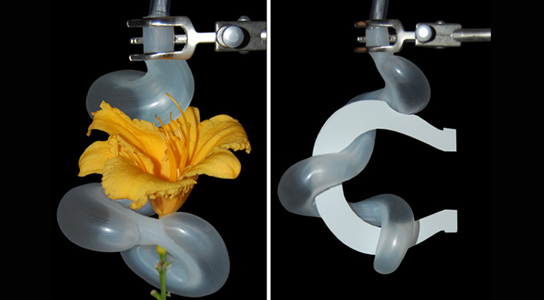
    Researchers have developed a robotic tentacle capable of twisting around a flower without causing any damage to it.

    Typically, robotic hands have had trouble being dexterous enough and delicate enough to perform certain tasks, but robotics experts from Harvard University have been developing a series of soft robots, capable of accomplishing much more than previously.

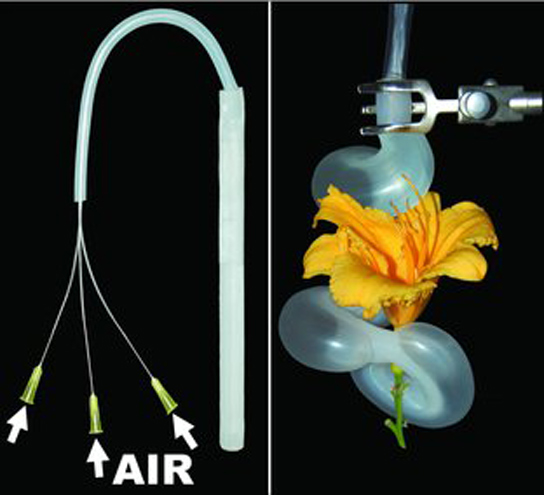
    The scientists published their findings in the journal Advanced Materials. George Whitesides and his colleagues created a robotic tentacle that can twist around a flower without damaging it. It’s made from a flexible plastic containing three air channels, running along the entire limb. The selective pumping of air into these channels causes the tentacle to bend, allowing it to curl around objects with a delicate grip.
    air-channels-roboti-tentacle

    The air channels can be split into multiple sections, letting the parts of the tentacle bend in different directions. This produces a full range of 3D movement. Previous efforts were limited to curling in just one direction.

    Whitesides’ team also experimented with adding a video camera, syringe, and suction cups at the end of the tentacle, making it more than just a simple grabbing arm. This cheap and soft technology could make it ideal for working with fragile objects or maneuvering in confined as well as hazardous spaces, but the need for air channels makes it difficult to scale the tentacles down to anything smaller than at least a few centimeters in size.

    Reference: “Robotic Tentacles with Three-Dimensional Mobility Based on Flexible Elastomers” by Ramses V. Martinez, Jamie L. Branch, Carina R. Fish, Lihua Jin, Robert F. Shepherd, Rui M. D. Nunes, Zhigang Suo and George M. Whitesides, 7 September 2012, Advanced Materials.
    DOI: 10.1002/adma.201203002

    Never miss a breakthrough: Join the SciTechDaily newsletter.
    Follow us on Google and Google News.

    DARPA Harvard University Materials Science Robotics
    Share. Facebook Twitter Pinterest LinkedIn Email Reddit

    Related Articles

    Shape-Shifting Materials With Infinite Possibilities: Totimorphic Structural Materials Can Achieve Any Shape

    DARPA & Harvard’s Soft, Self-Camouflaging Robot

    Nanomaterials Actively Self-Regulate in Response to Environmental Change

    Engineers to Develop a Smart Suit That Improves Physical Endurance

    Solid-Oxide Fuel Cell That Converts Hydrogen Into Electricity Also Capable of Battery-Like Storage

    SLIPS Prevents Ice From Sticking on Metal Surfaces

    “Cheetah” Sets Legged Robot Land Speed Record

    Elastomeric “Soft” Robots Running on Pneumatic Actuators

    DARPA’s Legged Squad Support System (LS3) To Ease Physical Load on Troops

    Leave A Reply Cancel Reply

    • Facebook
    • Twitter
    • Pinterest
    • YouTube

    Don't Miss a Discovery

    Subscribe for the Latest in Science & Tech!

    Trending News

    Your Blood Pressure Reading Could Be Wrong Because of One Simple Mistake

    Astronomers Stunned by Ancient Galaxy With No Spin

    Physicists May Be on the Verge of Discovering “New Physics” at CERN

    Scientists Solve 320-Million-Year Mystery of Reptile Skin Armor

    Scientists Say This Daily Walking Habit May Be the Secret to Keeping Weight Off After Dieting

    New Therapy Rewires the Brain To Restore Joy in Depression Patients

    Giant Squid Detected off Western Australia in Stunning Deep-Sea Discovery

    Popular Sugar-Free Sweetener Linked to Liver Disease, Study Warns

    Follow SciTechDaily
    • Facebook
    • Twitter
    • YouTube
    • Pinterest
    • Newsletter
    • RSS
    SciTech News
    • Biology News
    • Chemistry News
    • Earth News
    • Health News
    • Physics News
    • Science News
    • Space News
    • Technology News
    Recent Posts
    • Hidden Warm Water Beneath Antarctica Could Rapidly Raise Global Sea Levels
    • Scientists Revive Ancient Chemistry Trick To Engineer Next-Generation Glass
    • Scientists Use AI To Supercharge Ultrafast Laser Simulations by More Than 250x
    • Scientists Just Found a Surprising Way To Destroy “Forever Chemicals”
    • Popular Supplement Ingredient Linked to Shorter Lifespan in Men
    Copyright © 1998 - 2026 SciTechDaily. All Rights Reserved.
    • Science News
    • About
    • Contact
    • Editorial Board
    • Privacy Policy
    • Terms of Use

    Type above and press Enter to search. Press Esc to cancel.