
Close Menu
    Facebook X (Twitter) Instagram
    SciTechDaily
    • Biology
    • Chemistry
    • Earth
    • Health
    • Physics
    • Science
    • Space
    • Technology
    Facebook X (Twitter) Pinterest YouTube RSS
    SciTechDaily
    Home»Health»Scientists Report a Major Breakthrough in Alzheimer’s Disease
    Health

    Scientists Report a Major Breakthrough in Alzheimer’s Disease

    By Trinity College DublinSeptember 20, 2015No Comments3 Mins Read
    Facebook Twitter Pinterest Telegram LinkedIn WhatsApp Email Reddit
    Share
    Facebook Twitter LinkedIn Pinterest Telegram Email Reddit
    Researchers Report a Major Breakthrough in Alzheimer's Disease
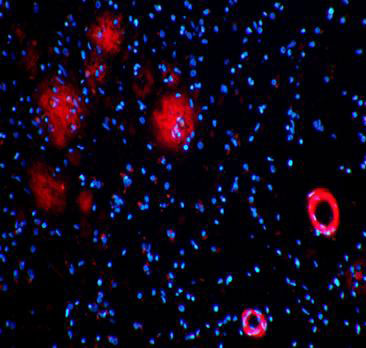
    A human donor Alzheimer’s disease brain tissue stained with an agent called ‘congo-red’, which allows for the visualization of amyloid-beta plaques (red) in the brain and surrounding blood vessels. Blue stains show the nuclei of the cells in the brain. Credit: Dr. Matthew Campbell, 2015

    New research sheds light on a fundamental mechanism underlying the development of Alzheimer’s disease and could lead to new forms of therapy people with the disease.

    Alzheimer’s is the most common form of dementia globally and affects up to 40,000 people in Ireland today. It is the fourth leading cause of death in individuals over the age of 65 and it is the only cause of death among the top ten that cannot be prevented, cured, or even slowed down.

    The condition is classically associated with memory loss. However, other symptoms and warning signs include difficulty performing familiar tasks, problems with language such as forgetting phrases or words, and changes in mood, behavior, and personality.

    The research, published this week in leading international journal, Science Advances, was supported by Science Foundation Ireland (SFI) and the US-based charity, Brightfocus Foundation.

    Alzheimer’s disease is characterized, in part, by the build-up of a small protein (‘amyloid-beta’) in the brains of patients. Impaired clearance of this protein appears to be a major factor in the build-up of plaques, and then in the disease process itself. While the mode by which amyloid-beta is cleared remains unclear, it is evident that it needs to be removed from the brain via the bloodstream.

    Unlike blood vessels anywhere else in the body, those in the brain have properties that strictly regulate what gets in and out of the delicate tissue – this is what is known as the blood-brain barrier (BBB). The BBB functions as a tightly regulated site of energy and metabolite exchange between the brain tissue and the bloodstream.

    “We have shown that distinct components of these blood vessels termed tight junctions are altered in Alzheimer’s disease. We think that this alteration could be an entrained mechanism to allow for the clearance of toxic amyloid-beta from the brain in those living with Alzheimer’s disease,” said postdoctoral researcher in Trinity’s School of Genetics and Microbiology, Dr. James Keaney, who spearheaded the study.

    Working with the Dublin Brain Bank, which is based in Beaumont Hospital, the researchers from Trinity examined the brain tissues of individuals who were affected by Alzheimer’s disease during their lifetime and then compared results to those observed in model systems in the laboratory.

    Research Assistant Professor in Genetics at Trinity, Dr. Matthew Campbell, added: “Our recent findings have highlighted the importance of understanding diseases at the molecular level. The concept of periodic clearance of brain amyloid-beta across the BBB could hold tremendous potential for Alzheimer’s patients in the future. The next steps are to consider how this might be achieved.

    “Given the recent advances in clinical trials of anti-amyloid beta antibodies, we hope our findings may lead to improved and adjunctive forms of therapy for this devastating condition.”

    Reference: “Autoregulated paracellular clearance of amyloid-β across the blood-brain barrier” by James Keaney, Dominic M. Walsh, Tiernan O’Malley, Natalie Hudson, Darragh E. Crosbie, Teresa Loftus, Florike Sheehan, Jacqueline Mcdaid, Marian M. Humphries, John J. Callanan, Francesca M. Brett, Michael A. Farrell, Peter Humphries and Matthew Campbell, 18 September 2015, Science Advances.
    DOI: 10.1126/sciadv.1500472

    Never miss a breakthrough: Join the SciTechDaily newsletter.
    Follow us on Google and Google News.

    Alzheimer's Disease Brain Activity Disease Genetics Microbiology Neurology Neuroscience Trinity College Dublin
    Share. Facebook Twitter Pinterest LinkedIn Email Reddit

    Related Articles

    New Study Shows Fructose Alters Brain Genes, Which Can Lead to Disease

    Proper Copper Levels Essential to Spontaneous Neural Activity

    Noninvasive Arterial Spin Labeling MRI Detects Evidence of Cognitive Decline Before Symptoms Appear

    New Imaging Method Detects Alzheimer’s Risk Years before the Disease Strikes

    UCLA Researchers Image Abnormal Brain Proteins in Retired NFL Players

    Galactic Cosmic Radiation Poses Significant Threat to Astronauts, Could Accelerate the Onset of Alzheimer’s

    Test for Alzheimer’s May Be Undermining Drug Trials

    Disrupted Sleep Patterns Linked to Alzheimer’s

    Imbalance Between Neuronal Excitation and Inhibition May Account for Seizure Susceptibility in Angelman Syndrome

    Leave A Reply Cancel Reply

    • Facebook
    • Twitter
    • Pinterest
    • YouTube

    Don't Miss a Discovery

    Subscribe for the Latest in Science & Tech!

    Trending News

    Bone-Strengthening Discovery Could Reverse Osteoporosis

    Scientists Uncover Hidden Trigger Behind Stem Cell Aging

    Scientists Find Way to Reverse Fatty Liver Disease Without Changing Diet

    Could Humans Regrow Limbs? New Study Reveals Promising Genetic Pathway

    Scientists Reveal Eating Fruits and Vegetables May Increase Your Risk of Lung Cancer

    Scientists Reverse Brain Aging With Simple Nasal Spray

    Scientists Uncover Potential Brain Risks of Popular Fish Oil Supplements

    Scientists Discover a Surprising Way To Make Bread Healthier and More Nutritious

    Follow SciTechDaily
    • Facebook
    • Twitter
    • YouTube
    • Pinterest
    • Newsletter
    • RSS
    SciTech News
    • Biology News
    • Chemistry News
    • Earth News
    • Health News
    • Physics News
    • Science News
    • Space News
    • Technology News
    Recent Posts
    • Scientists Decode Mysterious Magnetic “Maze Domains” To Boost EV Efficiency
    • Scientists Say This Fungus Could Survive the Trip to Mars
    • The Universe Is Expanding Too Fast and Scientists Can’t Explain Why
    • Gaining Weight Young May Be More Dangerous Than You Think
    • Scientists Discover Hidden Pathway Inside Catalysts That Defies Decades of Assumptions
    Copyright © 1998 - 2026 SciTechDaily. All Rights Reserved.
    • Science News
    • About
    • Contact
    • Editorial Board
    • Privacy Policy
    • Terms of Use

    Type above and press Enter to search. Press Esc to cancel.